Airport Vocabulary: A Complete Guide for Travelers
- vocabulary
- travel
- speaking
- listening
Before You Go to the Airport
When you plan to fly, you start by booking a flight (buying a plane ticket). You can book a one-way ticket (flying to one place without a return) or a round-trip ticket (also called a return ticket in British English), which includes both the outbound (going) and inbound (coming back) flights.
Your ticket will show your departure time (when the plane leaves) and arrival time (when the plane lands). It will also tell you the flight number (a code like AA123 or BA456 that identifies your specific flight) and the airline (the company operating the flight, such as United, British Airways, or Emirates).
If your flight goes straight to your final destination without stopping, it is a nonstop flight (also called a direct flight, though some people use "direct" to mean a flight that stops but does not require you to change planes). If you must stop at another airport and change planes, you have a connecting flight, and the waiting time between flights is called a layover or stopover.
At the Airport: Arrival and Check-In
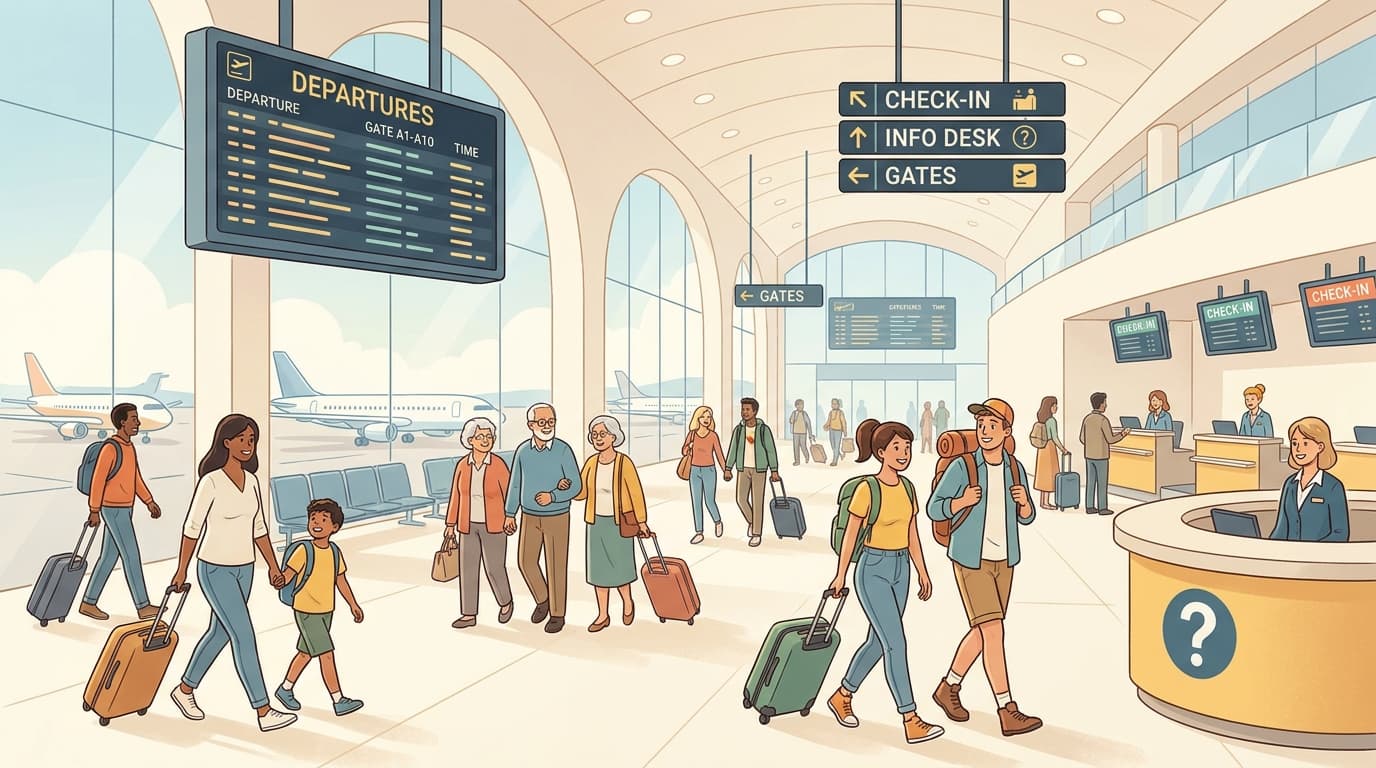
When you arrive at the airport, look for signs that say Departures (the area for passengers leaving). The opposite area is Arrivals (where passengers who have just landed come out).
Check-In
Check-in is the process where you confirm your flight, show your documents, and receive your boarding pass. You can check in online before you arrive, at a self-service kiosk (a machine where you scan your passport and print your boarding pass yourself), or at the check-in counter (also called the check-in desk), where an airline employee helps you.
At check-in, you will check your luggage (also called checking bags). This means you hand over your large suitcases to the airline. The bags go into the hold (the storage area under the passenger cabin), and you will not see them again until you land. This type of luggage is called checked luggage or checked baggage.
Smaller bags that you take with you onto the plane are called carry-on luggage, hand luggage, or cabin baggage. Most airlines allow one carry-on bag and one personal item (like a purse, laptop bag, or small backpack).
If your luggage is too heavy, you may have to pay an excess baggage fee (a charge for weight over the limit) or an overweight baggage fee.
The Boarding Pass
A boarding pass is the document (paper or electronic) that allows you to board the plane. It shows important information:
- Your seat number (for example, 12A or 23F)
- The gate (the waiting area where you board the plane)
- The boarding time (when boarding begins, usually 30–45 minutes before departure)
- The departure time
- The flight number
Keep your boarding pass with you—you will need to show it at security, at the gate, and sometimes when you board the plane.
Security Screening
After check-in, you go to security (also called security screening or the security checkpoint). At security, officers check passengers and their carry-on items to make sure no dangerous objects are brought onto the plane.
You will need to:
- Show your boarding pass and passport (or national ID card, depending on the country)
- Place your carry-on luggage and personal items on the conveyor belt to be scanned by an X-ray machine
- Walk through a metal detector or body scanner
- Remove items like shoes, belts, jackets, laptops, and liquids from your bags (rules vary by country)
Liquids in carry-on bags usually must be in containers of 100 milliliters (3.4 ounces) or less, and all containers must fit in one clear, resealable plastic bag.
After you pass through security, you enter the secure area (the part of the airport beyond security, where only ticketed passengers can go).
In the Departures Area
Once you pass security, you are in Departures (sometimes called the departure lounge or concourse). This is where you wait before your flight.
Finding Your Gate
A gate is the area in the airport where you wait to board a specific flight and where you walk onto the plane. Gates are numbered (for example, Gate 12, Gate A7). Your boarding pass will tell you which gate to go to, but this can change, so check the departure board (a screen showing flight information, including gate numbers, departure times, delays, and cancellations).
Airports are often divided into terminals (separate buildings or sections for different airlines or destinations). If you have a connecting flight, make sure you know whether you need to change terminals.
Boarding
When it is time to board, the airline will make an announcement (a spoken message over loudspeakers). Airlines usually board passengers in groups:
- Passengers with disabilities, families with small children, and first-class or business-class passengers often board first
- Then economy-class (also called coach) passengers board, usually by row number or boarding group
When you hear your group called, go to the gate and show your boarding pass. Then you walk down the jetway (also called the jet bridge or airbridge)—a movable hallway that connects the gate to the plane door.
On the Plane
Once you board, find your seat. Seats are arranged in rows (horizontal lines of seats) and columns (identified by letters: A, B, C, etc.). A seat labeled 23F means row 23, seat F.
Common seat types:
- Window seat: next to the window (usually A or F)
- Middle seat: between the window and aisle (usually B or E)
- Aisle seat: next to the aisle (the walkway between seats, usually C or D)
Put your carry-on luggage in the overhead bin (also called the overhead compartment)—the storage space above the seats. Smaller items go under the seat in front of you.
During the flight, flight attendants (also called cabin crew) help passengers, serve food and drinks, and handle safety.
The person flying the plane is the pilot (or captain). The cockpit is the front part of the plane where the pilots sit.
After You Land: Arrivals
When the plane lands, you disembark (get off the plane). Follow signs to Arrivals.
Immigration and Passport Control
If you are arriving in a foreign country, your first stop is immigration (also called passport control). Here, an officer checks your passport and may ask questions:
- What is the purpose of your visit?
- How long will you stay?
- Where will you be staying?
You may need a visa (official permission to enter the country, stamped or attached to your passport) depending on your nationality and the country you are visiting.
Baggage Claim
After immigration, you go to baggage claim (also called baggage reclaim in British English), the area where you pick up your checked luggage. Luggage comes out on a carousel (a moving conveyor belt that goes in a loop). Check the screens to see which carousel has your flight number.
If your luggage does not arrive, go to the airline's baggage service office or lost and found to report lost luggage (bags that did not arrive with you) or damaged luggage (bags that were broken or harmed during the flight).
Customs
After you collect your bags, you go through customs, where officers may inspect what goods (items, products) you are bringing into the country. Some items are restricted (limited) or prohibited (not allowed). You may need to declare (officially report) certain items, such as large amounts of cash, food, or expensive goods. If you have nothing to declare, you may walk through the green channel (for passengers with nothing to declare). If you do have items to declare, use the red channel.
Exit
Once you pass customs, you exit into the arrivals hall, where you can meet people, find ground transportation (taxis, buses, trains, rental cars), or continue to a connecting flight.
Connecting Flights
If you have a connecting flight, you will not leave the airport. Instead, follow signs that say Connections or Transfer. Depending on the airport and whether you are staying in the same country or entering a new one, you may need to:
- Go through security again
- Go through immigration (if you are entering a new country)
- Collect and re-check your luggage (sometimes your bags are transferred automatically; other times you must pick them up and check them in again)
Make sure you have enough time between flights. A tight connection (a short layover) can be stressful if your first flight is delayed.
Useful Phrasal Verbs and Expressions
Here are some verbs and phrases you will hear at the airport:
- Check in: to confirm your flight and receive a boarding pass
- We need to check in at least two hours before departure.
- Check (luggage): to hand over your bags to the airline
- I checked two suitcases.
- Board: to get on the plane
- Boarding will begin in ten minutes.
- Take off: when the plane leaves the ground
- The plane took off on time.
- Land: when the plane arrives and touches the ground
- We landed twenty minutes early.
- Pick up: to collect something
- I need to pick up my luggage at baggage claim.
- Drop off: to leave someone at a place (often used for cars)
- My friend dropped me off at the airport.
Common Airport Signs and Abbreviations
- Departures / Arrivals: outgoing and incoming passengers
- Gates: where you board your flight
- Restrooms / Toilets / WC: bathrooms
- Information / Help Desk: where you ask questions
- Duty-Free: shops in the secure area where you can buy goods without paying certain taxes (only for international flights)
- ETD / ATD: Estimated Time of Departure / Actual Time of Departure
- ETA / ATA: Estimated Time of Arrival / Actual Time of Arrival
- Delayed: the flight is late
- Cancelled: the flight will not happen
- On time: the flight is leaving or arriving as scheduled
Tips for Using Airport Vocabulary
-
Listen carefully to announcements. Flight information can change. If you do not understand an announcement, check the departure board or ask an airport employee.
-
Read your boarding pass. It tells you everything you need: gate, seat, boarding time. Do not assume the gate will stay the same—check the screen.
-
Ask for help. If you do not understand something, ask. Airport staff are used to helping travelers who do not speak English as a first language. You can say:
- Excuse me, where is Gate 12?
- Can you help me find baggage claim?
- I don't understand. Can you repeat that, please?
-
Arrive early. For international flights, most airlines recommend arriving at least three hours before departure. For domestic (within the same country) flights, two hours is common. This gives you time to check in, go through security, find your gate, and handle any problems.
-
Keep documents ready. Have your passport, boarding pass, and any visas easy to reach. You will show them several times.
Practice Scenarios
At Check-In
Agent: Good morning. May I see your passport and booking confirmation?
You: Here you are.
Agent: Are you checking any bags today?
You: Yes, one suitcase.
Agent: Please place it on the scale. ... It's within the weight limit. Here is your boarding pass. You're in seat 14A, and you'll board at Gate 22. Boarding begins at 9:30.
You: Thank you. What time should I be at the gate?
Agent: Please be there by 9:15. Have a good flight!
At the Gate
Announcement: Attention, passengers on flight BA 214 to London. We are now boarding rows 20 through 35. Please have your boarding pass ready.
You (thinking): I'm in row 14, so I'll wait for the next group.
At Baggage Claim
You: Excuse me, my luggage hasn't come out yet. What should I do?
Employee: What was your flight number?
You: UA 857 from New York.
Employee: That's carousel 5. Sometimes bags take a few extra minutes. If it doesn't arrive in the next ten minutes, come to the baggage service desk over there, and we'll help you file a report.
Airports can feel overwhelming, especially in a second language. But once you know the key vocabulary—check-in, boarding pass, gate, security, baggage claim, customs—you will feel much more confident. These words are not just for passing an English test; they are practical tools that help you travel smoothly and communicate clearly when you need help. Safe travels!
Share
Test yourself
Where do you receive your boarding pass?
Sources
Related articles

Restaurant Vocabulary: From Reservation to Tip
Learn the essential words and phrases you need to navigate a restaurant in English, from making a reservation to paying the bill.

Data Analytics for Dummies: A Complete Beginner's Guide
Learn what data analytics is, why it matters, and how businesses use it to make better decisions. A complete guide for beginners with clear explanations and real examples.

Popular Acapulco Destinations: Your Guide to Mexico's Famous Resort City
Discover the best places to visit in Acapulco, from world-famous cliff diving and stunning beaches to vibrant nightlife and water sports.