The Ariel School UFO Incident: When 62 Children in Zimbabwe Saw Something Unexplained
- culture
- history
- storytelling
- zimbabwe
What happened that September morning
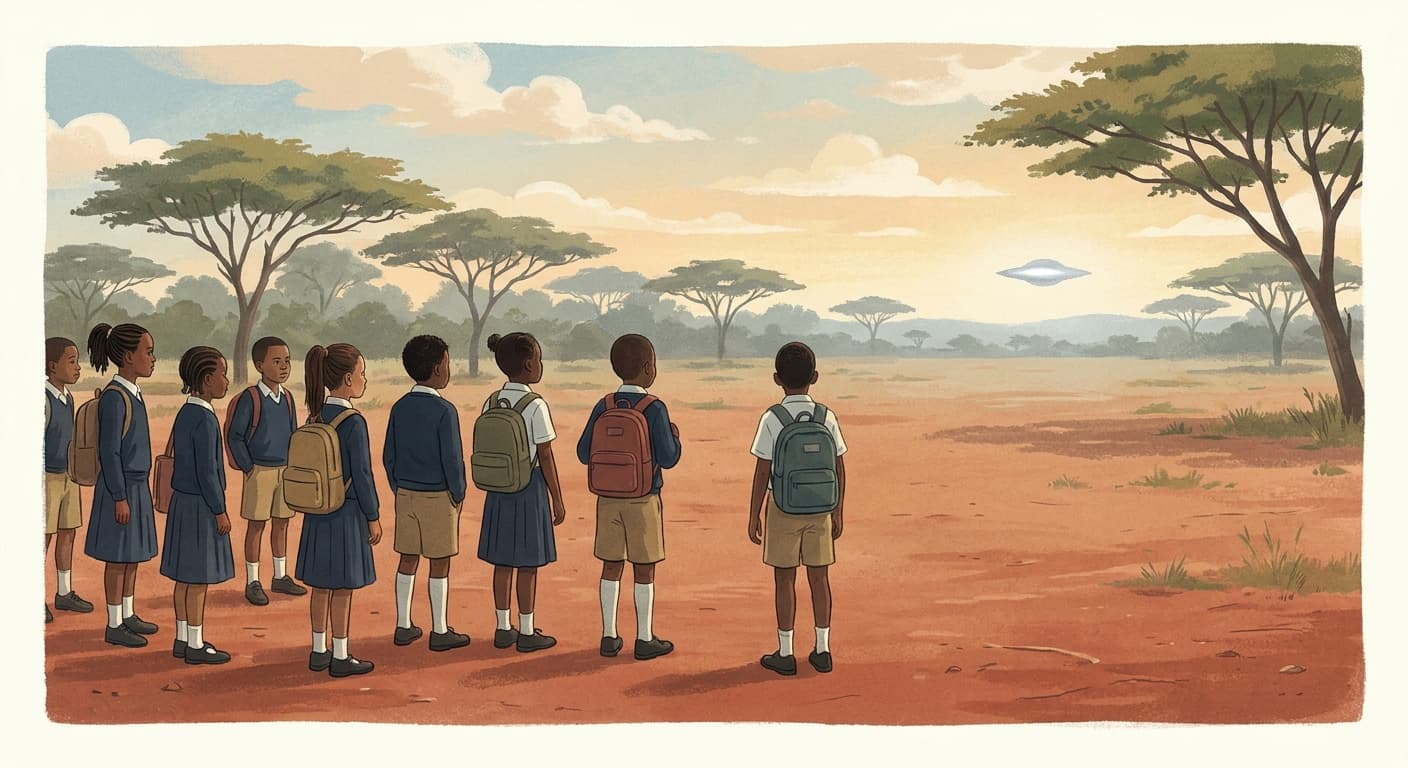
On September 16, 1994, sixty-two pupils at the Ariel School in Ruwa, Zimbabwe—a small town about 20 kilometers from the capital, Harare—reported that they saw one or more silver craft descend from the sky and land on a field near their school . The children were between six and twelve years old.
The sightings occurred at 10:00 a.m. on September 16, 1994, when pupils were outside on mid-morning break, while the adult faculty at the school were inside having a meeting . The entire incident lasted about fifteen minutes .
What makes this story unusual—even for people interested in UFO reports—is not just the number of witnesses, but their age, their consistency (how similar their stories were), and the long-lasting effect the experience had on them. The Fortean writer Jerome Clark called the incident "the most remarkable close encounter of the third kind of the 1990s" . On a June 2021 episode of the BBC's Witness History, the event was described as "one of the most significant events in UFO history" .
The setting: Ariel School and Ruwa
Ariel School was a private primary school. Most of the pupils were from wealthy white families in Harare , though the school served children from diverse cultural backgrounds. The school grounds bordered bushland—open fields with small trees and brush. This detail matters because the children said they saw something land just beyond the school's property line, in an area they could see clearly but were not allowed to enter.
Ruwa itself was (and still is) a small, semi-rural town. In 1994, Zimbabwe had limited television access compared to Western countries, and the children at the school would not have been constantly exposed to UFO imagery from movies or TV shows.
What the children said they saw
According to the interviews by Hind, Leach, and Mack, 62 children between the ages of six and twelve said they had seen at least one UFO—one or more silver objects, usually described as discs, appeared in the sky and then floated down to a field of brush and small trees just outside school property .
Many of the children described seeing figures—beings—near the craft. Some children claimed that one or more creatures dressed all in black approached and telepathically communicated to them a message with an environmental theme, frightening them and causing them to cry .
The children's descriptions of the beings were similar but not identical. Some said the figures had large eyes—"like rugby balls," according to one account. Others said the beings were about one meter tall, dressed in tight black suits. The children were adamant that they had not seen a plane .
Interestingly, Hind noted that the different cultural backgrounds of the children gave rise to different interpretations of what they had seen, and they did not all believe they had seen extraterrestrials—some of the children thought the short little beings were tikoloshes, creatures of Shona and Ndebele folklore . This shows that while the children agreed on what they saw, they understood it through their own cultural lenses (the ideas and stories they grew up with).
The immediate aftermath
When the children returned to class, they told the teachers what they had seen but were dismissed. When they returned home, they told their parents, and many of those parents came to the school the next day to discuss what had happened with the faculty .
The story was soon reported on ZBC Radio, Zimbabwe's national broadcaster, and it quickly attracted attention from local UFO researchers and international media.
The investigators
Three key people investigated the Ariel School incident in its immediate aftermath, and their work is the reason we know so much about it today.
Cynthia Hind
Cynthia Hind was a well-known UFO researcher based in southern Africa. She visited the school on September 20, 1994, interviewed some of the children, and asked them to draw pictures of what they had seen. She reported that the children all told her the same story .
Hind's drawings—dozens of them, created by the children independently—show remarkable consistency. Most depict disc-shaped or oval silver objects, sometimes with smaller craft nearby, and figures with large eyes standing near the objects.
Tim Leach
Tim Leach, the BBC's correspondent in Zimbabwe, visited the school on September 19 to film interviews with pupils and staff. After investigating the incident, Leach stated, "I could handle war zones, but I could not handle this" . Leach was a hardened war reporter who had covered violent conflicts, so his reaction to the children's testimony was striking.
In September 1994, Leach—a hardened war correspondent who passed away in 2011—had been reporting on the Ariel School incident and didn't know what to make of it. It was a bizarre and eerie story, and weeks later the kids remained terrified and disturbed .
Dr. John Mack
That November, Harvard University professor of psychiatry John Mack visited the Ariel School to interview witnesses. Throughout the 1990s, Mack had investigated UFO sightings and the alien abduction phenomenon . In 1977, Mack had won the Pulitzer Prize for his book A Prince of Our Disorder, about T. E. Lawrence .
Mack's involvement in UFO research was controversial. He had recently been investigated by Harvard for giving credence to the idea that patients who reported a "close encounter" with an extraterrestrial life form might have experienced something real . Despite the professional risk, Mack traveled to Zimbabwe and conducted extensive filmed interviews with the children.
In Mack's interviews, one fifth-grader said he was warned "about something that's going to happen" and that "pollution mustn't be." An eleven-year-old girl told Mack, "I think they want people to know that we're actually making harm on this world and we mustn't get too technologed" .
Critics have pointed out problems with both Hind's and Mack's methods. Hind interviewed the children in groups of four to six with every other child allowed to listen, so their stories were cross-contaminated . Mack only interviewed the children two months after the alleged sighting, and skeptic Brian Dunning says Mack, a known environmentalist, "prompted and suggested" the telepathic communication angle, which was not present in Hind's previous report .
What was happening in Zimbabwe at the time
The Ariel School incident did not happen in a vacuum. Two days prior to the incident at Ariel, there had been numerous reports of a bright fireball passing through the sky at night. Many people answered ZBC Radio's request to call in and describe what they had seen. Although some witnesses interpreted the fireball as a comet or meteor, it resulted in a wave of UFO mania in Zimbabwe at the time .
According to skeptic Brian Dunning, the fireball "had been the re-entry of the Zenit-2 rocket from the Cosmos 2290 satellite launch. The booster broke up into burning streaks as it moved silently across the sky, giving an impressive light show to millions of Africans" .
So in the days before the Ariel School incident, Zimbabwe was already buzzing with UFO talk. The question is whether that atmosphere influenced the children's interpretation of whatever they saw on September 16.
Skeptical explanations
Skeptics have proposed several explanations for the Ariel School incident, none of which fully satisfy everyone.
Mass hysteria
Some skeptics have described the incident as one of mass hysteria . Mass hysteria (also called mass psychogenic illness) is a phenomenon where a group of people suddenly develop similar physical or psychological symptoms with no identifiable external cause. It often spreads through groups of children or adolescents.
Mass hysteria typically begins when an individual becomes ill or hysterical during a period of stress. After this initial individual shows symptoms, others begin to manifest similar symptoms .
However, critics of this explanation point out that the Ariel School children did not show the typical signs of mass hysteria—screaming, fainting, physical symptoms like nausea or hyperventilation. They were frightened and upset, but they gave coherent, detailed accounts of a visual experience. They weren't physically ill.
Prank or hoax
Skeptics have suggested the incident could be explained as a prank . In 2023, in the Netflix documentary Encounters, a former student named Dallyn claimed that he was behind the incident. He claimed that he purposefully told his classmates and other students that a "shiny rock" in the distance was a UFO .
According to his own statement, he never thought this would work and was surprised about the mass hysteria. However, Dallyn's claims in the documentary directly contradict claims he made on camera 15 years prior to the documentary, describing the UFO as having a light that would "flash a different color in the sky." They also contradict all the other Ariel School witnesses' testimony in the film .
Other explanations
Researcher Gideon Reid proposed the hypothesis of a confusion with touring puppet shows designed to promote awareness around AIDS . It has alternatively been argued that the children misidentified a dust devil (a small whirlwind that picks up dust and debris).
None of these explanations account for all the details—the duration of the sighting, the consistency of the drawings, the emotional impact, and the fact that so many children from different backgrounds described similar things.
The lasting impact
What happened at Ariel School has continued to affect the witnesses into adulthood.
Several of those who witnessed the event maintain that their account of the incident is true . In 2014, the Mail & Guardian spoke to one witness who said that she fears the creatures will return and that she can "sense when they are back in the atmosphere" . In 2016, witness Emily Trim exhibited paintings that she described as a "manifestation of the messages she received" from the beings that day .
In one old grainy video, a young girl named Lisil looks visibly shaken talking about the sighting, describing her ongoing fears at night: "I worry that the man is still looking at me and he is gonna kill me." Years later, she said she is still traumatized by the event and that she remembers "seeing big black eyes" and receiving a message "that we were harming the planet" .
Many of the witnesses said that people over the years tried to discredit their experiences or convince them that what they saw wasn't real . The documentary Ariel Phenomenon, released in 2022, revisits many of the witnesses as adults. For the children who were there and then went through the global media circus that surrounded their alleged encounter, the event has in many ways defined their lives since .
One former witness named Tapfu reflected on how different people have coped: "Some people chose to dig deeper. Some people chose to just shut it down and not think about it. Some people may have found answers that make sense to them. Some people, it may still be a puzzle piece that doesn't fit anywhere. The people that were that day, that say, that didn't happen, that's okay, too. That's a choice, too" .
Why this case still matters
The Ariel School incident raises questions that go beyond "Did aliens land in Zimbabwe in 1994?" It asks us to think about belief, memory, trauma, and how we treat people—especially children—who report experiences that don't fit our understanding of the world.
Not all the children at the school that day stated that they saw something . There were over 200 students at the school; 62 reported seeing the UFO and beings. What did the other children see? Why didn't they report anything? We don't know, because investigators focused on those who claimed to have witnessed something.
The case also highlights the power of investigation methods. If you interview children in groups, let them hear each other's stories, and ask leading questions two months after an event, how much do you shape what they remember? On the other hand, the earliest interviews—conducted within days, with children drawing independently—showed remarkable consistency before any major media attention or time for "story consolidation."
Finally, the Ariel School incident is a story about how we respond to the unexplained. Tim Leach, a BBC war reporter, risked his professional credibility because he believed the children. John Mack, a Harvard psychiatrist and Pulitzer Prize winner, faced an investigation by his own university for taking UFO reports seriously. The children themselves have carried the weight of being believed by some and dismissed by others for three decades.
Whether the children saw extraterrestrial beings, experienced a shared psychological phenomenon, misidentified something mundane, or fell victim to a prank, the experience they had was real to them. And that experience changed their lives.
Vocabulary notes
Here are some terms from this post that might be new to intermediate learners:
- UFO = Unidentified Flying Object. An object in the sky that someone cannot identify. It does not necessarily mean "alien spacecraft," though people often use it that way.
- Close encounter of the third kind = A term from UFO research meaning a sighting that involves seeing occupants or beings associated with a UFO. The phrase comes from astronomer J. Allen Hynek's classification system.
- Mass hysteria = A situation where many people in a group suddenly develop similar symptoms or behaviors with no clear physical cause, often due to stress, fear, or suggestion.
- Skeptic = Someone who questions or doubts claims, especially extraordinary ones, and looks for evidence before accepting something as true.
- Telepathic / telepathy = Communication through thoughts, without speaking or writing. Many of the children said they received messages this way.
- Fortean = Related to the work of Charles Fort, who studied strange and unexplained events. A Fortean writer studies mysteries and anomalies (things that don't fit normal patterns).
- Mania = Extreme enthusiasm or obsession about something. "UFO mania" means lots of people were excited and talking about UFOs.
- Cross-contaminated = In the context of witness interviews, this means that witnesses heard each other's stories, which might have influenced what they remembered or reported.
- Consistency = The quality of being the same or similar across different examples. The children's drawings and stories showed consistency, meaning they matched each other in many details.
The unanswered question
The Ariel School UFO incident quickly became one of the most famous UFO cases in Africa . Thirty years later, we still don't have a definitive answer to what happened that morning.
The incident challenges us because it doesn't fit neatly into "believers vs. skeptics." Even skeptics acknowledge that something happened—that the children genuinely believed they saw what they reported. And even those who find the testimony compelling must grapple with the methodological problems in how the story was investigated and recorded.
What we're left with is a story—about children, about fear and wonder, about belief and doubt, about how we make sense of the inexplicable. Whether or not a silver craft ever landed near a playground in Ruwa, the Ariel School incident is a reminder that extraordinary experiences can happen to ordinary people, and that the line between what we know and what we don't know is much thinner than we like to think.
The 2022 documentary Ariel Phenomenon provides extensive interviews with former students as adults, as well as archival footage from 1994. It is available on various streaming platforms for those interested in hearing the witnesses' stories in their own words.
Share
Test yourself
Where did the Ariel School incident take place?
Sources
- Ariel School UFO incident - Wikipedia
- Documentary explores the UFO sighting that changed the course of 62 children's lives - WHYY
- A 1994 UFO Sighting by Children Changed Lives. What If This Guy Made It Up? - VICE
- The Ariel School Phenomenon: What Really Happened When 68 Children Witnessed A UFO? - IFLScience
- John E. Mack - Wikipedia
Related articles

Bob Lazar and Area 51: The Story That Made a Secret Base Famous
In 1989, a man named Bob Lazar claimed he worked on alien spacecraft at a secret U.S. government base. His story made Area 51 world-famous, but investigations found serious problems with his claims.

History of Corn
Corn transformed from a wild grass in ancient Mexico into one of the world's most important crops through 9,000 years of human selection and cultivation.

The History of Chocolate
Discover how chocolate traveled from ancient Mesoamerican ceremonies to the modern candy bar, transforming from a bitter sacred drink into the sweet treat loved worldwide today.