The Blue Whale: Earth's Largest Animal
- animals
- marine life
- wildlife
- nature
The Largest Animal Ever
The blue whale is not just the largest animal alive today. It is the largest animal ever to have lived on Earth . To understand how big that is, imagine an animal that can grow more than 30 meters (98 feet) long and weigh approximately 150 tons . That length is equal to three school buses parked end to end.
Females are generally larger than males , and the largest accurately measured blue whale was a 29.5-meter female that weighed 180 metric tons . When you compare this to the largest land animal, the African elephant, which weighs only about 4.5 tons, you can see how truly massive blue whales are.
The scientific name for the blue whale is Balaenoptera musculus. The genus name Balaenoptera means "winged whale" (referring to the whale's long flippers), while musculus can mean "muscle" in Latin—but it can also mean "little mouse," which might have been a pun by Carl Linnaeus when he named the species .
What Blue Whales Look Like
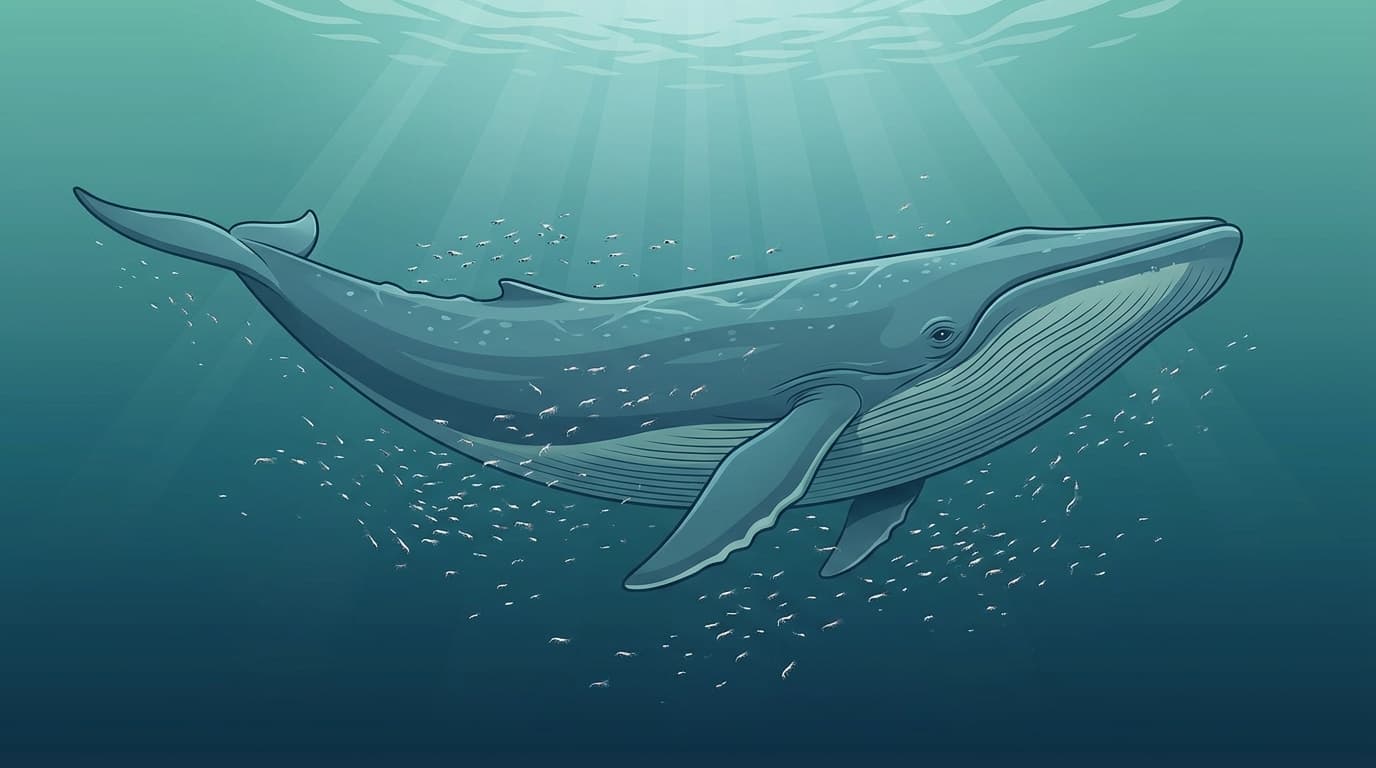
Blue whales are predominantly blue-gray animals whose lower surfaces are lighter gray or white . When you see them underwater, they appear light blue, which is how they got their common name. Their skin has a mottled pattern (that is, spotted or blotched), and this pattern is different on each whale, so scientists can use it to identify individual animals.
The blue whale has been called the sulfur-bottom whale because of the yellowish underside of some individuals . This yellow color comes from certain algae (diatoms) living on the whale's body .
The blue whale has a wide head, a small dorsal fin located near the fluke, and 80–100 long grooves running lengthwise down the throat and chest . These throat grooves are pleated, meaning they can expand like an accordion. This allows the whale to take in enormous amounts of water when feeding.
Its mouth contains up to 800 plates of short, wide, black baleen . Baleen plates hang from the roof of the mouth like a curtain and have bristles that work like a filter or sieve.
A Heart as Big as a Car
The blue whale's heart weighs about 180 kg (roughly 400 pounds), the largest of any animal . That is about the same weight as a small piano or car. Its heartbeat can be heard 2 miles away , and a blue whale's heart pumps about 60 gallons of blood with each beat .
The heart rate changes dramatically depending on what the whale is doing. At the surface, its heart rate is about 25-37 beats per minute (bpm). During a deep dive, this decreases to only 2-10 bpm . Compare that to a human heart rate of 60-100 bpm, and you can see how slowly a blue whale's heart beats.
Where Blue Whales Live
Blue whales are found in all oceans except the Arctic Ocean . They don't stay in one place all year. They generally migrate seasonally between summer feeding grounds and winter breeding grounds , though some individuals in certain areas might not migrate at all.
They spend the summer in polar waters, feeding on krill, and in the winter blue whales move toward the Equator to breed . For example, blue whales in the North Pacific feed off the coast of California during summer and fall, then migrate south to the waters of Mexico during winter and spring, where they both feed and breed .
Blue whales are found alone or in small groups , and they are more solitary than many other whale species.
What Blue Whales Eat
Despite their enormous size, blue whales feed almost exclusively on krill, straining huge volumes of ocean water through their baleen plates. Some of the biggest individuals may eat up to 6 tons of krill a day . Recent research suggests this number may be even higher— in one day a blue whale can eat about 16 tonnes of krill .
Krill are small oceanic creatures that generally measure 1-2 centimeters long, though some species of krill can grow close to 6 inches in size . They are shrimp-like crustaceans that swim in huge swarms in the ocean.
How does a blue whale catch such tiny prey? Blue whales lunge through large swarms of krill with their mouths open, taking in more food in one mouthful than any other animal on Earth . The whale's throat has an expandable, pleated structure to engulf a volume of water and prey that is greater than the animal's own body weight. The water is pushed out of the mouth by its enormous tongue, through strainer-like baleen plates which hang down from the upper jaw . The krill stay trapped inside the baleen while the water flows out.
This feeding method is called "lunge feeding," and during a dive, the blue whale may engage in a series of turns and 360° rolls to locate prey and rapidly reorient its body to sweep up large concentrations of krill in a single open-mouthed lunge .
Talking Across the Ocean
Blue whales are among the loudest animals on the planet. They emit a series of pulses, groans, and moans, and it's thought that, in good conditions, blue whales can hear each other up to 1,000 miles away .
These calls have been described as pulses, grunts, groans, and moans, and are typically in the 15-40 Hz range, often below the threshold of human hearing. Blue whale vocalizations are also recognized among the most intense . All blue whale groups make calls at a fundamental frequency of between 10 and 40 Hz, and the lowest frequency sound a human can typically perceive is 20 Hz . This means that many blue whale calls are too low for humans to hear, though we would feel them as vibrations if we were in the water nearby.
The sound level of blue whale calls is extraordinary. Blue whale calls ranged between 188 and 191 dB , which is louder than a jet engine.
Scientists think they use these vocalizations not only to communicate, but, along with their excellent hearing, to sonar-navigate the lightless ocean depths .
Baby Blue Whales
After a gestation of about 12 months, one calf about 8 metres (about 26 feet) long is born in temperate waters . That means a newborn blue whale is already longer than a giraffe is tall!
The growth rate of blue whale calves is astonishing. While nursing, calves gain up to 90 kg (about 198 pounds) per day on the rich milk of their mothers . A nursing blue whale mother produces over 50 gallons of milk a day. The milk is about 35 to 50 percent milk fat, which allows the calf to gain weight at a rate of up to 10 pounds an hour, which amounts to over 250 pounds a day .
Young are weaned after seven to eight months, when they have reached a length of about 15 metres (about 49 feet) . Female blue whales can give birth every two to three years once they reach sexual maturity around 5 to 15 years old .
How Long Do Blue Whales Live?
Blue whales' average lifespan is estimated at around 80 to 90 years. Scientists can estimate the age of whales by counting the layers of wax-like earplugs collected from deceased animals .
Scientists look at a blue whale's earwax or ear plug to estimate its age. Each year, a light and dark layer of wax is laid corresponding with fasting during migration and feeding time. Each set is thus an indicator of age. The oldest blue whale discovered using this method was found to be 110 years old .
An Endangered Species
The blue whale was abundant in nearly all the Earth's oceans until the end of the 19th century. It was hunted almost to the point of extinction by whalers until the International Whaling Commission banned all blue whale hunting in 1966 .
The numbers are shocking. Blue whale whaling peaked between 1930 and 1931 with 30,000 animals taken. Harvesting of the species was particularly high in the Antarctic, with 350,000–360,000 whales taken in the first half of the 20th century .
Blue whales were significantly depleted by commercial whaling activities worldwide. Today, blue whales are listed as endangered under the Endangered Species Act and protected under the Marine Mammal Protection Act . The International Union for Conservation of Nature has listed blue whales as Endangered as of 2018 .
Some populations are recovering. Blue whales have been protected from hunting by the IWC since 1966, and today some populations appear to be recovering at rates of up to 7% per year . However, the Antarctic subspecies is listed as Critically Endangered due to the fact that the current estimated population is still less than 1% of its original pre-whaling size .
Modern Threats
Even though whaling has stopped, blue whales still face serious dangers. Ship strikes are a significant mortality factor for blue whales, especially off the U.S. West Coast . When large ships travel through areas where blue whales feed, collisions can happen, and these can injure or kill the whales.
Commercial exploitation of krill and climate change affecting the distribution of krill in various ocean basins could also have a negative impact on blue whales . Because blue whales depend almost entirely on krill for food, anything that harms krill populations threatens the whales as well.
Ocean noise from ships and other human activities is another problem. It can make it harder for blue whales to communicate with each other over long distances, which they need to do to find mates and coordinate their movements.
Why Blue Whales Matter
Blue whales play an important role in the ocean ecosystem. Their nutrient-rich waste (that is, their feces or poop) fertilizes the ocean. Krill rely on the reintroduction of nutrients, especially iron, back into the ecosystem and a large supply of those nutrients comes from whale poop . This helps tiny plants called phytoplankton grow, and phytoplankton produce much of the oxygen we breathe and absorb carbon dioxide from the atmosphere.
The blue whale's story is also a reminder of both human impact and conservation success. We nearly destroyed this magnificent animal, but through international cooperation and protection, we have given it a chance to recover. While blue whale populations are still endangered, their slow comeback shows that conservation efforts can work—if we act in time.
Understanding and protecting blue whales helps us preserve not just one species, but the health of our entire ocean.
Share
Test yourself
What is special about the blue whale's size?
Sources
- Blue whale | Length, Weight, & Facts | Britannica
- Blue whale - Wikipedia
- Blue Whale | NOAA Fisheries
- Blue Whale | The Marine Mammal Center
- Blue whale, facts and photos | National Geographic
- Blue whale | International Whaling Commission
- What do blue whales eat? | Natural History Museum
- Blue whale vocalizations | Discovery of Sound in the Sea
- The Big-Hearted Blue Whale | NOAA Fisheries
- Blue whale lifespan | Animal Diversity Web
Related articles
Pufferfish in the Wild
Learn about pufferfish: their unique defense system, where they live, what they eat, and why they are both fascinating and dangerous creatures in the ocean.

The History of Competitive Dog Racing
Competitive dog racing developed in two main forms: sled dog racing in cold northern regions and greyhound racing on enclosed tracks. Both sports evolved from practical uses of dogs into organized competitions with complex histories.

Understanding Spirituality in 2026: A Guide to Modern Beliefs and Practices
Spirituality in 2026 is shifting toward personal, flexible practices that blend technology with timeless traditions. Young people are choosing individual spiritual paths over formal religion while seeking meaning and connection.