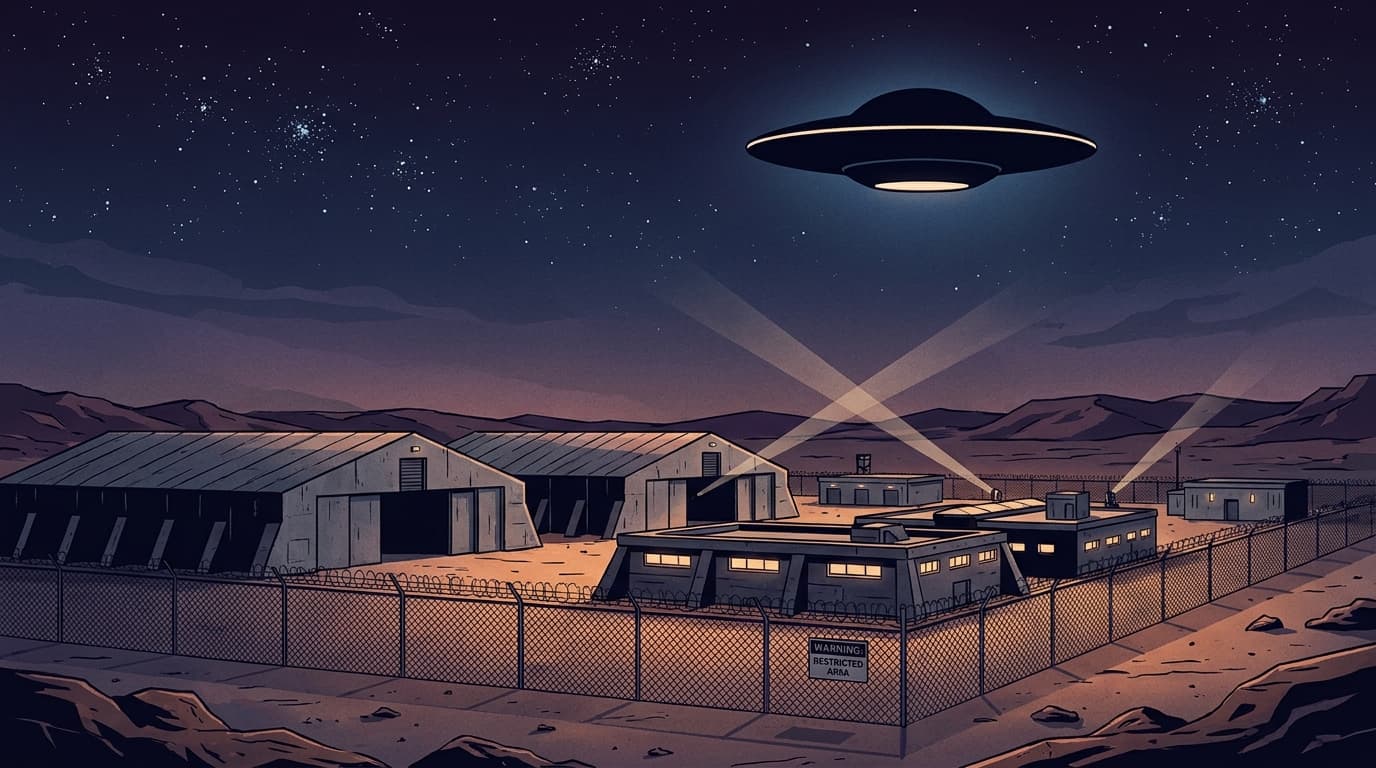
Bob Lazar and Area 51: The Story That Made a Secret Base Famous
- culture
- conspiracy
- history
- america
What Is Area 51?
Area 51 is a highly classified United States Air Force facility within the Nevada Test and Training Range in southern Nevada, 83 miles northwest of Las Vegas. For many years, the U.S. government refused to even admit that this military base existed. The CIA and U.S. Air Force acquired the site in 1955, primarily for flight tests of the Lockheed U-2 aircraft.
The U.S. government officially acknowledged the existence of Area 51 in 2013, when it released a formerly classified CIA document about the history of the U-2 spy plane. Test flights of the U-2, which were carried out at Area 51 during the 1950s, accounted for many of the UFO sightings in the area.
The name "Area 51" comes from how the site was marked on old government maps. According to the CIA, the name Area 51 comes from its map designation. It was also previously referred to as "Paradise Ranch" to make the facility sound more attractive to those that would be working there. Today, it is still an active military base where the U.S. tests secret aircraft. You cannot visit Area 51—it is guarded by armed security, and trespassing (that is, entering without permission) can result in arrest or even the use of deadly force.
The Real Purpose of Area 51
During the Cold War (a period of tension between the United States and the Soviet Union from about 1947 to 1991), the U.S. government needed to develop advanced spy planes. These aircraft had to fly higher than enemy radar could detect them.
Military aircraft developed at Area 51 include the U-2 spy plane, the A-12 reconnaissance plane, and the F-117 Nighthawk, which was the first stealth aircraft. The U-2 could fly above 60,000 feet—much higher than commercial airplanes, which flew between 10,000 and 20,000 feet at that time.
Why People Started Seeing "UFOs"
In the mid-1950s, most commercial airliners flew at altitudes between 10,000 and 20,000 feet. Consequently, once U-2s started flying at altitudes above 60,000 feet, air-traffic controllers began receiving increasing numbers of UFO reports. In the evenings the U-2's silver wings would catch and reflect the setting sun's light and appear as "fiery" objects to airline pilots flying at 20,000 feet.
By checking flight records, the Air Force found that U-2 and later OXCART flights accounted for more than one-half of all UFO reports during the late 1950s and most of the 1960s. In other words, people were seeing real aircraft—just aircraft that were so advanced they seemed impossible.
Who Is Bob Lazar?
Robert Scott Lazar is an American who, since 1989, has claimed to have been part of a classified US government project concerned with the reverse engineering of extraterrestrial technology. "Reverse engineering" means taking apart something (like a machine) to figure out how it was made and how it works. Lazar claimed the U.S. government had alien spacecraft and hired him to study them.
In May of 1989, he appeared in an interview with investigative reporter George Knapp on Las Vegas TV station KLAS, under the pseudonym "Dennis" and with his face hidden, to discuss his purported employment at "S-4", a subsidiary facility he claimed exists near Area 51. Lazar said that his job was to help with the reverse engineering of one of nine flying saucers, which he alleged were extraterrestrial in origin. A "pseudonym" is a fake name used to hide your real identity.
His story brought additional public attention to the facility and spawned conspiracy theories regarding government knowledge of extraterrestrial life. Before Lazar's interviews, Area 51 was relatively unknown to the general public. After his television appearances, it became world-famous.
Lazar's Main Claims
Bob Lazar made several specific claims about what he saw and did at S-4, a site he said was near Area 51:
-
Nine alien spacecraft: He claimed the government had nine flying saucers stored at the facility.
-
His job: Lazar said that his job was to help with the reverse engineering of one of nine flying saucers.
-
Element 115: He claimed to have read documents indicating the existence of ongoing research on an "anti-gravity reactor" for use in propulsion systems. He said the spacecraft used a mysterious fuel called Element 115, which didn't exist on the periodic table of elements in 1989.
-
Government briefings: He also purported to have read government briefing documents that described alien involvement in human affairs over the past 10,000 years.
-
Education: Lazar claims to have obtained master's degrees in physics from the Massachusetts Institute of Technology (MIT) and in electronics from the California Institute of Technology (Caltech).
Problems With Lazar's Story
Journalists, scientists, and even other people interested in UFOs investigated Bob Lazar's claims. They found serious problems.
Fabricated Education
Lazar has provided no evidence of alien life or technology, and his claims about his education and employment history are replete with fabrications. "Replete with" means "full of." "Fabrications" means lies.
Both MIT and Caltech show no record of him. Scientists Stanton T. Friedman and Donald R. Prothero have stated that nobody with Lazar's high school performance record would be accepted by either institution.
Lazar graduated from high school late, in the bottom third of his class. The only science course he took was a chemistry class. He subsequently attended Pierce Junior College in Los Angeles.
When investigators dug deeper, they found more problems. When asked in 1993 to name any professors who taught him at either place, Lazar offered up "Dr Duxler" and "Hohsfield". No such people have ever worked at Caltech or MIT, whereas a William Duxler was at Pierce Junior College and a Frederick Hohsfield taught at the W Tresper Clarke High School. Lazar had simply named his actual high school and junior college teachers, not university professors.
No Evidence of Employment at Area 51
Lazar's claims were later disproven by UFO skeptics and believers alike. He was found to have fabricated not only his employment at Nellis but indeed his entire background; almost nothing of what he said was true. Still, Lazar's lies propelled Area 51 into the public's consciousness.
Inquiry into Lazar's position at Los Alamos revealed his role to have been a technician for a contractor, and that he worked neither as a physicist or for the lab directly. So Lazar did work at Los Alamos—but as a low-level technician, not as a physicist.
Criminal Record
In 1990, Lazar was arrested for aiding and abetting a prostitution ring. This was reduced to felony pandering, to which he pleaded guilty. He was ordered to do 150 hours of community service, stay away from brothels, and undergo psychotherapy. "Pandering" means helping to operate illegal prostitution.
In 2006, Lazar's supply business was charged with violating the Federal Hazardous Substances Act for shipping restricted chemicals across state lines.
The Element 115 Controversy
One of the most interesting parts of Lazar's story involves Element 115. In 1989, this element did not exist—or at least, scientists had not yet created it. Lazar claimed it was the fuel source for alien spacecraft.
What Really Happened
In 2003, scientists successfully synthesized an element with 115 protons, which they named "Moscovium". Contrary to Lazar's claim, isotopes of element 115 are highly unstable, decaying in a few hundred milliseconds. "Synthesized" means created in a laboratory. "Isotopes" are different versions of the same element with different numbers of neutrons. "Decaying" means breaking apart into other elements.
So Element 115 does exist—but not in the way Lazar described. Lazar claimed it is "impossible to synthesize an element that heavy here on Earth. The substance has to come from a place where superheavy elements could have been produced naturally." But scientists did synthesize it on Earth.
Independent nuclear physics experiments succeeded in synthesizing element 115 (now named moscovium) in the early 2000s and the element was formally added to the periodic table as part of a cluster of new superheavy elements, but the laboratory isotopes decay in milliseconds or at best fractions of a second—properties that are the opposite of the stable, manipulable substance Lazar described.
Did Lazar Predict Element 115?
Some people say Lazar deserves credit for predicting Element 115 before it was discovered. However, it's important to note that his claim was not based on any groundbreaking insight or discovery. Element 115 was simply the next in line on the periodic table, making its eventual discovery by scientists a matter of time and advanced technology. The periodic table follows a predictable order, so predicting the existence of element 115 didn't require any special knowledge or foresight.
Scientists already knew that heavier elements could be created by smashing atoms together in particle accelerators (large machines that speed up particles). It was only a question of when technology would advance enough to do it.
Why Lazar's Story Became So Popular
Despite all the evidence against him, Bob Lazar's story remains popular. Why do so many people still believe him?
Timing and Media Attention
Bob Lazar rose to national attention in 1989 claiming he reverse-engineered extraterrestrial craft at a secret site called S‑4 near Area 51, a story that helped put Area 51 in the public imagination. Before Lazar, most people had never heard of Area 51. His story was exciting and detailed, which made it seem more believable.
Lazar was featured in Knapp's and Jeremy Corbell's 2019 documentary Bob Lazar: Area 51 & Flying Saucers, and he has appeared on The Joe Rogan Experience. The Joe Rogan podcast episode has been watched by millions of people, introducing Lazar's story to a new generation.
The Appeal of Mystery
It's the secrecy of Area 51 that makes it so fascinating and enthralling to the public. Just the fact when you say there's a secret base in the middle of the desert, that secret nature of Area 51 just breeds speculation. People naturally want to know what the government is hiding.
The Air Force hasn't helped themselves because they've refused to talk about it. The more the base tries to make it a big deal about secrecy, the more interested people are from the outside. It's human nature to want to see the forbidden.
Confirmation Bias
Some people want to believe in alien visitation, so they interpret Lazar's story in ways that support what they already believe. "Confirmation bias" means the tendency to accept information that confirms what you already think and ignore information that contradicts it.
The Scientific Consensus
Scientists and investigators who have studied Lazar's claims carefully have reached a clear conclusion.
Lazar has provided no evidence of alien life or technology. Lazar has presented no actual evidence of alien life or technology.
HowStuffWorks and other skeptical outlets highlight that Lazar's technical claims remain uncorroborated by physical evidence or independent scientific validation. "Uncorroborated" means not supported by other evidence or witnesses.
Bob Lazar's testimony remains as compelling and unverifiable right now as it was thirty years ago. "Compelling" means interesting or believable. "Unverifiable" means it cannot be proven true or false with evidence.
Understanding "Conspiracy Theory"
The Bob Lazar story is often called a "conspiracy theory." This term refers to an explanation that claims a secret group (often the government) is hiding the truth about something important. Conspiracy theories typically:
-
Explain away missing evidence: When people can't find proof of Lazar's MIT degree, believers say the government erased his records.
-
Rely on secrecy: The more secret something is claimed to be, the easier it is to say "there's no evidence because they're hiding it."
-
Are hard to disprove: If you say "prove aliens didn't visit Earth," that's almost impossible—you can't prove something didn't happen.
-
Appeal to emotions: The idea of alien technology is exciting and makes people feel like they have special knowledge.
The problem is that claims require evidence. In science and journalism, the burden of proof (that is, the responsibility to show something is true) lies with the person making the claim. Lazar has never provided physical evidence—no samples of Element 115, no photographs from inside S-4, no documents that can be verified.
What We Can Learn
The Bob Lazar story teaches us several important lessons about critical thinking:
Check the Source
When someone makes an extraordinary claim, look at their background. Can other people verify what they say about themselves? Lazar's educational claims fell apart when investigators checked with MIT and Caltech.
Extraordinary Claims Require Extraordinary Evidence
The scientist Carl Sagan popularized this phrase. If someone says they worked on alien spacecraft, we should expect very strong evidence—not just their word.
Be Skeptical of "Erased Records"
When a story relies on the idea that all evidence has been destroyed or hidden, that's a warning sign. Real events leave traces that are hard to completely erase.
Experts Matter
Multiple scientists have examined Lazar's technical claims about Element 115 and propulsion systems. They found serious errors in his physics. While experts can be wrong, we should take their analysis seriously—especially when many independent experts agree.
The Lasting Impact
Whether or not Bob Lazar told the truth, his impact on popular culture is undeniable.
Lazar's lies propelled Area 51 into the public's consciousness. Today, Area 51 appears in movies, television shows, video games, and books. The closest town to Area 51 is Rachel, Nevada, which is a famous stop for alien enthusiasts on the Extraterrestrial Highway. The highway (Nevada State Route 375) was officially named the "Extraterrestrial Highway" in 1996, largely because of interest generated by Lazar's story.
The story also influenced how people think about government secrecy and UFOs. Some proponents argue that recent Pentagon acknowledgments of unexplained aerial phenomena and declassified UAP videos create a new context that makes government secrecy over advanced craft less implausible. "UAP" stands for "Unidentified Aerial Phenomena"—the government's current term for what used to be called UFOs.
The Bottom Line
Bob Lazar's story remains one of the most consequential—and controversial—chapters in modern UFO lore. Element 115 does exist as moscovium, but not in the form or with the properties Lazar claimed.
The real Area 51 has a fascinating history involving some of the most advanced aircraft ever built—the U-2, the SR-71 Blackbird, the F-117 stealth fighter. These were genuine technological marvels that pushed the boundaries of what seemed possible. That true story is remarkable enough without needing to add aliens.
As for Bob Lazar, investigations revealed he fabricated his educational credentials and provided no verifiable evidence for his claims about extraterrestrial technology. That doesn't mean he intentionally deceived everyone—it's possible he genuinely believes some of what he says, or that he worked at the facility in a different capacity than he claims. But the evidence shows that his story about reverse-engineering alien spacecraft cannot be trusted.
The lesson is valuable: in our age of information (and misinformation), we need to think critically, check sources, and demand evidence. Exciting stories can be compelling, but truth requires more than a good tale—it requires facts we can verify.
Useful Vocabulary
Classified (adjective): kept secret by the government for security reasons
The documents were classified and could not be shared with the public.
Conspiracy theory (noun): a belief that a secret group is hiding important information
Many conspiracy theories surround Area 51.
Declassified (adjective/verb): made public after being secret
The CIA declassified documents about Area 51 in 2013.
Fabricate (verb): to make up or invent; to lie
He fabricated his entire educational background.
Propulsion (noun): the force that moves something forward
The spacecraft's propulsion system was supposedly powered by Element 115.
Reconnaissance (noun): military observation to gather information
The U-2 was used for reconnaissance missions over the Soviet Union.
Skeptic (noun): a person who questions or doubts claims
Many skeptics have examined Lazar's story.
Testimony (noun): a formal statement or account, especially in a legal context
Lazar's testimony has never been supported by physical evidence.
Unidentified Flying Object (UFO) (noun): an object in the sky that cannot be explained
Many UFO sightings were actually U-2 spy planes.
Whistleblower (noun): a person who exposes secret or illegal activity
Some people consider Lazar a whistleblower; others call him a hoaxer.
Share
Test yourself
Where is Area 51 located?
Sources
Related articles

The Ariel School UFO Incident: When 62 Children in Zimbabwe Saw Something Unexplained
In 1994, sixty-two children at a school in Zimbabwe reported seeing a silver craft land near their playground and beings emerge from it—a story that still divides believers and skeptics three decades later.

History of Corn
Corn transformed from a wild grass in ancient Mexico into one of the world's most important crops through 9,000 years of human selection and cultivation.

The History of Chocolate
Discover how chocolate traveled from ancient Mesoamerican ceremonies to the modern candy bar, transforming from a bitter sacred drink into the sweet treat loved worldwide today.