The History of Competitive Dog Racing
- sports history
- animals
- racing
- culture
Two Different Sports, Two Different Origins
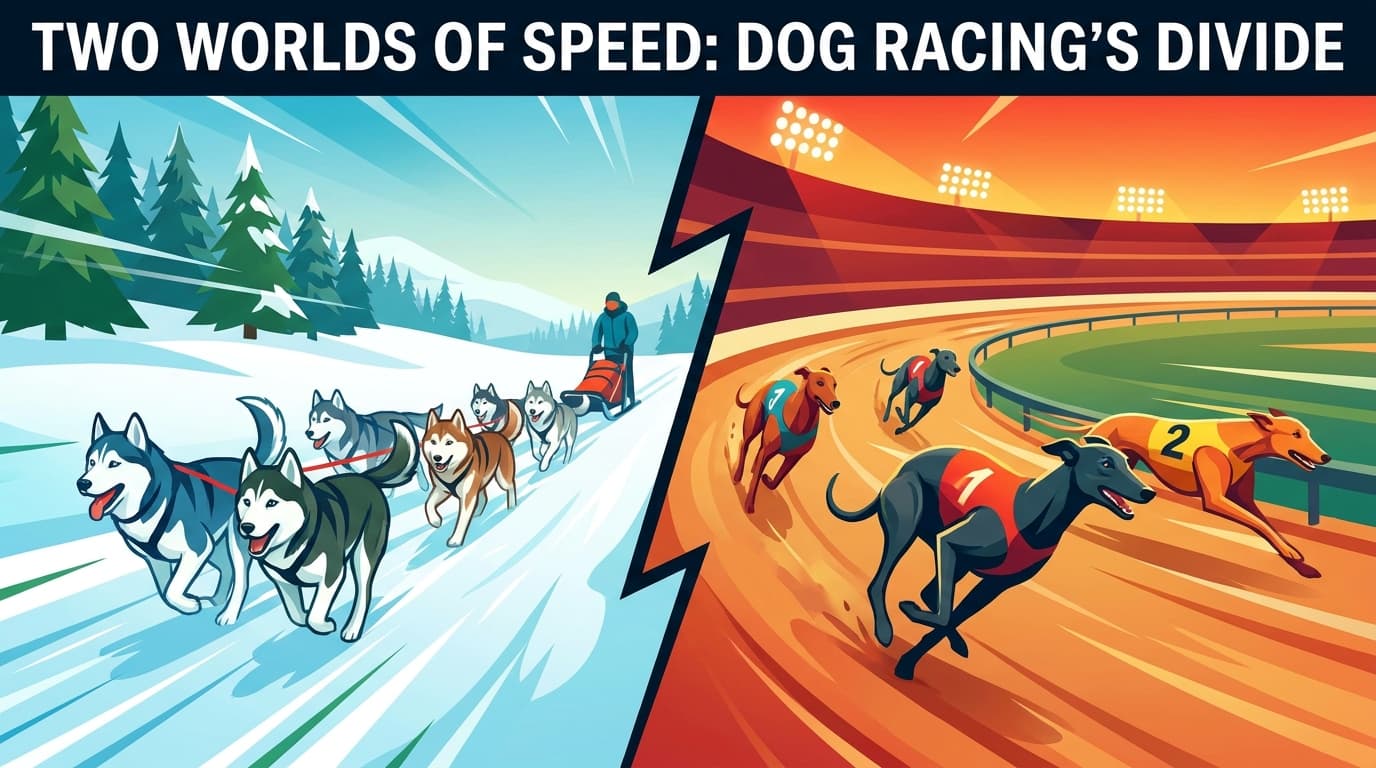
When we talk about competitive dog racing, we mean two very different activities. The first is sled dog racing (also called dog mushing), where teams of dogs pull a sled across snow and ice. The second is greyhound racing, where fast hunting dogs run around an enclosed track. Both sports use dogs, but they developed in completely different places and for different reasons.
Sled Dog Racing: From Work to Competition
The First Races in Alaska
Sled dog racing is a winter sport most popular in the Arctic regions of the United States, Canada, Russia, Greenland and some European countries. For thousands of years before racing became a sport, people in these cold regions used dogs to pull sleds because they needed to move supplies and people across frozen land. The dogs were working animals, essential for survival.
The first recorded sled race in North America took place in 1908 in Alaska, the All Alaska Sweepstakes.
It ran 400 miles through some of Alaska's most arduous areas from Nome to Candle and back. This race became very popular in mining towns during the gold rush era, when people looked for entertainment during the long winter months.
The American Dog Derby and Growing Popularity
The American Dog Derby is the oldest dogsled race in the United States still raced annually today and was the first dogsled race that rose to international prominence. First raced in 1917 and heavily promoted by Union Pacific Railroad, it was on par with the Kentucky Derby and with the Indianapolis 500 in terms of interest and press coverage in the early part of the 20th century. This shows how popular sled dog racing became—newspapers wrote about it as much as they wrote about horse racing or car racing.
The 1925 Serum Run: A Heroic Moment
One event changed how Americans viewed sled dogs forever. The 1925 serum run to Nome, also known as the Great Race of Mercy and The Serum Run, was a transport of diphtheria antitoxin by dog sled relay across the US territory of Alaska by 20 mushers and about 150 sled dogs across 674 miles (1,085 km) in 5+1⁄2 days, saving the small town of Nome and the surrounding communities from a developing epidemic of diphtheria.
Diphtheria is a dangerous bacterial disease that can kill people, especially children. In winter, planes could not fly in the terrible weather, so the only way to bring medicine to Nome was by dog sled. Both the mushers and their dogs were portrayed as heroes in the newly popular medium of radio and received headline coverage in newspapers across the United States.
A musher is the person who drives (that is, controls and directs) the dog sled team. The most famous dog from this event was Balto, who led the final team into Nome, though another dog named Togo actually ran the longest and most dangerous part of the journey.
The Decline and Revival
After the serum run, something unexpected happened. Dog sledding persisted in the rural parts of Alaska, but was almost driven into extinction by the increased use of snowmobiles in the 1960s. During its heyday, mushing was also a popular sport during the winter, when mining towns shut down. Modern machines replaced dogs for practical transportation, and the tradition nearly disappeared.
Two people, Joe Redington Sr. and Dorothy Page, worried that this important part of Alaska's history would be lost. Redington had two reasons for organizing the long-distance Iditarod Race: to save the sled dog culture and Alaskan huskies, which were being phased out of existence due to the introduction of snowmobiles in Alaska; and to preserve the historical Iditarod Trail between Seward and Nome.
A short race of about 25 miles (40 km) was organized in 1967 as part of the centennial celebration of the Alaska Purchase and evolved in 1973 into the current race. The architects of the race were Dorothy G. Page, chairman of one of Alaska's centennial committees, and Joe Redington, Sr., a musher and kennel owner; they are known as the mother and father of the Iditarod.
Today, the Iditarod is one of the most famous long-distance races in the world. The Iditarod Trail Sled Dog Race, more commonly known as The Iditarod, is an annual long-distance sled dog race held in Alaska in early March. It travels from Anchorage to Nome. Mushers and a team of between 12 and 16 dogs, of which at least 5 must be on the towline at the finish line, cover the distance in 8–15 days or more.
Greyhound Racing: From Hunting to Tracks
Ancient Hunting Dogs
Greyhounds are one of the oldest dog breeds. For thousands of years, people used these fast, slim dogs to hunt animals like rabbits and deer. The dogs hunted by sight (that is, they found prey by seeing it move) rather than by smell, which made them perfect for chasing fast animals across open fields.
Coursing: The Predecessor
Before greyhounds raced on tracks, there was a sport called coursing. Modern greyhound racing has its origins in coursing. In coursing, a live hare (a rabbit-like animal) was given a head start, and two greyhounds were released to chase it. The dog that caught the hare won. This was popular entertainment for hundreds of years in Europe, especially in England, but it was violent—the hare usually died—and not everyone could watch because the dogs ran across large areas of open countryside.
The Mechanical Lure Changes Everything
The breakthrough came when someone invented a mechanical device that dogs could chase instead of live animals. The industry emerged in its recognisable modern form, featuring circular or oval tracks, with the invention of the mechanical, or artificial, hare in 1912 by an American, Owen Patrick Smith. A mechanical hare is a fake rabbit (usually made of cloth or stuffed material) attached to a motor that makes it move around the track. The greyhounds chase it, but they never catch it.
Greyhound track racing, as we know it today, began with Owen Patrick Smith's invention of a mechanical lure around 1912. He is generally recognized as the father of modern greyhound racing.
The First Tracks in America
The first recognized commercial greyhound racetrack in the world was built in Emeryville, California in 1919 by Owen Patrick Smith and the Blue Star Amusement Company. However, this first track was not very successful. Smith kept trying to develop the sport.
The big breakthrough came in Florida. The first race was run on March 1, 1922. Over five thousand people came to see Old Rosebud take the sixty-dollar purse. This track in Hialeah (near Miami) featured important innovations like overhead lights so races could happen at night, and a "tote board" that showed betting odds and results. These features made greyhound racing exciting for spectators and convenient for people who worked during the day.
Greyhound Racing Spreads to Britain
The oval track and mechanical hare were introduced to Britain in 1926 by American promoter Charles Munn, in association with Major Leslie Lyne Dixson, a coursing judge.
It was on 24 July 1926, that the first British greyhound meeting – in which the dogs chased an electrically propelled artificial hare – took place at Belle Vue, Manchester.
The sport exploded in popularity in Britain. The sport rapidly gained popularity and within a decade there were 200 tracks that attracted total attendances of well over 32 million a year.
At first it seemed modern, glamorous, and American, but the middle class lost interest when working-class audiences took over. The working class appreciated the nearby urban locations of the tracks and the evening times of the meetings.
Greyhound racing became popular because it was accessible—tracks were built in cities where ordinary workers lived, races happened in the evening after work finished, and people could place bets legally at the track.
Betting and Controversy
Betting has always been a key ingredient of greyhound racing, both through on-course bookmakers and the totalisator, first introduced in 1930. A totalisator (often shortened to "tote") is a system that pools all bets together and calculates the odds automatically. People bet on which dog will win, and this gambling aspect made the sport exciting but also controversial. Some religious groups and social reformers criticized greyhound racing, arguing that it encouraged working-class people to gamble away their money.
Types of Races and Modern Competition
Sled Dog Race Categories
There are three typical types of sled dog races: sprint, mid-distance, and long-distance. Sprint races cover relatively short distances, generally from 5 miles up to 30 miles/day, mid-distance races cover a total of 30 to 300 miles, and long-distance races cover 300 miles to more than 1,000 miles.
The Iditarod is the most famous long-distance race, but many other races exist around the world. Joe Redington and the Iditarod helped restart worldwide interest in mushing, specifically in long-distance events. Since mushing's resurgence, the sport has proliferated and sled dog races are hosted in towns around the world, from Norway and Finland to Alaska and Michigan.
Olympic Recognition (Almost)
Olympics Race in 1932 — Demonstration of race during the 1932 Olympic Games in Lake Placid, New York. The race was participated in by 5 contestants from Canada, and 7 contestants from the US. The race involved two 25.1 miles (40.4 km) heats. The race was won by Emile St. Godard. However, sled dog racing never became an official Olympic sport.
Decline of Greyhound Racing
While sled dog racing has experienced a revival, greyhound racing has declined significantly. In recent years, greyhound racing has declined in several jurisdictions, with a number of countries and regions introducing bans or phase-outs, often citing animal welfare concerns. People worry about how the dogs are treated, whether they are injured during races, and what happens to them when they stop racing. Many tracks have closed, and some countries have banned the sport entirely. On 10 December 2024, Minister for Racing Winston Peters announced that the sport would be banned, citing animal welfare concerns. The ban provides for a phased closure over 20 months to allow for the rehoming of an estimated 2,900 racing dogs, with the final race to occur no later than July 2026. This refers to New Zealand, showing how attitudes toward greyhound racing have changed.
Legacy and Cultural Impact
Both forms of dog racing left lasting marks on popular culture. The statue of Balto stands in New York's Central Park, reminding people of the 1925 serum run. The Iditarod race draws international attention every March, with media coverage tracking mushers as they cross Alaska's wilderness. Greyhound racing, at its peak, was a major form of entertainment that millions attended.
The history of competitive dog racing teaches us how human needs and values change over time. What began as practical transportation became sport and entertainment. What was celebrated in one era faces criticism in another as society reconsiders how animals should be treated. Both sled dog racing and greyhound racing show the complex relationship between humans and working animals—a relationship that continues to evolve today.
Note: A musher is the person who drives a dog sled team. The word comes from the French command "marche" (walk), which became "mush" in English and eventually "musher" for the person giving commands.
Coursing refers to hunting or chasing game using dogs that rely on sight rather than scent to track prey.
Share
Test yourself
What was the first recorded sled dog race in North America?
Sources
- Sled dog racing - Wikipedia
- Iditarod Trail Sled Dog Race - Wikipedia
- List of sled dog races - Wikipedia
- Dogsled racing | Arctic Sport, Mushing & Breeds | Britannica
- Greyhound racing - Wikipedia
- The Fascinating Origins of Greyhound Racing by Michael LaPointe
- Greyhound Racing History - A Look into the Origins
- History of Greyhound Racing | GREY2K USA Worldwide
- Greyhound History – Oxford Stadium
- Dog racing | Greyhound racing, betting, tracks | Britannica
- Going to the Dogs: A History of Greyhound Racing in Britain - University of Huddersfield
- Iditarod Trail Sled Dog Race | History, Map, & Facts | Britannica
- All About the Iditarod | Travel Alaska
- Iditarod Race History – Iditarod
- 1925 serum run to Nome - Wikipedia
- The True Story of Togo: Siberian Husky Sled Dog Hero of 1925 Nome Serum Run
Related articles

Urban Legends from Guerrero, Mexico
Discover the haunting and fascinating supernatural stories that come from the state of Guerrero in southern Mexico, from weeping spirits to vengeful water creatures.

Similarities Across Major Religions
Despite their differences, the world's major religions share many fundamental beliefs and practices that reflect our shared human values. Learn about the common threads that connect Christianity, Islam, Judaism, Hinduism, and Buddhism.

The Ariel School UFO Incident: When 62 Children in Zimbabwe Saw Something Unexplained
In 1994, sixty-two children at a school in Zimbabwe reported seeing a silver craft land near their playground and beings emerge from it—a story that still divides believers and skeptics three decades later.