The History of Japanese Anime: From Early Experiments to Global Phenomenon
- anime
- japanese-culture
- animation-history
- entertainment
The Earliest Days: 1917–1945
The earliest Japanese animation dates to 1917.
The first Japanese animated film we know for certain was commercially released was Dekobo Shingacho - Meian no Shippai (Dekobo's New Picture Book - Failure of a Great Plan) in February of 1917.
Manga artists Oten Shimokawa and Junichi Kouchi, as well as painter Seitaro Kitayama were by this new medium. Hired by existing film studios and working with very small crews, these three men were responsible for the remarkable output that first year and have been nicknamed "the fathers of anime".
These pioneers did not work in isolation. Japan began producing animation in 1917—still the age of silent films—through trial-and-error drawing and cutout animation techniques, based on animated shorts from France and the United States. However, Japanese animators faced significant from the start. Japanese anime were costlier to produce than Western animations and were by the popularity of Disney cartoons.
During the 1920s and 1930s, Japanese animation struggled to find its place. Domestic anime production was beginning to develop a small but solid foundation when Tokyo and the surrounding area suffered damage in the Great Kantō Earthquake in 1923. The industry continued to struggle, unable to respond adequately to successive , including the appearance of the first talkies in 1929 and color film in 1932.
The arrival of World War II changed the industry dramatically. It was in this context that the first full-length theatrical film in the history of Japanese anime was released. Momotarō: Umi no shinpei (Momotarō's Divine Sea Warriors, B&W, 74 minutes), produced by the navy, came out just before the end of the war. This film, though commissioned as , showed what anime could achieve as a narrative medium.
Rebuilding and Early Television: 1945–1960
After the war, the anime industry needed to rebuild from scratch. It wasn't until after WWII—in 1948, to be precise—that the first modern Japanese animation production company, one devoted to entertainment, came into being: Toei. This company would become crucial to anime's development, but the industry still moved slowly.
Television changed everything. Prior to 1958, if you wanted to see animation, you had to go to a theater or have a wealthy friend with a projector and access to reels. Television changed that. The earliest animation to air on the medium was Mogura no Aventure (Mole's Adventure).
Two years later in 1960, an experimental animated anthology called Mittsu no Hanashi (Three Tales) was created and aired by NHK as a special. Comprised of three ten-minute segments telling fantasy tales, it would make the journey to the United States the next year, where it was the first anime to air on American television.
The Revolution: Osamu Tezuka and Astro Boy (1963–1966)
The real transformation came with one person: It was not until the 1960s, with the work of Osamu Tezuka, often called the "God of Manga," that anime began to take shape as a distinct cultural phenomenon. Tezuka's Astro Boy (1963) is considered one of the first major anime TV series, setting the foundation for the animation industry.
Astro Boy premiered on Fuji TV on New Year's Day, 1963 (a Tuesday) and is the first popular animated Japanese television series that embodied the that later became familiar worldwide as anime. The timing was perfect. With the Tokyo Olympics the following year, the number of households with televisions was surging. This was the starting point for the growth of Japan's content creation industry.
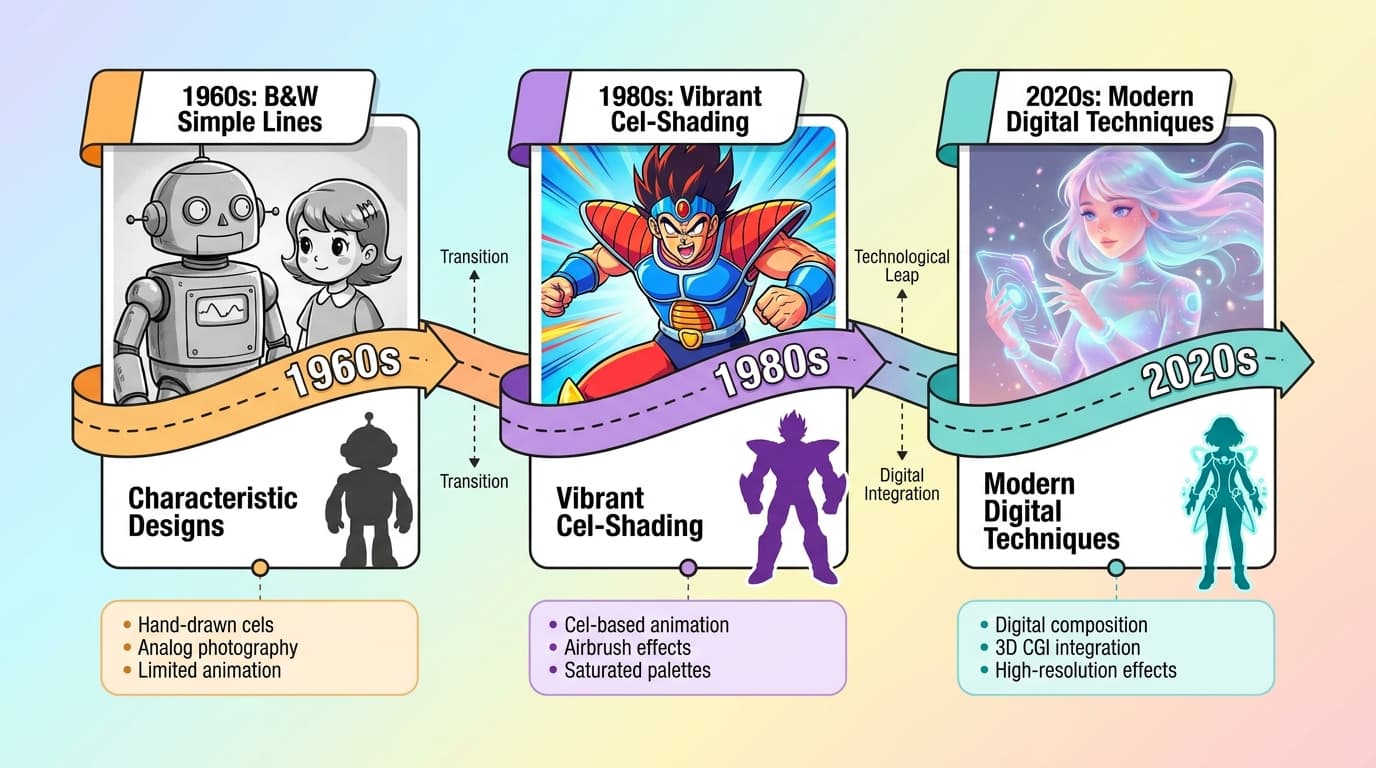
What made Tezuka's achievement remarkable was how he solved the problem that had plagued anime for decades: cost. In the 1960s, manga artist and animator Osamu Tezuka adapted and simplified Disney animation techniques to reduce costs and limit frame counts in his productions. Originally intended as temporary measures to allow him to produce material on a tight schedule with inexperienced staff, many of his limited animation practices came to define the medium's style.
This technique, called "limited animation," worked by reducing the number of drawings per second and reusing cels (transparent sheets with hand-drawn characters). This meant he needed to adapt high-quality story concepts to a form of limited animation that required only 10 frames per second or so (as opposed to the standard 24-29) and relied on an image bank of re-usable cells that could be combined and re-combined in new ways to prolong the action sequences.
The result was instant success. It lasted for four seasons, with a total of 193 episodes, the final episode presented on a Saturday, New Year's Eve 1966. At its height it was watched by 40% of the Japanese population who had access to a TV.
Astro Boy was highly influential to other anime in the 1960s, and was followed by a large number of anime about robots or space.
International Expansion and the 1970s
Astro Boy, renamed from Tetsuwan Atom, is first broadcasted by the American national network, NBC. It is subsequently broadcast on television in the United Kingdom, France, West Germany, Australia, Taiwan, Hong Kong, Thailand, the Philippines, and other countries. This global distribution laid the groundwork for anime's later popularity.
The 1970s saw anime develop beyond robot stories. Heidi was an international success, popular in many European countries, and so successful in Japan that it allowed for Hayao Miyazaki and Takahata to start a series of literary-based anime (World Masterpiece Theater).
Two of Miyazaki's critically acclaimed productions during the 1970s were Future Boy Conan (1978) and Lupin III: The Castle of Cagliostro (1979).
More importantly, anime developed distinct genres and fan communities. Some early works include Mazinger Z (1972–1974), Science Ninja Team Gatchaman (1972–1974), Space Battleship Yamato (1974–75) and Mobile Suit Gundam (1979–80).
A subculture in Japan, whose members later called themselves otaku, began to develop around animation magazines such as Animage and Newtype. These magazines formed in response to the overwhelming fandom that developed around shows such as Yamato and Gundam in the late 1970s and early 1980s.
The Golden Age: The 1980s
The success of the theatrical versions of Yamato and Gundam is seen as the beginning of the anime boom of the 1980s, and of "Japanese Cinema's Second Golden Age". This was a period of extraordinary growth and experimentation.
In the 1980s, anime became mainstream in Japan, experiencing a boom in production with the rise in popularity of anime including Gundam, Macross, Dragon Ball, and genres such as real robot, space opera and cyberpunk.
In the 1980s, anime started to go through a "visual quality renewal" thanks to new directors like Hayao Miyazaki and Isao Takahata, who founded Studio Ghibli in 1985, and Katsuhiro Ōtomo.
Home video technology transformed the industry in an unexpected way. Home video transformed the anime industry in the Eighties even more radically than TV had. It allowed casual re-watching of a show apart from the rerun schedules of broadcasters, which made it that much easier for die-hard fans—otaku, as they were now starting to be known in Japan—to congregate and share their enthusiasm.
It also created a new submarket of animated product, the OAV (Original Animated Video), a shorter work created directly for video and not for TV broadcast, which often featured more ambitious animation and sometimes more experimental storytelling as well.
The 1988 film Akira an international success. This film proved that anime could reach adult audiences worldwide and opened doors for anime to be taken seriously as cinema.
Animation Techniques: From Cel to Digital
Throughout anime's history, the way it was made changed dramatically. Cel-ga (セル画) is the Japanese term for Celluloid Picture. This refers to the transparent material used to make frames of animation in the production of Japanese Anime shows. Each cel is one frame.
To create the illusion of movement, each drawing differs slightly from the one before it, then the completed cels are photographed one-by-one against a painted background by a rostrum camera onto motion picture film to produce the final animation.
The transition to digital happened gradually. During the 1990's, CGI became increasingly commonplace as a supplemental technique. The ease with which computers could manipulate images even won over traditional-animation purist Miyazaki, who used CGI on 1997's Mononoke-Hime (Princess Mononoke) to animate demonic tendrils and a few other effects after his staff demonstrated how seamlessly they could blend the animation in.
The general transition point to digital took place after 2001, so more modern shows such as Naruto and One Piece will generally only have their sketches available. This is also the case for some longer running series, such as Hunter x Hunter and Pokemon, whose earlier episodes will have been made using traditional techniques, but later shifted to the digital format for newer episodes after about 2001.
The 1990s and 2000s: Global Growth
The 1990s marked a shift in anime's audience. The 1990s were a time of genre expansion in anime, making it more attractive to a wider audience. The Japanese animation industry started to incorporate various genres like magical girls, mechas, action-adventures, and psychological dramas to diversify the viewer base and increase its global appeal.
Big-hitting anime series like Dragon Ball Z (DBZ), Sailor Moon, and Pokémon played a significant role in promoting anime in the West.
Overseas licensing boomed, and Studio Ghibli's Sen to Chihiro no Kamikakushi (Spirited Away) took the Best Animated Feature Oscar in 2002. This achievement showed that anime films could compete at the highest levels of cinema.
In the 2000s, the internet became a game-changer. In the early 2000s, websites like Crunchyroll and Funimation started providing legal access to anime, significantly contributing to the medium's growth. These platforms introduced new titles and made classic series readily available.
The 2000s signified the digital transformation of the anime industry. The shift from traditional cel animation to digital techniques resulted in cleaner lines, brighter colors, and greater in animation production.
The Streaming Era and Modern Boom (2010s–Present)
The 2010s brought another revolution through streaming. The 2010s brought about a digital revolution in the form of streaming platforms, fundamentally changing the way anime was distributed and consumed worldwide. Platforms like Crunchyroll and Netflix facilitated instant, global access to anime, resulting in a significant rise in its popularity outside Japan.
This shift had measurable impact. Japan has historically represented a large portion of the market for anime. However, with the growth of video streaming services, other countries' market share began a rapid expansion from around 2015, ultimately overtaking that of Japan in 2020.
By 2021, anime had the third most in-demand TV genre worldwide, right behind crime dramas and sitcoms.
The COVID-19 pandemic accelerated this trend. Anime's popularity has further been spurred by the explosive increase in video viewing times during the COVID-19 pandemic. It is no exaggeration to say that especially for Gen Z digital natives, anime is now part of the mainstream culture, rather than a niche hobby only known to a few dedicated enthusiasts.
Recent years have seen unprecedented global recognition. The Boy and the Heron by Studio Ghibli added to anime's growing recognition on the global stage by winning the Academy Award for Best Animated Feature.
Attack on Titan made history as the first non-English-language series to be named the world's most in-demand TV show, earning its place among cultural titans such as Game of Thrones and The Walking Dead.
Key Themes Throughout Anime's Evolution
Looking at anime's development, certain patterns emerge. First, innovation born from limitation: Tezuka's limited animation was a cost-cutting measure that became anime's defining visual style. Second, the importance of strong stories: anime grew not just through technical advancement but through compelling narratives adapted from manga. Third, fan communities: otaku culture transformed passive viewers into active participants who supported the industry through conventions, merchandise, and word-of-mouth.
Finally, global reach has accelerated at each technological shift—from TV broadcasts in the 1960s, to home video in the 1980s, to the internet in the 2000s, to streaming services today. Each innovation made anime more accessible, and accessibility bred familiarity, which bred passion, which grew into the cultural phenomenon anime is today.
Anime has traveled from handmade frames in 1917 to digital pixels in 2026. What began as an experimental curiosity in Japan has become a worldwide force in entertainment, influencing not just animation but storytelling itself. The journey reflects both Japan's creativity and the world's hunger for stories told in fresh, imaginative ways.
Share
Test yourself
In what year did the first commercial Japanese animation film release?
Sources
Related articles

Introduction to Comedy
Comedy is a form of entertainment that makes audiences laugh by highlighting absurdities and incongruities in human life and society. From ancient Greek theatre to modern sitcoms, comedy has evolved into numerous genres and techniques—each designed to amuse, surprise, and sometimes challenge our perspectives.
Understanding Spirituality in 2026: A Guide to Modern Beliefs and Practices
Spirituality in 2026 is shifting toward personal, flexible practices that blend technology with timeless traditions. Young people are choosing individual spiritual paths over formal religion while seeking meaning and connection.

How to Manage Risk for the Everyday Man
Learn practical strategies to identify, understand, and manage the financial and life risks that affect your family and future, from emergency savings to insurance and smart budgeting.