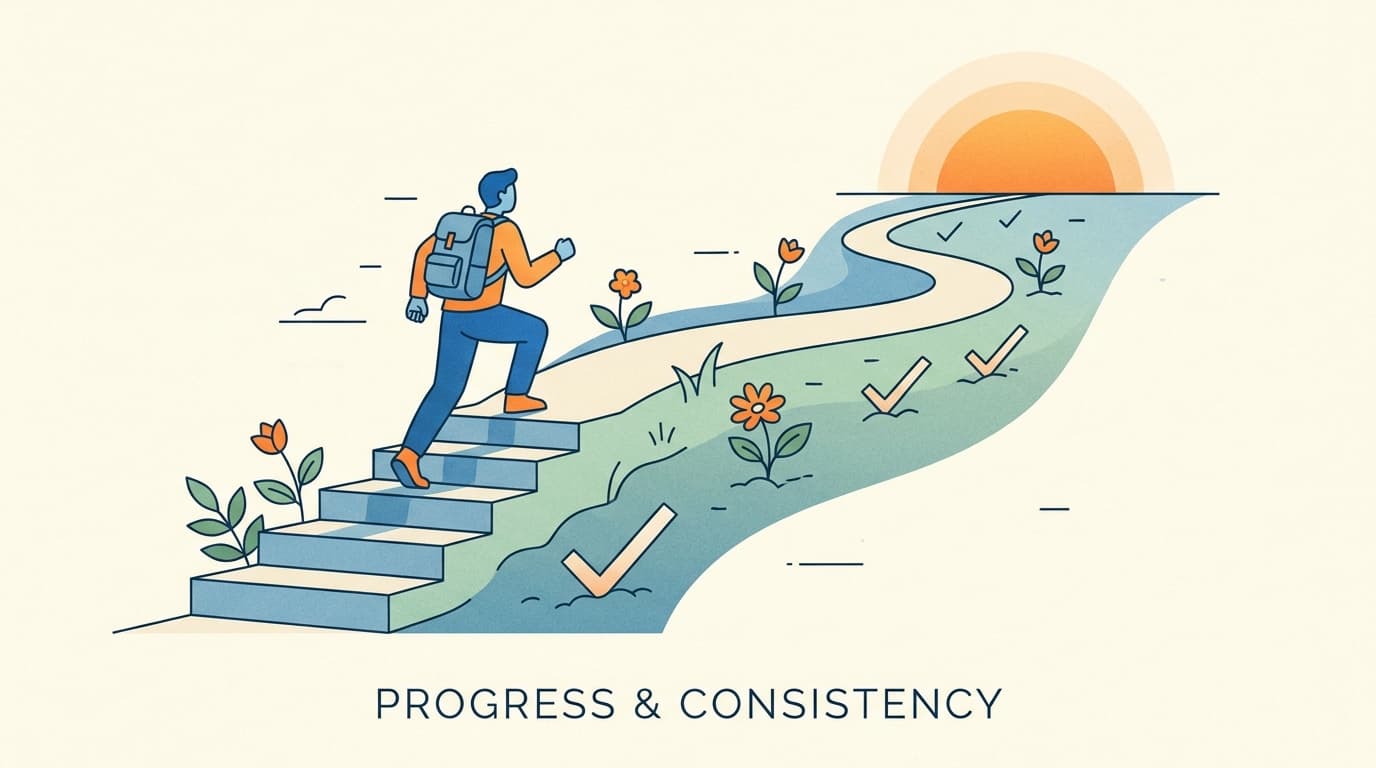
How to Be More Disciplined in 2026
- self-improvement
- habits
- goals
- productivity
What "Discipline" Really Means
When you look up "discipline" in the Cambridge Dictionary, you find this definition: "training that produces obedience or self-control, often in the form of rules and punishments if these are broken, or the obedience or self-control produced by this training."
That definition might sound heavy, even strict. But here's the good news: there has been a major change in psychology away from the "willpower" understanding of self-control toward one that focuses on specific strategies or habits that make self-discipline easier .
This shift matters for you. It means becoming more disciplined in 2026 is less about having superhuman willpower and more about being smart with your strategies.
The Truth About Willpower
For decades, psychologists believed discipline was like a muscle—you either had it or you didn't. People frequently think of self-control as something that requires willpower—the effort of giving up some immediate pleasure for a long-term goal. A study from last year found that people in the U.S., the Netherlands and China tend to write about self-control with words such as "difficult" and "unpleasant."
But in the past decade, the science has shifted. Scientists noticed that some people found self-discipline to be completely effortless yet still stuck to their goals better than those who had to exercise a lot of willpower.
So what's their secret?
What Disciplined People Actually Do
Whether students who reported high self-control were pursuing good grades, regular exercise or better sleep, they relied on routines for studying, exercising or going to bed. These structured habits—doing the same thing in the same place at the same time of day—were more likely to lead to long-term success than attempting to squelch counterproductive impulses in the moment.
Let's be clear: disciplined people don't have better willpower. They have better systems.
They organize their lives so that doing the right thing becomes automatic, almost effortless. Instead of fighting temptation every day, they avoid it entirely—or make good choices so routine that they barely think about them.
The Habit Formation Timeline
You've probably heard that habits take 21 days to form. That's a myth. This myth appears to have originated from anecdotal evidence of patients who had received plastic surgery treatment. More relevant research found that automaticity plateaued on average around 66 days after the first daily performance, although there was considerable variation across participants and behaviours. Therefore, it may be helpful to tell patients to expect habit formation (based on daily repetition) to take around 10 weeks.
So if you start a new habit in April 2026, expect it to feel truly automatic by July—not by the end of the month.
Establishing a habit does require effort at first, but after about three months, it often gets easier.
Strategy 1: Build Routines, Not Resolutions
The first strategy is simple: create specific routines instead of vague goals.
✗ "I want to exercise more in 2026."
✓ "I will walk for 20 minutes every morning at 7:00 a.m. before breakfast."
✗ "I need to study harder."
✓ "I will study vocabulary at my desk for 30 minutes right after dinner."
Why does this work? Because your brain loves patterns. These structured habits—doing the same thing in the same place at the same time of day—were more likely to lead to long-term success than attempting to squelch counterproductive impulses in the moment. People with these good habits reported doing them automatically, without having to think about it.
The less you have to think about whether to do something, the less willpower you need.
Strategy 2: Change Your Environment
Here's a powerful idea: situational strategies should be more effective than intrapsychic strategies because they are deployed earlier in the process of impulse generation. That is, strategies targeted at influences outside of the mind are in general better than strategies targeted at downstream mental processes.
In plain English? Don't try to resist temptation—remove it before it tempts you.
Examples of situational self-control include the partygoer who chooses a seat far from where drinks are being poured, the dieter who asks the waiter not to bring around the dessert cart, and the student who goes to the library without a cell phone.
For 2026, ask yourself: What can I change in my surroundings to make discipline easier?
- Want to eat healthier? Don't buy junk food at the store. If it's not in your house, you can't eat it.
- Want to focus better? Leave your phone in another room while you work.
- Want to save money? Delete shopping apps from your phone.
This sounds unspectacular, but it was proven in scientific studies to be extremely effective. In fact, so effective that it helped U.S. soldiers to break free from heroin addiction. 95 percent of the people who were addicted in Vietnam did not become re-addicted when they returned to the United States. The study showed how intensively our environments affect our behavior. Luckily, even the smallest changes in your environment can help to break negative habits.
Strategy 3: Use Implementation Intentions
An implementation intention is a fancy term for a simple idea: make an if-then plan.
Implementation intention (if–then approaches to planning) can be a concrete and effective method for connecting your behaviors to desired outcomes. In other words, they bridge the gap between intentions and actions, leaving us with more mental resources for avoiding distractions and competing goals.
Instead of saying "I'll exercise more," say:
"If it's Monday, Wednesday, or Friday morning, then I will put on my running shoes and go for a run."
Instead of saying "I'll eat better," say:
"If I'm at a restaurant, then I will order vegetables with my meal."
The "if" part is the cue. The "then" part is the behavior. When you plan exactly when and where you'll do something, your brain can spot the cue and trigger the action automatically.
Strategy 4: Start Small
Patients should be encouraged to aim for small and manageable behaviour changes, because failure can be discouraging. The automaticity of habit means that breaking existing habits requires different and altogether more effortful strategies than making new habits.
Many people fail at discipline because they try to change everything at once. They want to:
- Exercise every day
- Eat perfectly
- Learn a new language
- Save money
- Read more
- And ten other things
All at the same time. All starting January 1st.
This doesn't work. It exhausts your willpower immediately.
Instead, we can improve our self-discipline with as little as two weeks of consistent practice —but only if we focus on one small change at a time.
Pick the smallest version of your goal:
- Not "exercise one hour daily" but "do 10 push-ups every morning"
- Not "become fluent in English" but "review five vocabulary words before bed"
- Not "read 50 books this year" but "read for 10 minutes before sleep"
Once the small habit feels automatic (remember, around 66 days), then add another one.
Strategy 5: Forgive Missed Days
Here's something most people get wrong: they think missing one day ruins everything.
You skip the gym on Monday. You feel guilty. You think, "I've already failed, so why bother?" You skip Tuesday, Wednesday, Thursday...
Stop this pattern. Successful habit-builders aren't more disciplined—they're better at bouncing back after they skip a day without abandoning the goal entirely. Missing Monday's workout doesn't erase the neural pathway you've been building. It's a single data point in a much longer pattern. What erodes the pathway is the decision to stop showing up to the cue.
The forgiveness isn't about feeling better. It's about preserving the cue loop.
So if you miss one day, just continue the next day. Don't restart your count. Don't punish yourself. Just show up again.
Strategy 6: Build Accountability
Accountability fosters a sense of responsibility and commitment, making it harder to ignore or abandon goals. It provides external pressure and internal motivation, both of which are essential for sustained progress.
Research has shown that individuals are far more likely to achieve their objectives when they share their goals and establish accountability measures.
Ways to add accountability:
- Tell a friend your goal and check in weekly
- Join a group of people working toward similar goals
- Track your progress in a visible place (a calendar, an app, a notebook)
- Hire a coach or teacher
- Post about your progress on social media
You are more likely to stay accountable to your goals if you know that someone else is monitoring your progress. This approach may seem daunting—you may fear embarrassment if you don't meet your publicly shared goals. But that little fear may also serve as motivation in the tough moments.
Strategy 7: Make Goals Meaningful
A 2025 study found that they may actually prefer doing something meaningful—that advances their goals—rather than something that's just fun or relaxing. The people high in self-control chose activities they rated as meaningful, such as exercising or doing chores; the others went for the purely enjoyable, such as taking a nap or listening to music.
This is fascinating. It suggests that discipline gets easier when you genuinely care about your goals.
So before you commit to being more disciplined, ask yourself: Why does this matter to me?
Don't choose goals because other people think you should. Don't pursue discipline for discipline's sake. Connect your habits to something deeper:
- Not "I should exercise" but "I want to have energy to play with my children"
- Not "I should save money" but "I want to visit my family in another country"
- Not "I should study English" but "I want to advance in my career and connect with more people"
When your goals are meaningful to you personally, willpower tends to be greater if you are working toward your own goals. If you're making the sacrifice for someone else, it's more of a drain on your willpower.
Strategy 8: Replace, Don't Remove
One of the most useful practical insights from recent habit research is that trying to stop a behavior without replacing it is usually a losing game. The cue still fires. If there's nothing to replace the old response, the old response wins. This is why most diets fail and most behavior-change attempts collapse. People try to subtract without adding. Behavioral researchers have argued for addition over restriction. Start by adding berries rather than eliminating sugar, build the new pattern alongside the old one, let the healthier option gradually crowd out the less helpful one.
So if you want to stop a bad habit:
- Don't just "stop scrolling social media"—replace it with "read a book when I feel bored"
- Don't just "stop eating snacks at night"—replace it with "drink herbal tea instead"
- Don't just "stop staying up late"—replace it with "do a calming routine at 10 p.m."
The new behavior fills the space left by the old one.
Why This Matters in 2026
You might wonder: why does all this research matter now, in 2026?
Because it makes sense to see self-control not merely as foregoing pleasure, but also as being able "to create adaptive routines and strategically avoid conflicts, which in turn leaves more room for attending to what one finds important in life." These structures can help organize your surroundings in a way that makes doing what you think is good for you feel more natural.
Life in 2026 is full of distractions. Phones, streaming services, endless information, constant notifications. The world is designed to grab your attention and drain your willpower.
But you now know: you don't need more willpower. You need better strategies.
You need routines that make discipline automatic. You need an environment that supports your goals. You need meaningful reasons to keep going.
Your Action Plan for 2026
Here's how to start today:
Step 1: Choose one habit to build. Just one. Make it small and specific.
Step 2: Decide exactly when and where you'll do it. Create an if-then plan.
Step 3: Change your environment to make this habit easier. Remove obstacles. Remove temptations.
Step 4: Tell someone about your plan. Ask them to check on you weekly.
Step 5: Track your progress. Mark each day you complete the habit on a calendar.
Step 6: When you miss a day (you will), forgive yourself and continue the next day.
Step 7: After 66 days, when the habit feels automatic, add another one.
A Final Word
Discipline isn't about being perfect. It isn't about never failing or always having willpower.
Self-control measured during the first decade of life predicts a startling array of adult life outcomes, including income, savings behavior, financial security, occupational prestige, physical and mental health, substance use, and (lack of) criminal convictions. In the same study, the predictive power of self-control was comparable to intelligence or family socioeconomic status.
The good news? Self-control can be built. Discipline can be learned. It just takes the right approach.
You don't need to rely on willpower alone. Build habits. Design your environment. Create accountability. Connect to meaning. Forgive yourself when you stumble.
Do this, and 2026 can be the year you become more disciplined—not through force, but through strategy.
Share
Test yourself
According to recent research, what do people with high self-discipline rely on more than willpower?
Sources
Related articles
How to Start a New Habit: A Science-Based Guide
Learn the science-backed strategies to start and maintain new habits, including the habit loop, implementation intentions, and why it takes longer than 21 days to build lasting change.

Understanding Spirituality in 2026: A Guide to Modern Beliefs and Practices
Spirituality in 2026 is shifting toward personal, flexible practices that blend technology with timeless traditions. Young people are choosing individual spiritual paths over formal religion while seeking meaning and connection.

How to Manage Risk for the Everyday Man
Learn practical strategies to identify, understand, and manage the financial and life risks that affect your family and future, from emergency savings to insurance and smart budgeting.