Introduction to Supply Chain Management
- supply chain
- business
- logistics
- management
What Is Supply Chain Management?
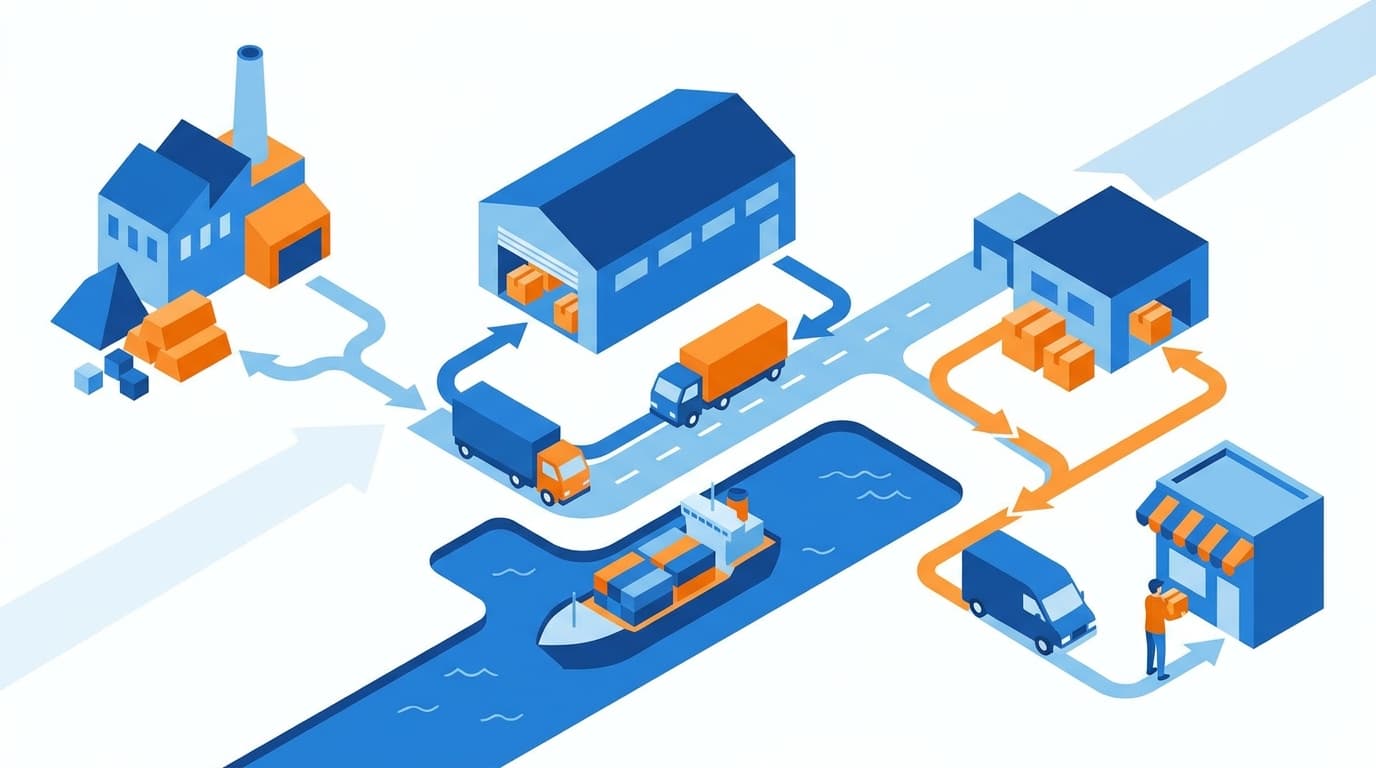
Supply chain management (SCM) is the of a business' entire production flow, from materials to delivering an item. Imagine you buy a smartphone. Before it reaches your hand, countless steps happen behind the scenes: The global supply chain is a complex network of suppliers, manufacturers, distributors, retailers, wholesalers and customers.
Supply chain management is not just about moving boxes from one place to another. Effective SCM is about this network to ensure that everything gets where it needs to be, when it needs to be there—and as smoothly as possible. It touches every part of how a product is made and delivered.
The term "supply chain" appeared widely in business after the 1990s, but the practice is much older. Some aspects of supply chain management have been around for centuries. Hyperlocal supply chains enabled communities to feed, clothe and house their members. Ancient trade routes required and distribution to exchange goods around the world.
The Five Main Stages of Supply Chain Management
Most supply chains follow a clear process with five main stages. Understanding these stages helps you see how a product moves .
Stage 1: Planning
Planning involves forecasting demand, arranging production and managing inventory levels to ensure that the right products are ready to meet customer demand. It also involves setting an overall SCM strategy by determining metrics to measure whether the supply chain is efficient, effective and meets company goals. This stage is critical. Without good planning, a company might produce too much of one item and too little of another, wasting money and disappointing customers.
Stage 2: Sourcing
Sourcing involves identifying which providers to work with, negotiating contracts and managing supplier relationships to ensure a reliable supply of raw materials and components. The work includes ordering, receiving, managing inventory and authorizing supplier payments. Think of sourcing as the groundwork—companies must find trustworthy suppliers who deliver quality materials on time and at a fair price.
Stage 3: Manufacturing
Manufacturing involves organizing the supply chain operations required to accept raw materials, design and produce the product, and handle quality control. This is where raw materials transform into finished products. The manufacturer must ensure quality, control costs, and keep production on schedule.
Stage 4: Delivery
This stage moves finished goods to customers. This component encompasses all the steps for processing customer orders, distributing them, and transporting them. Warehousing and inventory, or paying a service provider to manage both, are also included in this stage. Delivery includes warehousing (storage), transportation, and the final "last-mile" delivery to customers' doors.
Stage 5: Returns
The last and final stage of supply chain management is referred as the return. In the stage, defective or damaged goods are returned to the supplier by the customer. This is also called "reverse logistics." Managing returns well helps companies learn from problems and maintain customer trust.
Why Supply Chain Management Matters
Effective supply chain management directly impacts a company's success and the customer's experience.
Cost Reduction
Effective supply chain management minimizes costs, waste and time in the production cycle. It directly impacts profitability and allows businesses to gain a in today's global marketplace. When companies reduce waste and move products efficiently, they can lower prices or increase profits.
Customer Satisfaction
By helping products arrive on time and in good condition, supply chain management can improve customer satisfaction and loyalty. Customers expect the right product, at the right place, at the right time. When the supply chain fails, customers suffer. When it works well, they come back.
Risk Management and Sustainability
Supply chain management also helps companies anticipate and risks (such as supply chain disruptions) and track compliance with regulations and standards. Additionally, Sustainable supply chain management can help companies reduce their carbon footprint and impact on the environment by optimizing logistics and energy management, and reducing waste.
The Difference Between Procurement and Supply Chain Management
Many people use the terms "procurement" and "supply chain management" as if they mean the same thing, but they don't. Procurement is responsible for sourcing, negotiating, and purchasing the materials, services, or goods a business needs. Supply chain management is broader, managing the end-to-end flow—from production and transportation through final delivery to the customer. In other words, procurement is a key part of SCM, focused on cost control and supplier relationships, while SCM is focused on overall flow efficiency, logistics, and meeting customer demand.
Think of it this way: procurement is like shopping for ingredients, while supply chain management is the entire journey from the farm to the dinner table.
Real-World Examples
Amazon's Supply Chain
When a customer wants to buy a pair of headphones on Amazon, long before the order is placed, Amazon's planning systems analyze purchasing patterns, regional demand, and seasonal trends to determine how much inventory should be stored in different locations. Based on those forecasts, Amazon places purchase orders with suppliers that manufacture or distribute the headphones. The supplier produces the product or prepares existing inventory for shipment. The goods then move through transportation networks to Amazon fulfillment centers, where they are received, scanned, and stored in warehouse systems designed for rapid retrieval.
Just-in-Time Manufacturing
Tata Motors uses a Just-in-Time (JIT) model, coordinating with suppliers to deliver components only when needed. Its Pune plant integrates real-time tracking for seamless supply chain operating. This approach reduces inventory costs and waste while keeping the operation lean and .
Modern Challenges in Supply Chain Management
Today's supply chains face many challenges that make management more difficult than ever.
Geopolitical Disruptions
Supply chains in 2023 are still feeling the effects of the COVID-19 pandemic and the lingering impacts of global shutdowns, as well as large shifts in consumer spending. Additionally, wars and political unrest have added significant pressures on global supply chains. Inflation and labor pressures are also driving prices up and affecting productivity for supply chain operations.
Visibility and Communication
Research from Tive found that even as technology improves, visibility challenges persist. The report found that overall, first- and last-mile visibility has improved. Yet 37% of companies still struggle to track activity during the mid-mile stage of transportation. Without visibility, managers cannot make quick decisions when problems arise.
Demand Forecasting
Unpredictable customer demand can leave you with empty shelves when a product is hot, or a warehouse full of items nobody wants. This guessing game leads directly to lost sales or wasted money.
The Role of Technology in Modern Supply Chains
Technology is transforming how supply chains operate. Digital transformation significantly improves SCM through improved demand forecasting, optimized inventory management, and real-time decision-making capabilities. AI provides predictive insights that mitigate risks and streamline processes, Blockchain offers secure, transparent, and immutable records that improve trust and , and IoT enables real-time monitoring and connectivity across the supply chain network.
Artificial Intelligence and Machine Learning
AI and machine learning improve forecasting accuracy, optimize inventory levels, and enhance overall operational efficiency by automating routine tasks and analyzing large datasets. Predictive analytics plays a crucial role in demand forecasting by using historical data, statistical algorithms, and machine learning techniques to predict future demand. This approach enables businesses to anticipate customer needs more accurately, reduce inventory costs, and improve service levels.
Internet of Things (IoT) and Real-Time Tracking
Digital transformation's significance in supply chain management is further emphasized by its capacity to improve supply chain . IoT sensors can track products in real time, allowing companies to see exactly where goods are located and detect any problems immediately.
Just-in-Time and Lean Supply Chain Strategies
Two important approaches that changed supply chain management are Just-in-Time (JIT) and Lean manufacturing.
Just-in-Time (JIT)
JIT inventory management ensures that stock arrives as it is needed for production or to meet consumer demand, but no sooner. The goal is to eliminate waste and increase the efficiency of your operations.
The core principle of JIT is simple: produce and deliver only what is needed, in the exact quantity, and at the right time.
JIT works well in stable environments, but it has risks. JIT has potential risks if you don't have accurate and frequently updated sales forecasts. During the COVID-19 pandemic, companies that relied too heavily on JIT suffered because suppliers could not deliver when factories shut down.
Lean Manufacturing
Lean manufacturing is a management system built on three principles: produce only what is needed, when it is needed; correct abnormalities as soon as they occur; and empower workers to improve the process themselves.
JIT is a component of lean manufacturing, but lean encompasses much more, including continuous improvement, value stream mapping, and customer-centric process design. JIT focuses specifically on timing and inventory reduction.
Looking Ahead: The Future of Supply Chain Management
Research from the MIT Center for Transportation and Logistics found that such supply chain digital transformation can cut process costs in half and increase revenue by 20%. As companies invest in technology and adapt to global challenges, supply chain management will continue to evolve.
The key lesson for the future is balance. Mastering lean manufacturing and JIT principles offers a powerful framework for supply chain risk management that balances efficiency with resilience. Companies that successfully implement these approaches gain not just cost savings but also strategic advantages against disruptions.
Organizations that build resilient, visible, and technology-enabled supply chains will have a stronger competitive advantage. The supply chain is no longer hidden behind the scenes—it is now a strategic asset that shapes how businesses compete and survive in a global market.
Share
Test yourself
What is the main goal of supply chain management?
Sources
Related articles
Mexico's Superpower: Why Companies Are Choosing Nearshoring
Mexico has become a major hub for nearshoring—moving production from distant countries to nearby ones. Learn why companies are reshaping supply chains around Mexico and what this means for the global economy.

Understanding Spirituality in 2026: A Guide to Modern Beliefs and Practices
Spirituality in 2026 is shifting toward personal, flexible practices that blend technology with timeless traditions. Young people are choosing individual spiritual paths over formal religion while seeking meaning and connection.

How to Manage Risk for the Everyday Man
Learn practical strategies to identify, understand, and manage the financial and life risks that affect your family and future, from emergency savings to insurance and smart budgeting.