The Past Perfect: When to Use 'Had Done' in English
- past perfect
- verb tenses
- grammar
- past tenses
What the past perfect is
The past perfect is formed with had + the past participle (the third form of the verb: done, eaten, seen, gone).
She had lived in Tokyo before she moved to Seoul.
They had already eaten when I arrived.
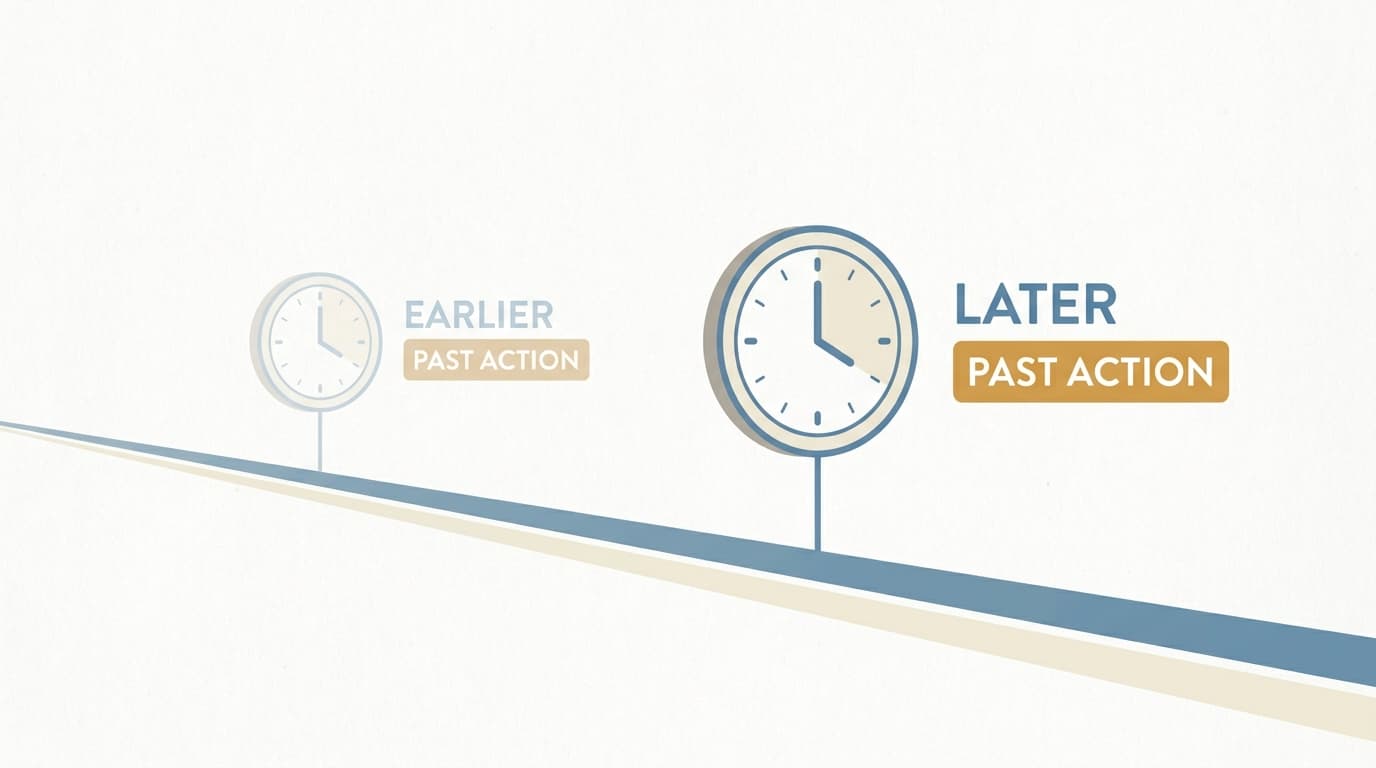
The past perfect refers to a time earlier than before now, specifically to show that something happened before another action in the past . Think of it as "the past of the past."
When you need the past perfect
To show which past action came first
You use the past perfect when you want to make clear that one past action happened before another past action .
When I got to the station, the train had left. (First the train left, then I got there.)
I couldn't get in because I had forgotten my keys. (First I forgot the keys, then I tried to get in.)
The timeline matters here. You're standing in the past (at the station, at the door) and looking back at something even earlier (the train leaving, forgetting the keys).
After time words that signal "earlier than"
Certain words and phrases almost always trigger the past perfect because they point to something that happened before the main past event.
By the time / by + past time:
By the time we arrived, the movie had started.
By 2010, she had published three novels.
Before:
He had never seen snow before he moved to Canada.
After:
After they had discussed the plan, they voted.
(Note: with after, you can sometimes use the simple past for both verbs — After they discussed the plan, they voted — because after already makes the order clear. But the past perfect is more precise and more common in formal writing.)
Already / just / never (in the past):
I wasn't hungry because I had already eaten.
We had just arrived when the power went out.
In reported speech (when the original was past simple)
When you report what someone said, and the original statement was in the past simple, it often shifts to the past perfect .
Direct speech: "I lost my wallet."
Reported speech: He said he had lost his wallet.
Direct speech: "Did you finish the report?"
Reported speech: She asked if I had finished the report.
In conditional sentences (third conditional)
The past perfect appears in the "if" clause of third conditional sentences, which talk about unreal past situations .
If I had known you were coming, I would have cooked dinner.
She wouldn't have failed if she had studied more.
These sentences describe things that didn't happen. They're about regret, hypothetical situations, or imagining a different past.
When you don't need it
When the order is obvious
If the sequence is already clear from context or from words like before, after, when, you can often use the simple past for both actions.
✓ After he finished his homework, he watched TV.
✓ After he had finished his homework, he watched TV.
Both are correct. The past perfect is more formal and more explicit, but not required.
✓ I got home, took a shower, and went to bed.
Here, the verbs are listed in the order they happened, so the simple past is fine. You wouldn't say "I got home, had taken a shower, and went to bed" — that would sound strange.
In simple narration
When you're telling a story in the past and moving forward through events, you use the simple past. The past perfect only comes in when you pause to mention something that happened before the story timeline.
I walked into the café and sat down. The waiter brought a menu. I ordered coffee. I had been to this place once before, years ago.
The first three sentences are simple past because they're moving forward. The last sentence shifts to past perfect because it jumps back to an earlier time.
Common mistakes
Using past perfect for every past action
✗ Yesterday I had gone to the store.
✓ Yesterday I went to the store.
If you're just saying what happened yesterday, use the simple past. The past perfect is only for showing that something was earlier than another past time.
Forgetting "had"
✗ When I arrived, they eaten all the food.
✓ When I arrived, they had eaten all the food.
The auxiliary had is required. You can contract it (they'd eaten) in speech and informal writing, but you can't drop it.
Using "has" instead of "had"
✗ She said she has seen that movie.
✓ She said she had seen that movie.
The past perfect always uses had, never has or have . Those belong to the present perfect.
Overusing it in speech
Native speakers don't always use the past perfect in casual conversation, even when the grammar "requires" it. You'll often hear:
I wasn't hungry because I ate already. (instead of had eaten)
This is informal but very common. In writing, exams, and formal contexts, stick to the past perfect. In relaxed speech, both forms are acceptable.
Past perfect continuous: had been doing
There's also a continuous form: had been + -ing. It emphasizes the duration of an action that was in progress before another past event.
I had been waiting for two hours when the bus finally arrived.
She was tired because she had been working all night.
The past perfect continuous focuses on the activity itself and how long it continued, while the past perfect simple focuses on the completion or result .
Compare:
He had painted the room. (It's finished; the room is painted.)
He had been painting the room. (He was in the middle of it; maybe it's not done.)
How to think about it
The past perfect is a reference point. It answers the question: "Before what?" There's always a past moment in the sentence — stated or implied — and the past perfect action happened before that moment.
Timeline:
Share
Test yourself
Which sentence correctly uses the past perfect to show the order of events?
Sources
Related articles

Possessive Pronouns: Mine, Yours, and the Rest
Possessive pronouns replace nouns to show ownership without repeating the noun itself. Learn the difference between mine and my, when to use whose, and how to avoid common mistakes.

Tag Questions: How to Use Them Correctly
Tag questions are short questions added to the end of statements to check information or ask for agreement. Learn how to form them correctly and use the right intonation.
The Present Perfect: Connecting Past and Present
Learn how to form and use the present perfect tense in English, understand when to choose it over the past simple, and master common time expressions like 'ever,' 'never,' 'already,' and 'yet.'