Present Perfect vs. Simple Past: How to Choose the Right Tense
- verb-tenses
- present-perfect
- past-tense
- grammar
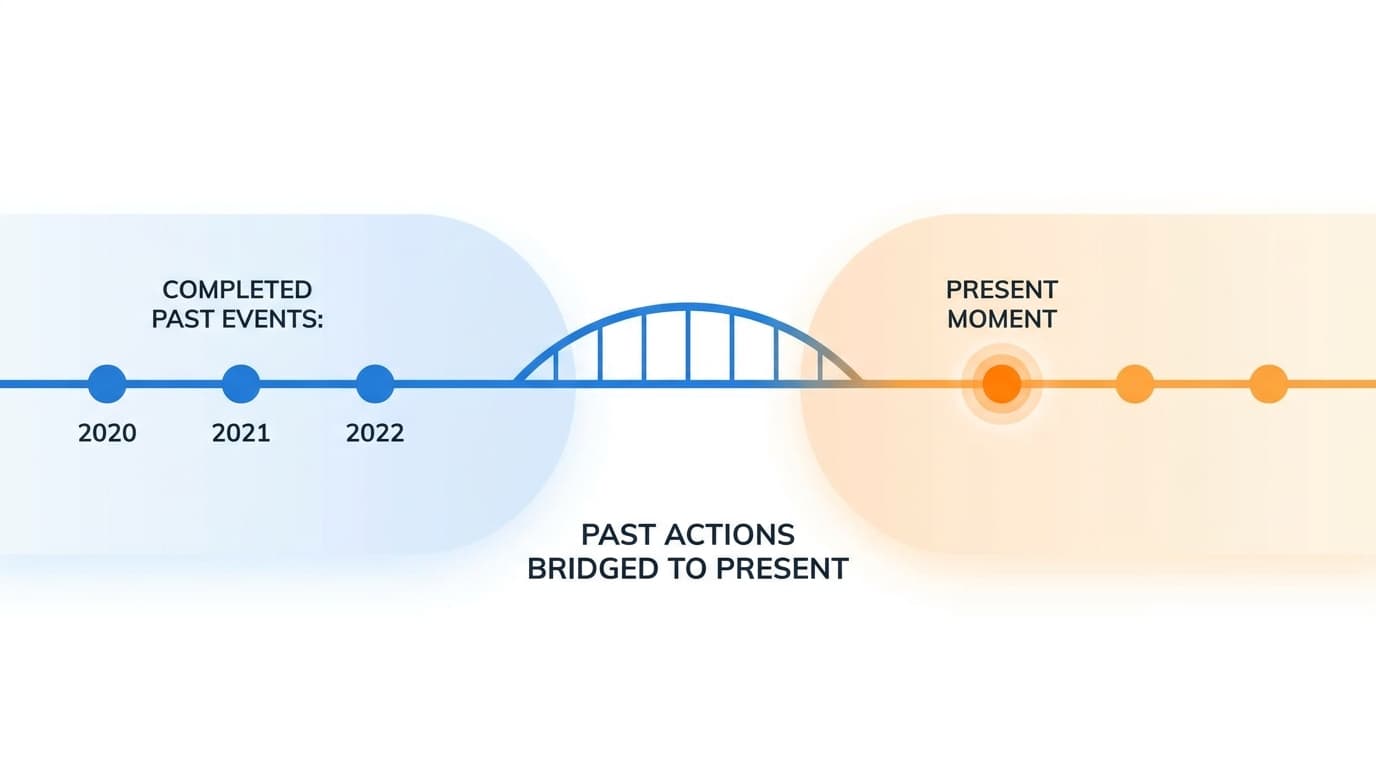
The choice between present perfect and simple past confuses many learners. Both tenses talk about the past, so why do we need two? The answer is that the present perfect is used to talk about time up to now, that is, events that took place in the past but which connect with the present , while the simple past describes finished actions with no present connection. The distinction matters for clear, natural English.
The core difference: connection to now
Think of the present perfect as a bridge between past and present. The present perfect is used to indicate a link between the present and the past. The time of the action is before now but not specified, and we are often more interested in the result than in the action itself .
The simple past, on the other hand, treats the past as closed. Use the simple past when the action started in the past, finished in the past, and is not continuing now .
Compare:
✓ I've lost my keys. (I don't have them now — the result is present.)
✓ I lost my keys yesterday. (The time is specified; this is simply a past event.)
Specified time: the big rule
You must always use the present perfect when the time of an action is not important or not specified. You must always use the simple past when details about the time or place that an action occured are given or requested .
This is the clearest signal. If you mention when something happened with a finished time expression (that is, a time period that is over), use the simple past:
- yesterday
- last week, last year
- in 2019
- two days ago
- when I was a child
✗ I have seen her yesterday.
✓ I saw her yesterday.
Last year means the year before now, and it is considered a specific time which requires simple past .
But if the time period includes now or is not mentioned, use the present perfect:
- today
- this week, this year
- recently
- ever, never, before
✓ I've seen three clients today. (Today hasn't finished yet.)
✓ I've been to France. (The time isn't mentioned because it doesn't matter.)
Unfinished time periods
We use the present perfect tense to talk about periods of time that have not finished such as today, this week, this month. Today has not finished. This week has not finished. This month has not finished. This year has not finished .
This leads to interesting contrasts:
✓ I've seen Jack this morning. (It's still morning.)
✓ I saw Jack this morning. (It's now afternoon or evening — the morning is finished.)
✓ Meg has run two marathons this year. (The year is not over; she may run more.)
✓ Meg ran two marathons last year. (That year is finished.)
The mental question to ask yourself is: Is this time period still open, or is it closed?
Life experience (no specific time)
We use the present perfect to talk about past experiences when we don't say or we don't know when something happened .
✓ I've visited Tokyo three times.
✓ She's never eaten sushi.
✓ Have you ever read this book?
The idea is: "at some point in my life up to now." The exact moment doesn't matter. We use the present perfect simple to talk about our experiences up to now. The time of the experiences is not important .
But as soon as you add when or continue the conversation with details, switch to the simple past:
A: I've been to the cinema.
B: What did you see?
A: I saw a very good film by Tarantino.
We use the present perfect to introduce a past event or experience, but if we continue talking and we give details, then we use the past simple .
Recent actions with a present result
We use the present perfect simple when a single past action has a connection with the present: She's broken her arm in two places. (Her arm is still broken now.)
Other examples:
✓ I've hurt my leg, so I can't walk. (The injury affects me now.)
✓ They haven't called me, so I don't think they need me. (The lack of a call is relevant now.)
The simple past would simply report the event without emphasizing the present result:
✓ I hurt my leg last week. (Reporting the event; the present effect is not the focus.)
Duration: for and since
Using the present perfect, we can define a period of time before now by considering its duration, with for + a period of time, or by considering its starting point, with since + a point in time .
Use for + length of time:
- for three years
- for a few hours
- for ages
Use since + starting point:
- since 2020
- since Monday
- since I was a child
✓ I've lived here for ten years. (I still live here.)
✓ I've known her since high school. (I still know her.)
If you use for with the simple past, it signals the action is finished:
✓ I lived in Paris for a year. (I don't live there anymore.)
✓ She worked at that company for five years. (She no longer works there.)
SINCE can only be used with perfect tenses , so you cannot say I know her since 2015. You must say I've known her since 2015.
Common adverbs: just, already, yet
In British English, we use the present perfect with just, already and yet to talk about recent events and actions .
just (very recent action)
Just used with the present perfect means 'a short time before' .
✓ She's just left. (She left moments ago.)
✓ I've just finished my homework. (I finished it very recently.)
already (sooner than expected)
We use already in positive sentences to talk about actions and events that happened before now or earlier than expected .
✓ I've already done my homework. (It's done, perhaps earlier than you thought.)
✓ He's already read that book. (Before you recommended it, or before you expected.)
yet (in negatives and questions)
We use yet in questions and negative sentences to talk about actions and events happening up to now .
✓ I haven't finished yet. (Up to this moment, it's not done.)
✓ Have you eaten yet? (Has it happened at any time up to now?)
British vs. American English: a note
American English allows more variation than British English in these conditions. It's not at all unusual for Americans to use the simple past in such cases .
For example, Americans commonly say things like 'I didn't eat yet' whereas (as a well-informed British friend of ours confirms) that's 'borderline ungrammatical' in BE. British usage would much more consistently require: Have you eaten yet?
Similarly, in British English, the words just, yet and already are often used with the present perfect tense. In American English, these words are also used with the past simple tense .
If you're learning British English, follow the stricter rules. If you're learning American English, know that both forms are often acceptable in informal speech, though the present perfect is still correct and more formal.
A decision tree
When you're choosing between the two tenses, ask yourself these questions in order:
-
Did I mention when it happened with a finished time word (yesterday, last year, in 2015, three days ago)?
→ Use simple past. -
Am I talking about a time period that includes now (today, this week, this year)?
→ Use present perfect. -
Am I emphasizing the present result or relevance of a past action?
→ Use present perfect. -
Am I describing an experience without saying when (Have you ever...? I've never...)?
→ Use present perfect. -
Am I saying how long something has lasted up to now (with for or since)?
→ Use present perfect.
If none of these apply and you're simply reporting a completed past event, use the simple past.
Common mistakes
✗ I have visited Rome last summer.
✓ I visited Rome last summer. (Specific finished time.)
✗ I know him since 2018.
✓ I've known him since 2018. (Since requires present perfect.)
✗ She has finished already her work.
✓ She has already finished her work. (Already goes between have/has and the past participle.)
✗ Did you finish yet? (British English)
✓ Have you finished yet?
(Though the first is acceptable in American English.)
✗ I've seen her yesterday.
✓ I saw her yesterday. (Finished time word.)
Practice thinking
The distinction becomes automatic with use, but here's a way to build your intuition: every time you're about to talk about the past, pause and ask, "Am I connecting this to now, or am I just reporting a finished event?" If there's a connection — a result, an experience that defines you now, a state that continues — reach for the present perfect. If it's simply "this thing happened at that time," use the simple past.
Language isn't about rules alone; it's about meaning. The present perfect keeps one foot in the present. The simple past lets the past stay in the past.
Share
Test yourself
Which sentence is correct?
Sources
- Past simple or present perfect? - Cambridge Grammar
- Present perfect simple (I have worked) - Cambridge Grammar
- Past simple or present perfect? - Test-English
- Present Perfect and Simple Past Verb Tenses - Britannica Dictionary
- Present perfect or past simple? - Cambridge Dictionary Blog
- The Present Perfect in British and American English - Cambridge English
- Present perfect simple with just, already and yet - Oxford Learner's Dictionaries
- Present perfect with for and since - EF
Related articles
The Present Perfect: Connecting Past and Present
Learn how to form and use the present perfect tense in English, understand when to choose it over the past simple, and master common time expressions like 'ever,' 'never,' 'already,' and 'yet.'

Possessive Pronouns: Mine, Yours, and the Rest
Possessive pronouns replace nouns to show ownership without repeating the noun itself. Learn the difference between mine and my, when to use whose, and how to avoid common mistakes.

Tag Questions: How to Use Them Correctly
Tag questions are short questions added to the end of statements to check information or ask for agreement. Learn how to form them correctly and use the right intonation.