Present Simple and Present Simple Negative
- present simple
- tenses
- negatives
- grammar
What is the present simple?
The present simple is one of several forms of present tense in English. It is used to describe habits, unchanging situations, general truths, and fixed arrangements. This tense is one of the first you will learn, and you will use it every day when you speak or write in English.
We use the present simple when something is generally or always true. For example:
People need food.
The sun rises in the east.
We also use this tense for a situation that we think is more or less permanent. That means the situation does not have a planned end right now, even if it might change in the future one day:
I work in a bank.
She lives in Tokyo.
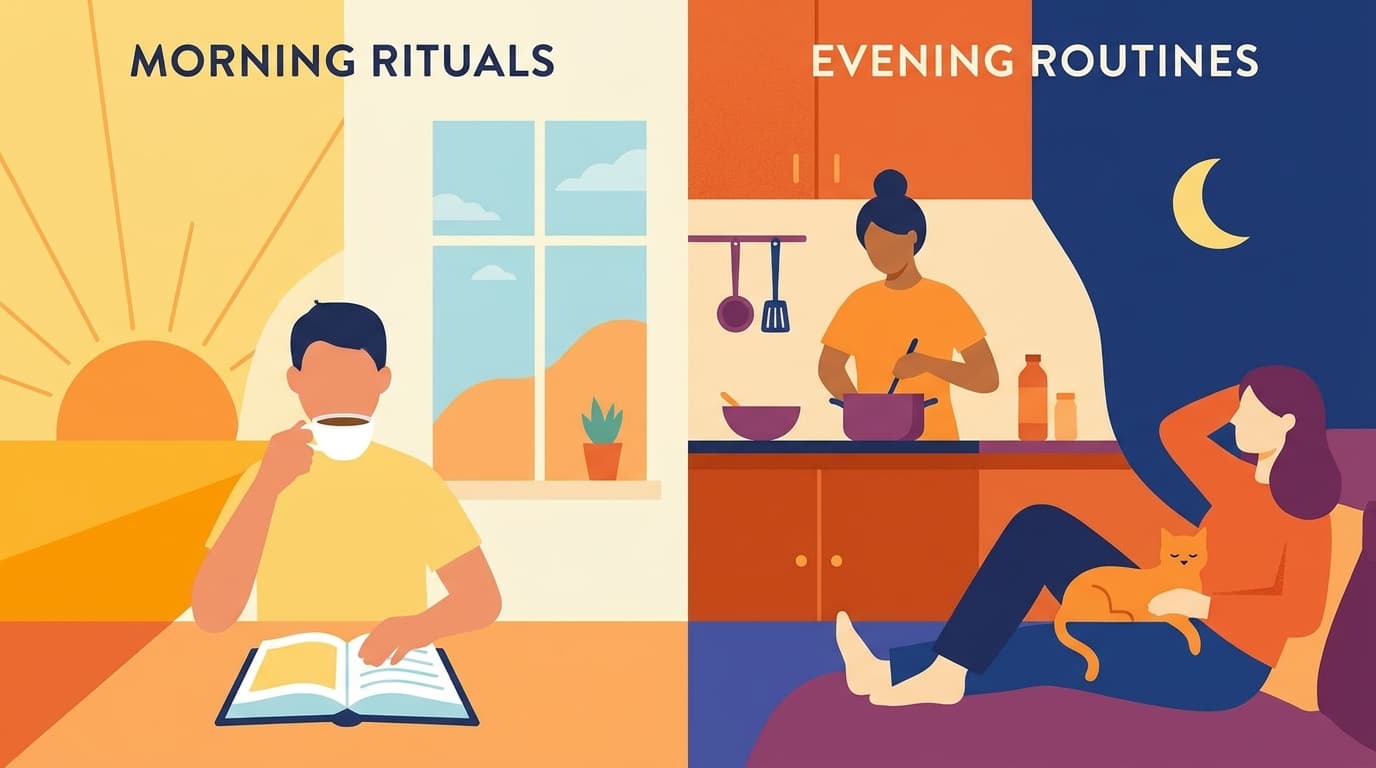
Finally, the present simple is for habits or things that we do regularly. We often use adverbs of frequency (such as 'often', 'always' and 'sometimes') in this case, as well as expressions like 'every Sunday' or 'twice a month'.
I drink coffee every morning.
He plays tennis on Saturdays.
How to form the present simple (positive sentences)
The present simple is simple to form. Just use the base form of the verb: (I take, you take, we take, they take). The third-person singular takes an -s at the end (he takes, she takes).
Here is the basic pattern:
Subject + verb (base form or +s/es for he/she/it)
Examples:
- I live in London.
- You work hard.
- We study English.
- They play football.
But notice what happens with he, she, and it:
- He lives in London.
- She works hard.
- It rains a lot here.
Spelling rules for third-person singular
Add -es instead of -s if the base form ends in -s, -z, -x, -sh, -ch, or the vowel o (but not -oo).
| Base verb | Third person (he/she/it) | Example |
|---|---|---|
| pass | passes | She passes the test. |
| wash | washes | He washes the car. |
| watch | watches | She watches TV. |
| go | goes | He goes to school. |
| do | does | It does the job. |
If a verb ends in y, and the letter before the y is a consonant, we change the y to i and add -es.
| Base verb | Third person (he/she/it) | Example |
|---|---|---|
| study | studies | She studies at night. |
| try | tries | He tries hard. |
| fly | flies | The bird flies. |
Do not change the -y when the base form ends in a vowel + y. Add -s.
| Base verb | Third person (he/she/it) | Example |
|---|---|---|
| play | plays | He plays guitar. |
| enjoy | enjoys | She enjoys music. |
| say | says | He says hello. |
How to form the present simple negative
To make a negative sentence in the present simple, we form negative statements with not or n't after be, modal and auxiliary verbs. n't is the contracted form of not.
For most verbs (that is, all verbs except "be"), we use not or n't to form negative questions. When there is no modal verb or be, we use auxiliary verb do + n't (don't, do not, doesn't, does not, didn't).
The structure is simple:
Subject + do not / does not + base verb
Or, more commonly in speaking and informal writing:
Subject + don't / doesn't + base verb
When to use don't and doesn't
We use don't when the subject is I, you, we or they.
When the subject is he, she or it, we add doesn't between the subject and the verb to make a negative sentence.
| Subject | Auxiliary | Base verb | Example |
|---|---|---|---|
| I / you / we / they | don't | like | I don't like cold weather. |
| he / she / it | doesn't | like | She doesn't like cold weather. |
Important: the verb returns to base form
Notice that the letter S at the end of the verb in the affirmative sentence (because it is in third person) disappears in the negative sentence.
✗ He doesn't likes coffee.
✓ He doesn't like coffee.
Because the verb after don't or doesn't is the base form of the infinitive. The auxiliary verb (does) already carries the third-person singular marker, so the main verb stays in its simple base form.
Here are more examples:
| Positive sentence | Negative sentence |
|---|---|
| He goes to the gym. | He doesn't go to the gym. |
| She works on Monday. | She doesn't work on Monday. |
| It rains in July. | It doesn't rain in July. |
| They speak French. | They don't speak French. |
Contractions: don't and doesn't
When creating negative sentences, we usually use shortened forms: don't, doesn't and didn't together with the base form of the verb. Note: Save the long forms (do not, does not and did not) for when you want to create emphasis.
In everyday English, you will hear:
I don't understand.
She doesn't speak Spanish.
In formal or emphatic speech, you might say:
I do not agree with that decision.
He does not live here anymore.
Common uses of the present simple
1. Habits and routines
We use the present simple to talk about regular or habitual events. We often use always, often, usually, sometimes, never and other frequency adverbs for regular and habitual events.
I drink coffee every morning.
She always arrives on time.
They never eat meat.
2. General truths and facts
We use the present simple to talk about general facts that are always true and permanent about the world.
Water boils at 100 degrees Celsius.
The Earth goes around the Sun.
Cats sleep a lot.
3. Permanent situations
We use the present simple to talk about general facts that we think are true and permanent at the present time.
My brother works in a bank.
They live in Paris.
I know her very well.
4. Timetables and schedules
We use the present simple to talk about the future when we are discussing a timetable or a fixed plan. Usually, the timetable is fixed by an organisation, not by us.
The train leaves at 6 p.m.
School starts at 9 a.m. tomorrow.
The concert begins at 8 o'clock.
Stative verbs and the present simple
Stative verbs describe a state rather than an action. They aren't usually used in the present continuous form. Because of this, we usually use stative verbs in the present simple even when we are talking about right now.
Common stative verbs include: thoughts and opinions (agree, believe, doubt, guess, imagine, know, mean, recognise, remember, suspect, think, understand), feelings and emotions (dislike, hate, like, love, prefer, want, wish), senses and perceptions (appear, be, feel, hear, look, see, seem, smell, taste), and possession and measurement (belong, have, measure, own, possess, weigh).
✗ I am knowing the answer.
✓ I know the answer.
✗ She is liking pizza.
✓ She likes pizza.
✗ They are having a car.
✓ They have a car.
A number of verbs can refer to states or actions, depending on the context. For example, "I think it's a good idea" (opinion, so present simple) vs. "Wait a moment! I'm thinking" (active mental process, so present continuous).
Common mistakes to avoid
Mistake 1: Forgetting the -s with he/she/it
One of the most frequent errors involves subject-verb agreement. Many learners forget to add the s or es to the verb when the subject is third-person singular (he, she, it).
✗ She walk to work every day.
✓ She walks to work every day.
✗ He play football on Sundays.
✓ He plays football on Sundays.
Mistake 2: Using doesn't with I/you/we/they
Use don't for I, you, we, or they. Use doesn't for he, she, or it.
✗ They doesn't like meat.
✓ They don't like meat.
✗ I doesn't understand.
✓ I don't understand.
Mistake 3: Adding -s after doesn't/don't
Creating negative sentences in the present simple tense requires the use of do not or does not. A common mistake is omitting do/does in negatives. Another error is keeping the -s on the main verb:
✗ He doesn't likes coffee.
✓ He doesn't like coffee.
✗ She doesn't speaks French.
✓ She doesn't speak French.
Mistake 4: Using present simple instead of present continuous for actions happening now
The present simple is not for actions happening at this exact moment. The simple present is not used to express actions happening now.
✗ I eat lunch right now. (if you mean you are eating at this moment)
✓ I am eating lunch right now.
But:
✓ I eat lunch at 1 p.m. every day. (habit)
Mistake 5: Confusing spelling rules for third-person singular
Pay attention to the spelling rules. Verbs ending in -o, -ch, -sh, -ss, -x, or -z take -es, not just -s.
✗ He gos to work by bus.
✓ He goes to work by bus.
✗ She teachs English.
✓ She teaches English.
And remember to change y to i before adding -es (when y follows a consonant):
✗ He studys every night.
✓ He studies every night.
Practice tip
The present simple is everywhere in English. You use it to introduce yourself, talk about your daily life, describe your job, your family, your likes and dislikes. To get comfortable with this tense, try these activities:
- Write five sentences about your daily routine using the present simple.
- Describe three facts about your country or city.
- Write three sentences about what you don't do (negatives).
- Find a text online (a news article, a blog post, a biography) and underline every present simple verb. Notice when and why the writer chose this tense.
The more you notice and use the present simple, the more automatic it will become.
Share
Test yourself
Which sentence is correct?
Sources
- Present simple ( I work ) - Cambridge Grammar
- Simple Present Tense | EF United States
- Simple Present Tense: How to Use It, With Examples | Grammarly
- Present Simple Use
- Present simple tense | EF Global Site (English)
- Forming negative statements, questions and imperatives - Cambridge Grammar
- Present simple ( I work ) - Cambridge Grammar
- Questions and negatives | LearnEnglish
- Don't vs Doesn't in English | English Grammar Lesson
- Don't and Doesn't in English – Simple Present Tense | Woodward English
- Third person singular -s | Britannica Dictionary
- Stative verbs | LearnEnglish
Related articles

Possessive Pronouns: Mine, Yours, and the Rest
Possessive pronouns replace nouns to show ownership without repeating the noun itself. Learn the difference between mine and my, when to use whose, and how to avoid common mistakes.

Tag Questions: How to Use Them Correctly
Tag questions are short questions added to the end of statements to check information or ask for agreement. Learn how to form them correctly and use the right intonation.
The Past Perfect: When to Use 'Had Done' in English
The past perfect shows which of two past actions happened first. Learn when you need it, when you don't, and how native speakers really use 'had done' in everyday English.