The History of Chocolate
- history
- food
- culture
- vocabulary
Ancient beginnings in the Americas
The cacao tree is native to the Amazon rainforest, and evidence of cacao domestication exists as early as 3300 BC in present-day southeast Ecuador by the Mayo-Chinchipe culture . This means people were using cacao—the plant from which chocolate comes—more than 5,000 years ago.
Later, the tree was introduced to Mesoamerica (the region that includes modern Mexico and Central America), where cacao drinks gained significance as an elite beverage among cultures including the Maya and the Aztecs .
A note about words
You will see two similar words when reading about chocolate: cacao and cocoa. The Spanish and other Europeans used the word "cacao," but it is believed the English "corrupted" the word into "cocoa" . The word "cocoa" is a corruption of "cacao" by influence of "coco" (the coconut palm). The confusion was already underway when the printers of Johnson's dictionary ran together the entries, and cocoa has been the regular spelling from around 1800 .
Today, both words refer to the same plant and its products. In this post, I will use "cacao" when talking about the ancient plant and beans, and "cocoa" when discussing the powder and modern products.
The word chocolate itself has an interesting origin. It is a Spanish loanword, first recorded in English in 1604. Despite uncertainty about its Nahuatl origin, there is some agreement that chocolate likely derives from the Nawat word "chikola:tl" , though the exact meaning is debated.
Chocolate in ancient Mesoamerican cultures
The Olmec: earliest chocolate makers
The Olmec of southern Mexico were probably the first to ferment, roast, and grind cacao beans for drinks and gruels, possibly as early as 1500 B.C.
According to scholars Sophie and Michael Coe, "kakawa" (cacao) was a term used by the ancient Olmec as early as 1000 BCE, and linguistic evidence suggests the Olmec might have been the first to domesticate the cacao tree and discover the process of making chocolate .
The Maya and their chocolate rituals
The earliest known use of chocolate was by the Olmec around 1900 BCE, and enjoyed as a drink, it was drunk from special round jars known as tecomates . Later, the Maya used tall cylinder beakers for drinking chocolate, and these very often had text on the rim indicating their intended use .
Unlike its modern form, ancient Mesoamerican chocolate was neither sweet nor solid. The bitter liquid form of chocolate was originally consumed as a beverage and remained unsweetened until it arrived in Spain .
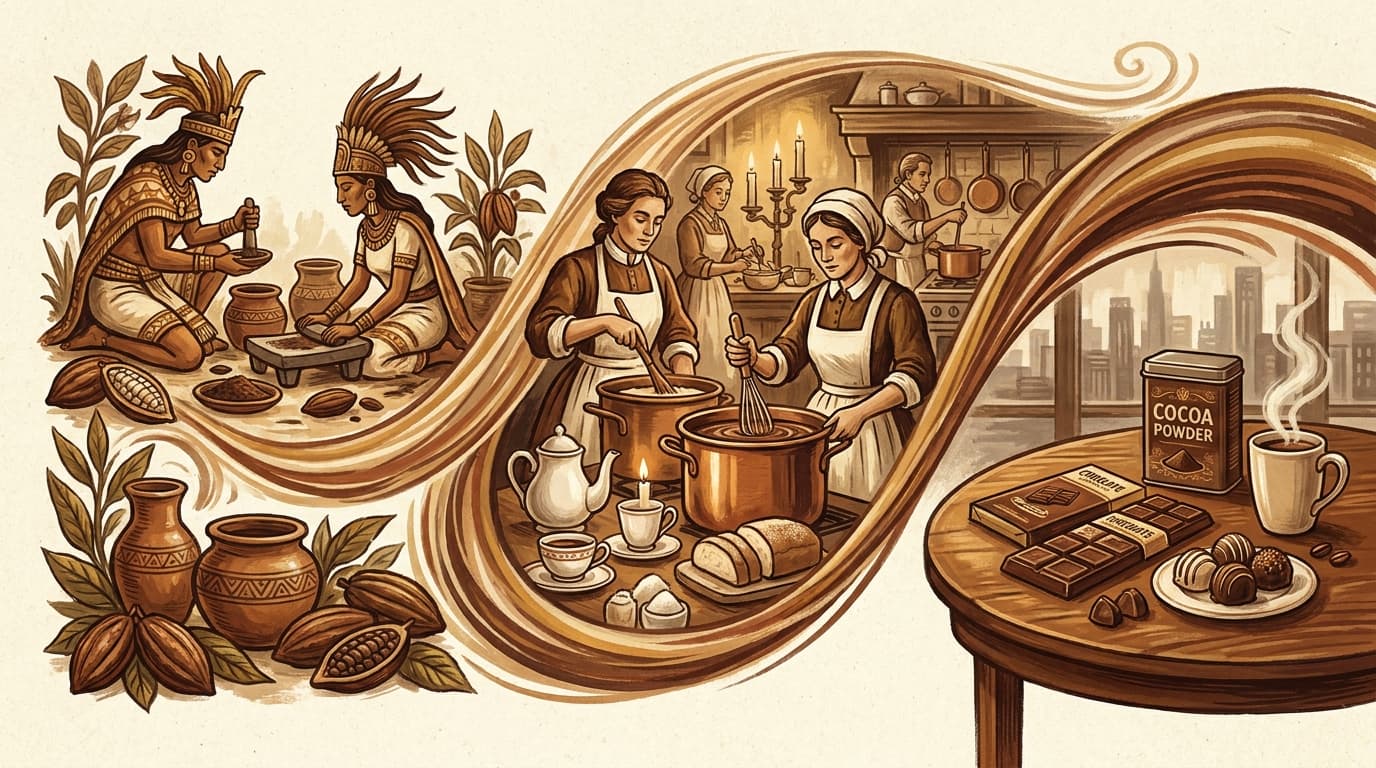
How did they prepare it? To prepare chocolate, cacao beans were fermented, cured, and roasted. Then the beans were ground into powder and mixed with hot water, as chocolate was usually consumed as a warm frothy drink. The froth was made by vigorously whisking the liquid with a wooden implement and pouring it from one vessel to another. Indeed, the froth was considered the best part of the drink. It could be flavored by adding maize, vanilla, flowers, ground chile peppers, herbs, honey, or fermented agave sap .
Flavorings added to chocolate included chili, vanilla, and cinnamon —a very different taste from the sweet milk chocolate we know today!
The Aztecs and cacao as currency
The Maya introduced chocolate to the Aztecs. Chocolate was one of the two most important drinks to the Aztecs , who valued it highly.
Cacao was considered a gift from the gods and was used as currency, medicine, and in ceremonies . So esteemed was chocolate that beans were a commonly traded item, very often demanded as tribute from subject tribes and even used as a form of currency by the Aztecs .
How much were things worth? In the Aztec markets, one cacao bean could buy you a single tomato, 30 beans got you a rabbit, and a turkey could be had for 200 beans . Cacao beans were so valuable that they were even counterfeited—either to pass as currency or, even more fiendishly, hollowed out and refilled with a substitute such as sand !
Cacao drinks in Mesoamerica became associated with high status and special occasions, like a fine French wine or a craft beer today. Special occasions might include initiation rites for young men or celebrations marking the end of the Maya calendar year .
Chocolate arrives in Europe
The Spanish encounter
Spanish conquistadors encountered cacao in 1519 and brought it to Spain, where it was used as a form of medicine . Spanish conquistador Hernán Cortés may have been the first European to encounter chocolate when he observed it in the court of Montezuma in 1519 .
At first, Europeans found the bitter drink strange. The chronicler Gonzalo Fernández de Oviedo complained that the lips appear stained with blood after drinking it. The Aztec often mixed it with chili, a flavor alien to the Spanish palate. Girolamo Benzoni wrote in his history of the New World: "Chocolate seemed more like a drink for pigs than something for human consumption" .
But attitudes changed. When Hernán Cortés returned to Spain from his bloody conquest of Mexico in 1521, he presented the Aztec drink made from cacao beans to King Charles V. Adjustments to the recipe were made, sugar was added, and chocolate soon became popular among the higher echelons of Spanish society. A new fad had been born .
The Spanish secret
The Spanish were the first ones who mixed the bitter cocoa with sugar, thus modifying a bitter Mayan drink into the delicious and sweet hot chocolate drink as we know today .
Spain kept the source of chocolate a secret for almost a century. In fact, in 1579, when English pirates boarded a Spanish galleon in search of gold and mistook cocoa beans for sheep's droppings, they burned the ship and its incredibly valuable cargo !
Spreading through Europe
From Spain, chocolate spread through Europe over the following three centuries, gaining popularity among elites . The rest of Europe, and especially France, soon fell under the spell of the cacao bean, thanks in great part to Anne of Austria, the daughter of Philip III of Spain. When she married Louis XIII of France in 1615, she brought with her the royal Spanish custom of drinking chocolate at breakfast time. Later, the wife of Louis XIV, Marie-Thérèse—another chocolate-loving Spanish princess—consolidated the supremacy of chocolate in the French court .
Chocolate arrived in England from France around 1657, around the same time as tea and coffee. Cocoa was supplied by Jamaican plantations after the British conquered the Spanish territory in 1655. Chocolate was served in coffee houses to whoever could pay, and by the end of the 17th century it was compulsory to include it in British Navy rations .
At the time, chocolate was very expensive in Europe because the cocoa beans only grew in South America. Sweet-tasting hot chocolate was then invented, leading hot chocolate to become a luxury item among the European nobility by the 17th century .
The Industrial Revolution transforms chocolate
For thousands of years, chocolate was only consumed as a drink. Everything changed in the 1800s with new inventions and machines.
Van Houten's cocoa press (1828)
A Dutch inventor named Coenraad van Houten created a machine for pressing the fat from cocoa beans. This allowed for the separation of cocoa solids and cocoa butter . This was crucial—it made cocoa powder that dissolved better in liquids, and it also made it possible to add cocoa butter back to create solid chocolate.
The first chocolate bar (1847)
In 1847, in Great Britain, the Fry brothers—Joseph, Richard, and Francis—discovered a way of producing a runny paste which could be poured into a mold, thus making the first bar of chocolate. Their process involved adding cocoa butter to the cocoa powder and sugar to refine the texture .
This was revolutionary! Before 1847, people only drank chocolate. After 1847, they could carry it in their pocket and eat it as a snack.
Milk chocolate (1875)
Milk chocolate was first created in 1875. It was the result of an unlikely partnership between Daniel Peter, a Swiss chocolatier, and his neighbor Henri Nestlé, a pharmacist . Daniel Peter combined milk powder with chocolate, creating the first milk chocolate bar in 1875 .
Milk chocolate was sweeter and creamier than dark chocolate, and it became extremely popular.
Conching makes chocolate smooth (1879)
The conche was invented in 1879 by Rodolphe Lindt. It is a machine that grinds cocoa particles extra small. The rapid mixing and grinding also distributes the cocoa butter evenly throughout the newly liquified chocolate, ensuring consistency of silky texture in the solid bar. Conching helps give chocolate its characteristic melt and snap and its creamy mouthfeel .
This is why modern chocolate melts smoothly on your tongue!
The age of chocolate companies
With these new technologies, chocolate became cheaper and more widely available. Large companies formed to produce chocolate for everyone, not just the rich.
Major companies emerge
The candies we know and love today were born shortly after these inventions: the Hershey Bar was launched in 1900, Cadbury's Dairy Milk bar in 1905, and Hershey's Kisses in 1907. During the 1920s, Hershey's Mr. Goodbar and Mars' Milky Way were introduced. Snickers, Three Musketeers, and M&Ms followed .
In 1970, facing growing competition from Mars, Inc.—which had gained market share with innovative advertising for products like Snickers and M&M's—Hershey launched its first consumer advertising campaign. This decision marked a strategic shift, reflecting the increasing importance of television and mass media in shaping consumer preferences during the 1970s .
Chocolate becomes affordable
As production moved from the Americas to Asia and Africa, mass markets in Western nations for chocolate opened up. By 1890, a worker could produce fifty times more chocolate with the same labor than they could before the Industrial Revolution, and chocolate became a food to be eaten rather than drunk .
Originally the elite drink of kings, chocolate's popularity never had to be manufactured, and in the West it has always readily matched its availability on the market. By the 20th century, chocolate was cheap and widely available, yet still wrapped in an aura of exclusiveness and illicit pleasure .
Chocolate today
Today, chocolate is one of the world's most popular foods. In the 21st century, cocoa beans for most chocolate are produced in West African countries, particularly Ivory Coast and Ghana, which contribute about 60% of the world's cocoa supply .
Single-origin chocolates were first created in 1984, starting the bean-to-bar, or craft chocolate movement . This movement focuses on high-quality chocolate made carefully from start to finish, similar to how wine lovers seek out special vineyards.
The journey of chocolate—from a sacred bitter drink in ancient Mesoamerica to the candy bar in your hand—spans more than 5,000 years and touches every continent. Next time you eat chocolate, you're tasting a food that emperors once drank, that fueled revolutions in technology, and that has delighted humans across cultures for millennia.
Vocabulary note: In this post, domesticate means to take a wild plant or animal and learn to grow or raise it for human use. Elite means the wealthy or powerful people in a society. Currency means money or anything used to buy and sell things. A conquistador was a Spanish soldier who conquered lands in the Americas. The Industrial Revolution was the period (roughly 1760–1840) when new machines and factories changed how things were made.
Share
Test yourself
Where was the cacao tree first domesticated?
Sources
- History of chocolate - Wikipedia
- The Mesoamerican origins of chocolate - Human Relations Area Files
- What We Know About the Earliest History of Chocolate - Smithsonian Magazine
- Chocolate in Mesoamerica - World History Encyclopedia
- Cacao & Chocolate - Mesoamerican Cultures and their Histories
- The secret history of chocolate - National Geographic Kids
- The History of Chocolate - Magnum Ice Cream
- Europe's colonial craze for chocolate - National Geographic
- Who REALLY first brought chocolate to Europe? - Cocoa Runners
- An Industrial History Of Chocolate - Cocoa Runners
- Chocolate - Wikipedia
- Cocoa - Etymology Online Dictionary
Related articles
History of Corn
Corn transformed from a wild grass in ancient Mexico into one of the world's most important crops through 9,000 years of human selection and cultivation.
The Ariel School UFO Incident: When 62 Children in Zimbabwe Saw Something Unexplained
In 1994, sixty-two children at a school in Zimbabwe reported seeing a silver craft land near their playground and beings emerge from it—a story that still divides believers and skeptics three decades later.
Bob Lazar and Area 51: The Story That Made a Secret Base Famous
In 1989, a man named Bob Lazar claimed he worked on alien spacecraft at a secret U.S. government base. His story made Area 51 world-famous, but investigations found serious problems with his claims.