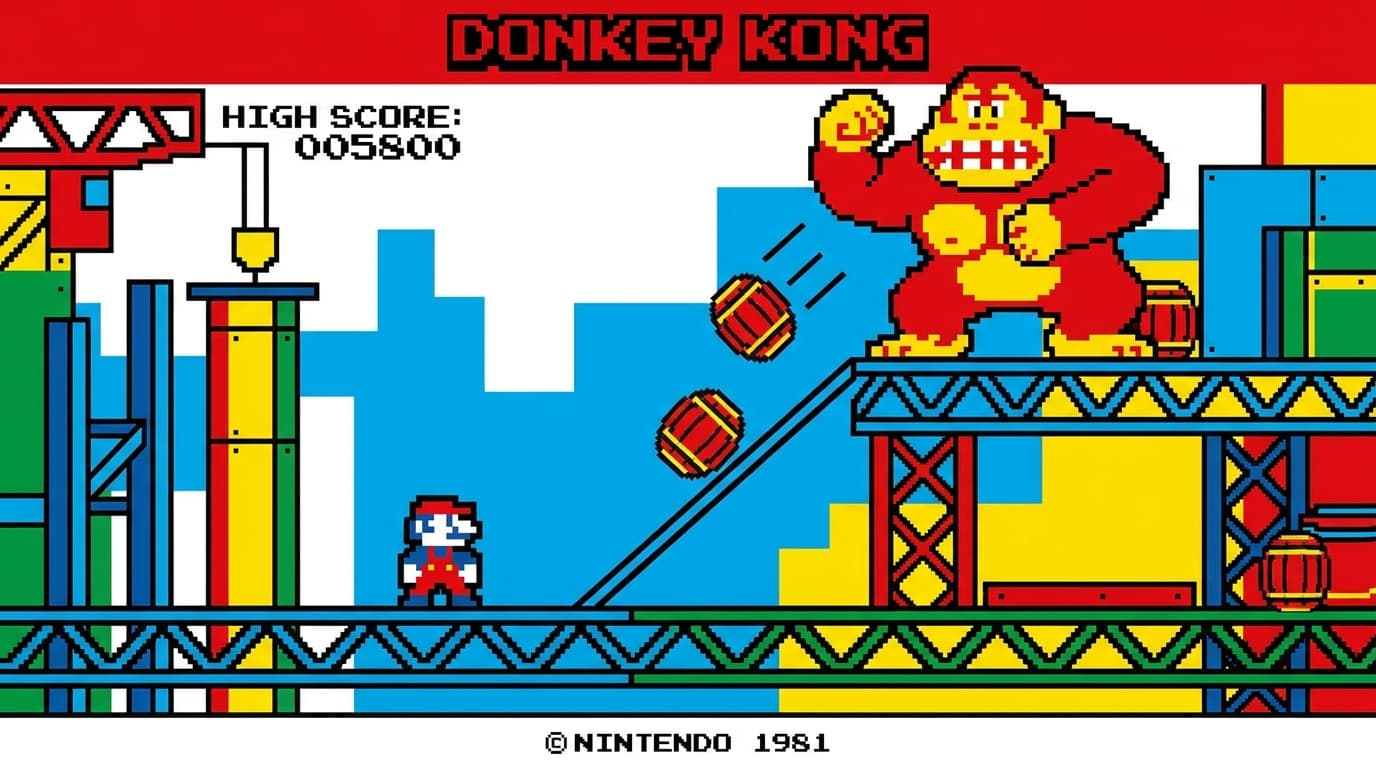
The History of the First Mario Game: Donkey Kong (1981)
- video-game-history
- Mario
- Nintendo
- arcade-games
The Beginning: Nintendo's Crisis and a Young Designer's Opportunity
Nintendo of America was founded in 1980 with minor success at importing arcade cabinets from Japan. In early 1981, its president Minoru Arakawa bet the small startup company on a major order of 3,000 Radar Scope games. This decision was a disaster. Radar Scope, a space-shooter game, failed to attract players in the American market. Donkey Kong was created to unsold arcade cabinets following the failure of Nintendo's Radar Scope (1980), and was designed for Nintendo of America's audience. Hiroshi Yamauchi, Nintendo's president at the time, assigned the project to first-time video game designer Shigeru Miyamoto.
Nintendo was in a desperate situation. The company needed to convert those thousands of unsold cabinets into something profitable, and fast. A young man in his mid-twenties would change everything.
Who Was Shigeru Miyamoto?
Shigeru Miyamoto is a Japanese video game designer, producer and game director at Nintendo. He joined Nintendo in 1977 after impressing the president, Hiroshi Yamauchi, with his toys. Miyamoto was not a programmer or engineer. He is a Japanese video game designer, producer, artist, and game director at Nintendo, best known for being the creator of the Super Mario, Donkey Kong, The Legend of Zelda, Star Fox, and Pikmin franchises. He joined the industry as a character artist and product designer in 1977.
When Yamauchi asked the young designer if he could create an arcade game, Miyamoto had no programming experience. Instead, he approached the problem from an artist's perspective. As he lacked programming , Miyamoto consulted technicians on whether his ideas were possible. Four programmers from Ikegami Tsushinki spent three months turning Miyamoto's design into a finished game.
The Birth of Mario (as Jumpman)
Shigeru Miyamoto created Mario while developing Donkey Kong in an attempt to produce Nintendo's first blockbuster video game; previous games, such as Sheriff, had not achieved the success of games such as Namco's Pac-Man. Originally, Miyamoto wanted to create a game that used the 1930s characters Popeye, Bluto, and Olive Oyl. At the time, however, because Nintendo was unable to acquire a license to use the characters (and did not until 1982 with Popeye), he ended up creating an unnamed player character, along with Donkey Kong and Lady (later renamed Pauline).
The character's appearance was shaped by harsh reality. The of arcade hardware influenced Mario's design, such as his nose, mustache, and overalls, and he was named after Nintendo of America's landlord, Mario Segale. In the early days of pixel art, designers had to make every visual choice count. The original Mario was a 16 x 16 pixelated image. This technical restriction brought about some of his features: for example, he was given white gloves to make his movements easier to spot when he jumped.
The character had several names before settling on Mario. Mario was first called "Ossan" by the development team behind the original Donkey Kong. Although he was unnamed in the Japanese launch release of Donkey Kong, he was named "Jumpman" in the English instructions and "little Mario" in the sales brochure.
The Game's Revolutionary Design
Donkey Kong is a 1981 platform game developed and published by Nintendo for arcades. As Mario (occasionally referred to as "Jumpman" at the time), the player runs and jumps on platforms and climbs ladders to ascend a construction site in New York City and rescue Pauline (occasionally referred to as "The Lady" at the time) from the giant gorilla Donkey Kong.
One of the most important decisions Miyamoto made was introducing jumping as the main action. In early development of Donkey Kong, Mario was drawn using pixel dots in a 16x16 grid. The focus of the game was to escape a maze, and Mario could not jump. However, Miyamoto soon introduced jumping capabilities for the player character, reasoning that "If you had a barrel rolling towards you, what would you do?"
This simple question led to one of gaming's most mechanics. With four unique stages, Donkey Kong was the most complex arcade game of the time, and one of the first arcade games with multiple stages, following games such as 1980's Phoenix and 1981's Gorf and Scramble.
Narrative and Presentation: Breaking New Ground
The game opens with the gorilla climbing a pair of ladders to the top of a construction site, accompanied by a variation on the musical theme from Dragnet. This sequence sets the scene and adds background to the gameplay—a first for video games. Before Donkey Kong, most arcade games simply repeated the same action with increasing difficulty. Miyamoto something different: Whereas previous platform games focused on climbing, Miyamoto placed an emphasis on jumping to avoid obstacles and cross gaps. He envisioned something akin to a playable comic strip that unfolded across multiple levels with unique scenarios. This was uncommon in contemporary arcade games, which typically featured a single scenario that repeated.
From Arcade Cabinets to Massive Success
The game officially went on sale in July 1981.
Around 132,000 arcade machines were sold in Japan and North America, making it one of the most successful arcade games during the golden age of arcade video games. The financial impact was . It was by far the most profitable game Nintendo had produced up till then and would not be surpassed until Super Mario Bros. One year from September 30, 1981, the sales of Nintendo of America went from $4.7 million to $111 million. Net revenues jumped from $64,000 to $22 million.
The Game That Changed Everything
Computer and Video Games called Donkey Kong "the most " release of 1981, as it "introduced three important names" to the global video game industry: Nintendo, Shigeru Miyamoto, and Mario. These three figures went on to play a significant role in video game history.
The impact extended far beyond arcade machines. Donkey Kong the NES, known as the Famicom in Japan. Following the success of Donkey Kong, Nintendo began developing the Famicom, the hardware of which was largely based on the Donkey Kong arcade hardware, with the goal of matching the system's powerful sprite capabilities in a home system.
Today, Mario is widely considered the most famous video game character in history. He has appeared in hundreds of games across multiple genres and platforms. But it all began in 1981 when a talented artist named Shigeru Miyamoto was asked to save Nintendo by turning unsold arcade cabinets into something new. The result was a game that introduced jumping to gaming, told a story without words, and created a character who would become a global icon. The first Mario game was not just a commercial success—it fundamentally changed what video games could be.
Share
Test yourself
In what year did the first Mario game, Donkey Kong, first appear in arcades?
Sources
Related articles

Understanding Spirituality in 2026: A Guide to Modern Beliefs and Practices
Spirituality in 2026 is shifting toward personal, flexible practices that blend technology with timeless traditions. Young people are choosing individual spiritual paths over formal religion while seeking meaning and connection.

How to Manage Risk for the Everyday Man
Learn practical strategies to identify, understand, and manage the financial and life risks that affect your family and future, from emergency savings to insurance and smart budgeting.

The Best Natural Sources of Carbohydrates for Your Health
Discover which natural carbohydrate sources provide the most nutrients and health benefits, from whole grains and legumes to starchy vegetables and fruits.