Who Are The Greys?
- culture
- vocabulary
- popular-culture
- idioms
What Does "The Greys" Mean?
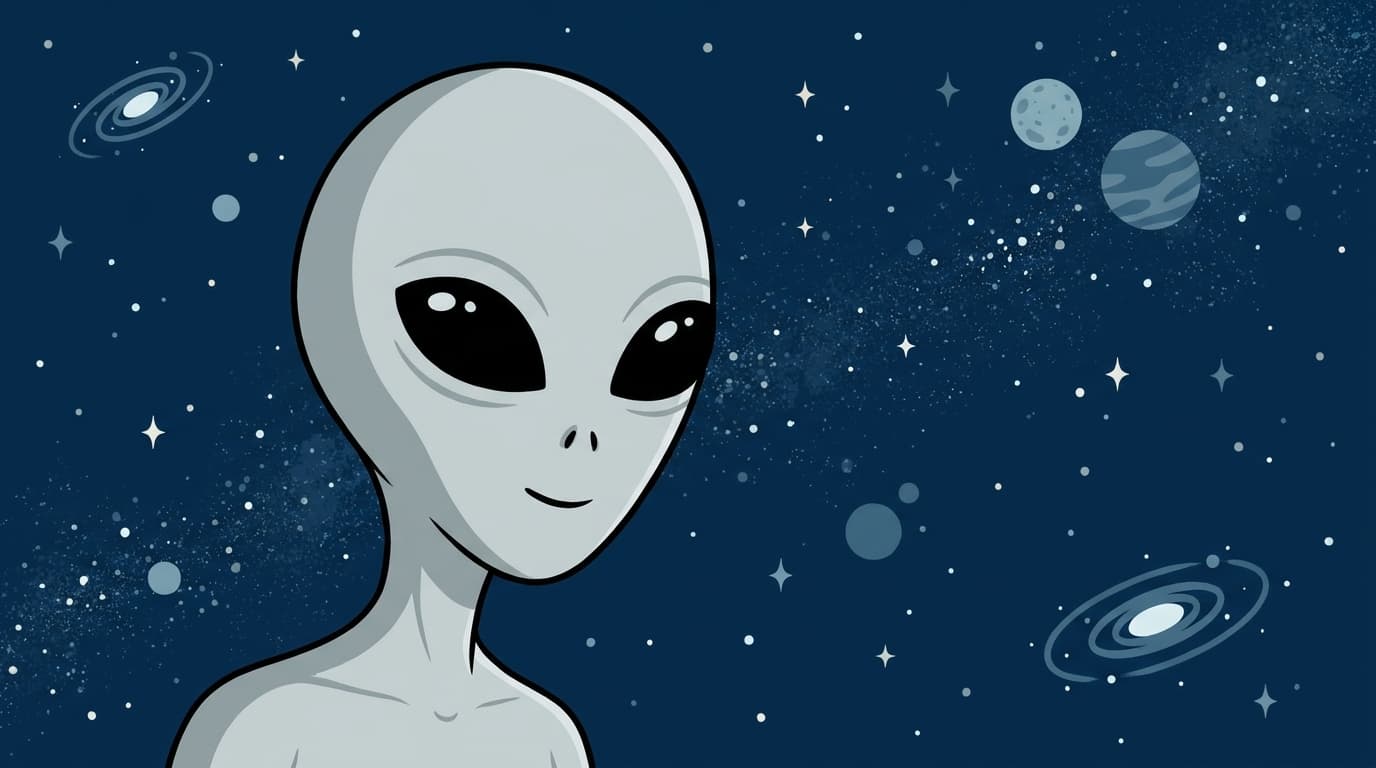
If someone asks you to picture an alien—a being from another planet—you probably imagine a small creature with grey skin, a large head, and huge black eyes. This image is so common that it appears in movies, television shows, books, and even jokes. These beings are called The Greys (or sometimes the Grays in American spelling).
The Grey alien is an archetypal image (that is, a standard example) of an intelligent non-human creature and extraterrestrial life in general, as well as an iconic trope of popular culture . The term uses a capital letter—The Greys—because it functions as a proper noun. It names a specific category of beings in UFO folklore and popular culture, not just anything that is grey in color.
In this post, we will explore where this image came from, why it became so famous, and what it tells us about language, culture, and the human imagination.
The Physical Description
Greys are typically depicted as grey-skinned, diminutive humanoid beings that possess reduced forms of, or completely lack, external human body parts such as noses, ears, or sex organs. Greys are depicted as having unusually large heads in proportion to their bodies, and as having no hair, no noticeable outer ears or noses, and small orifices for ears, nostrils, and mouths. In drawings, Greys are almost always shown with very large, opaque, black eyes, without eye whites.
Here is a breakdown of the typical Grey alien features:
-
Height: typically between 3 and 5 feet tall
-
Skin: smooth, hairless, varying shades of grey
-
Head: very large compared to the body
-
Eyes: oversized, almond-shaped black eyes that are often described as lacking pupils or irises and appearing to be more like lenses
-
Body: thin limbs, giving them a somewhat frail appearance
-
Facial features: minimal nose, small mouth, no visible ears
The word diminutive means very small. The word orifice means a natural opening or hole. When we say something is opaque, we mean you cannot see through it.
Where Did The Greys Come From?
Early Science Fiction Roots
The Grey alien did not appear suddenly. In literature, descriptions of beings similar to Grey aliens predate claims of supposed encounters with them. In 1893, H. G. Wells presented a description of humanity's future appearance in the article "The Man of the Year Million", describing humans as having no mouths, noses, or hair, and with large heads. In 1895, Wells also depicted the Eloi, a successor species to humanity, in similar terms in the novel The Time Machine.
Even earlier, in 1933, the Swedish novelist Gustav Sandgren, using the pen name Gabriel Linde, published a science fiction novel called Den okända faran (The Unknown Danger), in which he describes a race of extraterrestrials who wore clothes made of soft grey fabric and were short, with big bald heads, and large, dark, gleaming eyes. This description would become the template upon which the popular image of grey aliens is based.
The word predate means to come before something else in time. A template is a pattern or model that other things are based on.
The Betty and Barney Hill Incident (1961)
The 1961 Barney and Betty Hill abduction claim was key to the popularization of Grey aliens. The conception remained a niche one until 1965, when newspaper reports of the Betty and Barney Hill abduction made the archetype famous.
Barney and Betty Hill were an American couple and civil rights activists who claimed they were abducted by extraterrestrials in a rural portion of the state of New Hampshire from September 19 to 20, 1961. They were driving home from a vacation when they saw a strange light in the sky that seemed to follow them. Behind the windows of the object were beings in grey uniforms , and the couple later experienced missing time—they could not remember what happened during a two-hour period.
About a year after their abduction, Betty and Barney sought hypnosis therapy to help reveal to them the events of the two missing hours. Through many hypnosis sessions, both were able to recall what had happened and both had similar stories.
The word niche means specialized or appealing to a small group. Rural means relating to the countryside, not cities.
The Influence of Television
Something interesting happened just before Barney Hill described the aliens under hypnosis. Martin Kottmeyer suggested that Barney's memories revealed under hypnosis might have been influenced by an episode of the science-fiction television show The Outer Limits titled "The Bellero Shield", which was broadcast 12 days before Barney's first hypnotic session. Barney first described and drew the wraparound eyes during the hypnosis session dated 22 February 1964. "The Bellero Shield" was first broadcast on 10 February 1964. Only twelve days separate the two instances.
This suggests that what people see in popular culture can influence what they remember—or think they remember—about unusual experiences.
Hollywood Solidifies the Image
By the late 1970s, science fiction and Hollywood helped standardize the Grey alien look. Steven Spielberg's blockbuster Close Encounters of the Third Kind (1977) showcased small, spindly aliens with big eyes and heads — softened for a benevolent, otherworldly effect. The movie became a cultural phenomenon, and soon after, UFO reports of "grey aliens" soared.
The word benevolent means kind and helpful, while otherworldly means seeming to belong to another world.
The Communion Book Cover (1987)
In 1987, Whitley Strieber released Communion, a book about his alleged alien encounters. Its haunting cover featured a single large-eyed, greyish face, arguably one of the most iconic "alien" images ever published. This eye-catching art appeared in bookstores nationwide, emblazoning the classic Grey alien visage in the minds of millions.
Strieber stated that he was abducted from his cabin in upstate New York on the evening of December 26, 1985, by non-human sentient beings. He wrote about this experience in Communion, his first non-fiction book. Although the book was perceived generally as an account of alien abduction, Strieber drew no conclusions about the identity of the alleged abductors. He referred to the beings as "the visitors", a name chosen to be as neutral as possible.
The word iconic means widely recognized and well-established. To emblazon means to display something in a very noticeable way. A visage is a person's face (a formal or literary word).
The 1990s: Peak Grey Culture
From the 1990s on, TV shows like The X-Files amplified the Grey alien archetype, weaving government conspiracies and abductions into prime-time entertainment.
The X-Files, which first aired in 1993, combined the quest to find proof of the existence of Grey-like extraterrestrials with a number of UFO conspiracy theory subplots, to form its primary story arc.
An archetype is an original model or typical example that others copy. A conspiracy theory is a belief that some secret group is responsible for an event or situation.
How Common Are Grey Reports?
Among reports of alien encounters, Greys make up about 50% in Australia, 73% in the United States, 48% in continental Europe, and around 12% in the United Kingdom.
This variation is interesting. Why would Americans report Greys much more often than people in the United Kingdom? The ubiquity of Greys in pop culture created a feedback loop: people who believed they'd been abducted often reported Greys because that's what they'd seen on TV or read in books. Researchers like Susan Clancy argued that cultural scripts — reinforced by Hollywood — shaped personal experiences, not the other way around.
The word ubiquity means being present everywhere. A feedback loop is a situation where the result of a process influences the process itself, creating a cycle.
Cultural and Psychological Explanations
Scientists and psychologists offer several theories about why the Grey alien form holds such power over our imagination:
Evolutionary symbolism: The big head, big eyes, and tiny body echo our subconscious notion of future human evolution — where intelligence (the brain) expands at the expense of other features.
Folklore continuation: The Greys continue the old tradition of "night visitors" who abduct humans, echoing medieval beliefs about fairies or demons. We've simply updated the lore to match a spacefaring society.
Sleep paralysis: Sleep paralysis, a well-documented neurological phenomenon where individuals experience temporary paralysis while falling asleep or waking, often accompanied by hallucinations and sense of a presence, shares remarkable similarities with many reported abduction experiences.
Infant perception hypothesis: Psychologist Frederick V. Malmstrom proposed the "Mother Hypothesis," suggesting that the Grey alien image derives from how infants perceive their caregivers—large heads, oversized eyes, and indistinct features seen through undeveloped newborn vision. This theory posits that abduction experiences may activate these early perceptual templates stored in our subconscious.
The word subconscious refers to thoughts and feelings that exist in your mind but that you are not aware of. Medieval means relating to the Middle Ages (roughly 500–1500 CE). Something neurological relates to the nervous system and the brain.
Using "The Greys" in English
When you write or speak about these beings, notice the grammar:
✓ "The Greys are the most common type of alien in American popular culture."
✓ "A Grey appeared in the movie."
✓ "Have you seen any Greys?"
✗ "The grey are everywhere." (needs capital letter and plural form when talking about the beings)
✗ "I saw a greys." (use "Grey" for singular)
The term can be both countable and uncountable depending on context:
- Countable: "three Greys," "many Greys"
- Used as a group name: "The Greys have become an iconic image"
You might also hear related vocabulary:
- UFO (Unidentified Flying Object): a flying saucer or strange craft in the sky
- Abduction: kidnapping, taking someone against their will
- Ufology: the study of UFOs and related phenomena
- Encounter: a meeting, especially an unexpected one
- Extraterrestrial: coming from outside Earth (extra = beyond, terrestrial = relating to Earth)
Why This Matters for Language Learners
Understanding The Greys helps you engage with a huge portion of English-language popular culture. These beings appear in:
- Movies: Close Encounters of the Third Kind, Independence Day, Men in Black, Paul
- TV shows: The X-Files, American Dad!, South Park, Resident Alien
- Video games: XCOM, Destroy All Humans!
- Books, comics, and internet humor
When native speakers make jokes about "being probed by aliens" or say something looks like "a Grey," they are referencing this shared cultural knowledge. Now you have that knowledge too.
The Bigger Picture
The "meaning" behind The Greys isn't necessarily about their literal existence, but rather about what they represent to us as individuals and as a society. They are a mirror reflecting our anxieties, our hopes, and our endless fascination with the unknown.
Whether The Greys are real extraterrestrials, products of human imagination, cultural symbols, or something else entirely, they have become a permanent part of how English speakers think about aliens and the possibility of life beyond Earth. They represent our questions about who we are, where we came from, and whether we are alone in the universe.
For language learners, understanding The Greys is more than learning vocabulary—it is understanding how a culture creates and shares stories about the unknown.
Share
Test yourself
According to reports, what is the most distinctive feature of Grey aliens?
Sources
Related articles
The History of Chocolate
Discover how chocolate traveled from ancient Mesoamerican ceremonies to the modern candy bar, transforming from a bitter sacred drink into the sweet treat loved worldwide today.

What is Earth Day?
Earth Day is an annual event on April 22 when people around the world take action to protect our planet. Learn about its history, why we celebrate it, and how you can participate.
Who Were the Majestic 12?
The Majestic 12 is a supposed secret government committee created to manage contact with extraterrestrials, but historians and experts agree it was a hoax based on fake documents from the 1980s.