Alpha Centauri: Our Closest Neighbor in the Stars
- astronomy
- stars
- space
- science
What Is Alpha Centauri?
Alpha Centauri is a star system located just over four light years, or about 25 trillion miles, from Earth. This makes it the closest star system to our sun , even though it lies far beyond our Solar System.
The name "Alpha Centauri" comes from the Centaurus, in which this system is located. Centaurus belongs to the constellation Centaurus, named after the part human, part horse creature in Greek mythology; Heracles accidentally wounded the centaur and placed him in the sky after his death.
Understanding Light-Years
Before exploring Alpha Centauri in detail, it helps to understand what a means. A light-year is the distance that light travels in in one Julian year (365.25 days). Despite its name, the term is not a unit of time. Instead, one light year is exactly 9460730472580.8 km (approximately 9.46 trillion kilometers or 5.88 trillion miles).
When we say Alpha Centauri is 4.2 light-years away, we mean that light from Alpha Centauri takes 4.2 years to reach Earth. This also means that when we look at Alpha Centauri today, we are seeing it as it was 4.2 years ago—a consequence of light's speed. When we are looking farther out into space, we are seeing farther back in time.
The Three Stars of Alpha Centauri
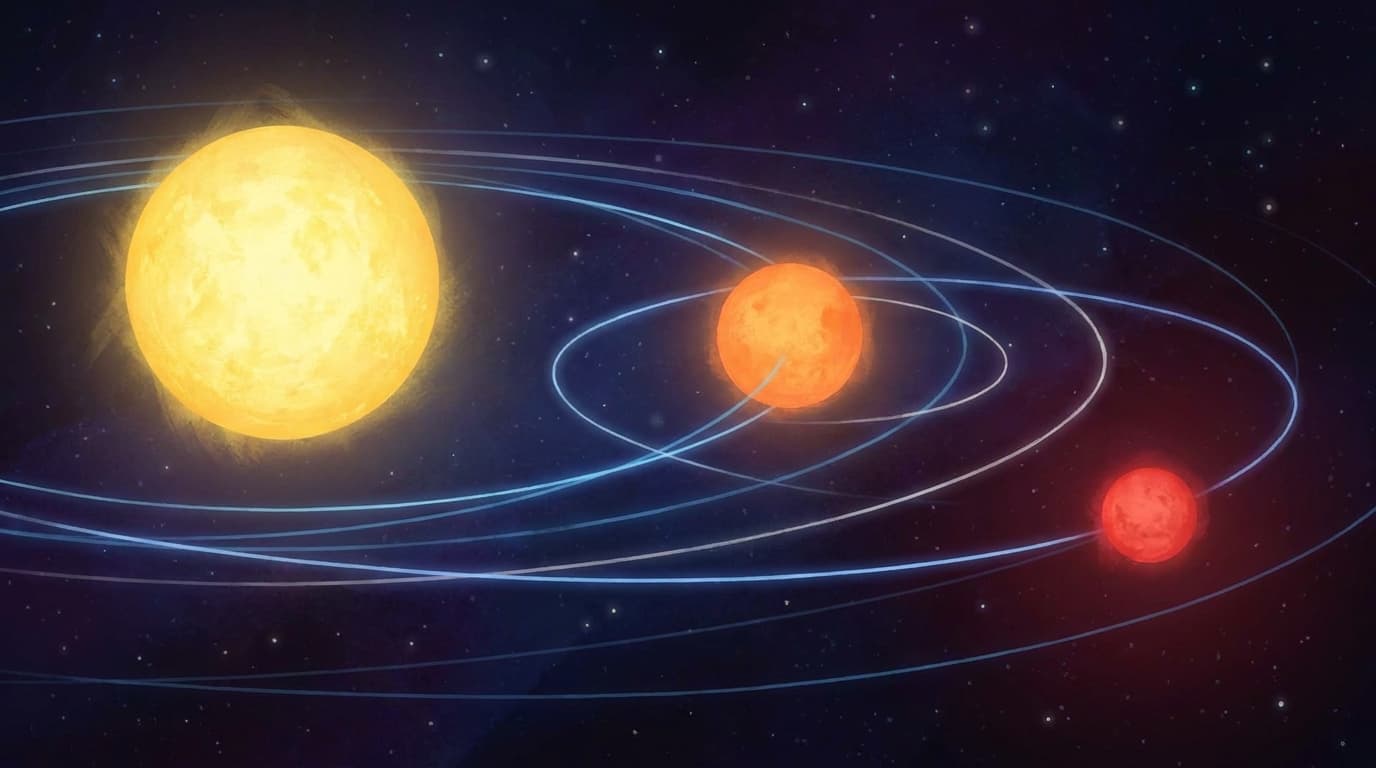
Alpha Centauri is not one star but three. It consists of three stars: Rigil Kentaurus (α Centauri A), Toliman (α Centauri B), and Proxima Centauri (α Centauri C).
Alpha Centauri A (Rigil Kentaurus)
Rigil Kentaurus, also known as Alpha Centauri A, is a yellowish star. It's slightly more massive than the sun and about 1.5 times brighter.
The name Rigil Kentaurus comes from the Arabic phrase Rijl al-Qinṭūrus, meaning "the foot of the Centaur."
Alpha Centauri B (Toliman)
Toliman, or Alpha Centauri B, has an orangeish hue. And it's a bit less massive and half as bright as the sun.
The name Toliman comes from the Arabic aẓ-Ẓalīmān or aṭ-Ṭhalīmān, meaning "the (two male) ostriches."
The Binary Pair: A and B
Alpha Centauri A and B are bound together. They orbit a common center of mass every 79.9 years at a relatively close proximity, varying between 11.2 to 35.6 astronomical units. (One AU is the distance from Earth to the Sun, about 93 million miles.)
, these two stars appear as a single bright object. These two main components appear to be a single star with an apparent magnitude of −0.27. It is the brightest star in the constellation and the third-brightest in the night sky, outshone by only Sirius and Canopus.
Proxima Centauri (Alpha Centauri C)
Proxima Centauri is a small faint red (class M). Though not visible to the naked eye, Proxima Centauri is the closest star to the Sun at a distance of 4.24 ly (1.30 pc), slightly closer than α Centauri AB.
Unlike the close pair of A and B, the distance between Proxima Centauri and α Centauri AB is about 13,000 AU (0.21 ly), equivalent to about 430 times the radius of Neptune's orbit.
It orbits with a period of about 550,000 years. This means Proxima takes over half a million years to complete one orbit around the A and B pair.
Planets in the Alpha Centauri System
The discovery of planets around these distant stars has been one of the most exciting developments in astronomy.
Proxima Centauri's Planets
Proxima Centauri has two confirmed planets — Proxima b and Proxima d. The former is an Earth-sized planet in the (though it is unlikely to be habitable) while the latter is a sub-Earth which orbits very closely to the star.
Proxima Centauri b was a landmark discovery. Announced on 24 August 2016 by the European Southern Observatory (ESO), Proxima Centauri b was confirmed via several years of Doppler spectroscopy measurements of its parent star.
Proxima Centauri b orbits its parent star at a distance of about 0.04848 AU (7.253 million km; 4.506 million mi) with an orbital period of approximately 11.2 Earth days. This is much closer to its star than Mercury is to our Sun.
It is probably a planet with a minimum mass of 1.06 M🜨 and a slightly larger radius than that of Earth.
The planet orbits within the habitable zone of its parent star; but it is not known whether it has an atmosphere, which would impact the habitability probabilities.
Proxima Centauri d is much closer to its host star. Proxima Centauri d was detected in 2022 and later confirmed in 2025.
Called Proxima Centauri d, the exoplanet has around a quarter the mass of Earth and orbits its star at around 3% of the distance between Earth and the sun. Proxima Centauri d is so close to its star that it completes an orbit every five Earth days.
Proxima Centauri c is disputed. A possible but disputed third planet, Proxima c, is a mini-Neptune 1.5 astronomical units away. Its existence remains uncertain.
Planets Around Alpha Centauri A and B
The Alpha Centauri system as a whole has two confirmed planets, both of them around Proxima Centauri. While other planets have been claimed to exist around all of the stars, none of the discoveries have been confirmed.
However, there is recent evidence. Webb's observations from its Mid-Infrared Instrument (MIRI), are providing the strongest evidence to date of a gas giant planet orbiting in the habitable zone of Alpha Centauri A.
Based on the brightness of the planet in the mid-infrared observations, researchers say it could be a gas giant approximately the mass of Saturn orbiting Alpha Centauri A in an elliptical path. Nevertheless, this discovery has not yet been officially confirmed.
Can You See Alpha Centauri from Earth?
Alpha Centauri's visibility depends entirely on where you live.
Visibility from the Southern Hemisphere
In Australia and much of the Southern Hemisphere, Alpha Centauri is , meaning that it never sets. This means that residents in these regions can see Alpha Centauri throughout the year, every night.
Visibility from the Northern Hemisphere
The situation is very different in the north. Alpha Centauri is located at a declination of almost -61 degrees and therefore only visible for latitudes south of +29 degrees. It can't be seen at all from Europe and most of North America.
However, people in the southernmost parts of the Northern Hemisphere might catch a glimpse. It can be glimpsed low down from southern Florida, southern Texas and Hawaii. It's also visible from the Spanish Canary Islands and practically all of India.
Best Time to View
It's best seen during the months of April, May and June. During these months, Alpha Centauri reaches its highest point in the southern sky.
Historical and Cultural Significance
Alpha Centauri has held special meaning for many cultures, particularly in the Southern Hemisphere. Polynesians have been using Alpha Centauri for their star navigation and have called it Kamailehope.
For ancient Incas, a llama graced the sky, traced out by stars and dark dust lanes in the Milky Way from Scorpius to the Southern Cross, with Alpha Centauri and Beta Centauri representing its eyes.
Ancient Egyptians revered Alpha Centauri, and may have built temples aligned to its rising point. In more recent times, Alpha Centauri has been recognized and associated throughout history, particularly in the Southern Hemisphere.
What Makes Alpha Centauri Special?
As our nearest stellar neighbors, the stars of Alpha Centauri represent the most logical targets for future exploration, despite the vast distances involved. We know that Alpha Centauri is the closest star system to ours, and we are fairly sure of the presence of Earth-like planets there.
Yet the distances remain almost unimaginably large. While this is a large distance in terrestrial terms, it is three times closer than the next nearest Sun-like star. Even at the speed of light—the fastest speed possible in the universe—it would take over four years to reach Alpha Centauri from Earth. With our current spacecraft technology, the journey would take tens of thousands of years.
For now, Alpha Centauri remains a distant in the night sky, a reminder of how vast the universe truly is and how much more there is to explore beyond our Solar System.
Share
Test yourself
What does 'light-year' measure?
Sources
Related articles
Dark Matter for Dummies
Dark matter is an invisible substance that makes up about 27% of the universe and holds galaxies together through gravity. Learn what it is, how scientists discovered it, and why it matters.

Science and the Paranormal: Understanding the Evidence and the Debate
Explore how scientists approach paranormal claims, the main areas of paranormal research, and why mainstream science remains skeptical of supernatural phenomena.

Plasma: The Fourth State of Matter Explained
Discover what plasma is, how it forms, and why it dominates the universe. Learn the key differences between plasma and gases, and see everyday examples you may have missed.