Dark Matter for Dummies
- astronomy
- physics
- space
- science
The Universe
Imagine walking through a crowded room where you can feel people pushing you but you cannot see them. This strange sensation is similar to how astronomers experience dark matter in the universe. Dark matter is an invisible and form of matter that does not interact with radiation, including light. Yet despite being invisible, dark matter makes up a shocking portion of everything that exists.
To understand how much of the universe remains hidden, consider this: Normal matter, which is everywhere in our daily lives, composes less than 5% of the total universe.
The universe is made up of three components: normal or visible matter (5%), dark matter (27%), and dark energy (68%). This means the stuff we can see—stars, planets, and even ourselves—represents less than one-twentieth of what is out there. The rest is a cosmic mystery.
What Is Dark Matter, Really?
Dark matter is that invisible glue that keeps stars, dust, and gas together in a galaxy. This mysterious substance makes up the majority of a galaxy's mass and forms the foundation of our Universe's structure. But what exactly is it?
The honest answer: scientists still do not know for certain. Its nature remains a mystery. What scientists do know is that dark matter has mass and gravity, but nothing else like ordinary matter does.
How Dark Matter Differs from Ordinary Matter
While dark matter interacts with ordinary matter through gravity, it does not seem to interact at all with the electromagnetic spectrum, including visible light. So dark matter doesn't absorb, reflect, or emit any light. Think of ordinary matter as social—it interacts with light, heat, electricity, and magnetism. Dark matter, by contrast, is antisocial. It only responds to gravity.
Most normal matter is made up of atomic particles: protons, neutrons, and electrons. It can exist as a gas, solid, liquid, or plasma of charged particles. Dark matter has none of these properties. That kind of matter is called "baryonic," and dark matter appears to be "non-baryonic." In other words, dark matter is made of something completely different from the atoms and molecules we know.
The Discovery Story
The history of dark matter is fascinating because its discovery was so surprising. Most scientists initially rejected the idea.
Fritz Zwicky and the Coma Cluster (1933)
In 1933, Swiss-born astronomer Fritz Zwicky published a paper in which he described an he observed studying a cluster of galaxies known as the Coma Cluster. He noticed that the galaxies in the cluster moved too quickly for the gravity created by its observed ordinary matter. The galaxies should have been escaping the cluster, but instead, they were staying together. After noting this , Zwicky suggested that there might be an invisible form of matter that created the gravity holding these galaxies together.
He dubbed this mysterious material "dunkle Materie," which is German for dark matter.
However, the scientific community was . While these early investigations sparked ideas and curiosity around dark matter, it was still seen as a fringe concept without sufficient evidence to support it. For nearly fifty years, dark matter remained controversial.
Vera Rubin's Breakthrough (1970s)
The game changed in the 1970s. American astronomer Vera Rubin observed this "missing matter" problem in spiral galaxies. Rubin looked at the stars on the outer edges of the spirals. To explain why these stars moved as fast as they did without flying into intergalactic space, there had to be a large amount of matter holding them in place. But, not seeing any of this matter, Rubin concluded that these galaxies must be held together by dark matter.
Rubin's discovery provided such strong evidence for dark matter that the concept was by the scientific community.
How Scientists Know Dark Matter Exists
If dark matter is invisible, how can scientists be so certain it exists? The answer lies in watching what it does.
Galaxy Rotation Curves
Imagine a record spinning on a turntable. The outer edge of the record moves more slowly than the center. Galaxies should work the same way: stars farther from a galaxy's center should move more slowly. But they do not. If there weren't anything else in the galaxy besides stars, planets, and gas, the stars farthest from the center would rotate more slowly than the ones closer to the center. But telescopes have found that this is not true. Stars farther away actually rotate faster. The only way scientists can explain this is if there is a lot of dark matter.
Dark matter doesn't interact with light, but its gravity can bend light from distant galaxies, creating an effect called gravitational lensing. Studying galaxies distorted by gravitational lensing can help scientists better understand dark matter and its place in the universe. This is similar to how a magnifying glass bends and enlarges images. Scientists can measure this bending and calculate how much invisible mass must be present to cause it.
The Bullet Cluster
One of the most dramatic pieces of evidence comes from a collision between two galaxy clusters, known as the Bullet Cluster. In 2006, scientists observed the Bullet Cluster and discovered some of the best direct evidence for dark matter. This galaxy cluster, formally known as 1E 0657-56, was created when two large galaxy clusters collided in an extremely energetic event about 3.8 billion light-years from Earth. During this collision, hot gas from one cluster interacted with hot gas from the other. In the image below, hot X-ray emitting gas made of normal matter and detected by NASA's Chandra X-ray Observatory is shown in pink. The blue portions show the distribution of dark matter and were revealed using gravitational lensing observations taken by NASA's Hubble Space Telescope and the Giant Magellan Telescope, which is operated by an international consortium. The blue areas represent most of the mass in these clusters and are distributed differently than the hot gas. Researchers think that this material is likely dark matter.
What Could Dark Matter Be?
Scientists have proposed several candidates for what dark matter might be made of. None has been confirmed yet, and the mystery remains unsolved.
WIMPs (Weakly Interacting Massive Particles)
WIMPs are hypothetical particles that are big, heavy, and slow-moving. They don't absorb or emit light or strongly interact with any other particles that we've seen so far. Scientists think WIMPs interact with gravity and possibly other forces, but in a way that allows these particles to pass through normal matter almost seamlessly.
One possibility is that dark matter is made of WIMPs (weakly interacting massive particles) that would have 1 to 1,000 times more mass than a proton.
Axions
Another candidate is the axion, a particle with ten-trillionth of the mass of an electron. Axions are so tiny that they would behave differently from WIMPs, requiring special detection methods.
Primordial Black Holes
The other main possibility is that dark matter is composed of primordial black holes. These would be black holes that formed in the very early universe, not from collapsed stars as modern black holes do.
The Hidden Sector
Alternately, dark matter may exist in a rich and complex set of particles that would form a universe parallel to our own (the so-called Dark Sector). This idea suggests that dark matter might be an entire hidden universe of particles alongside our own.
The Role of Dark Matter in Our Cosmos
Dark matter is not just a curiosity—it shapes the entire universe.
Building Galaxies
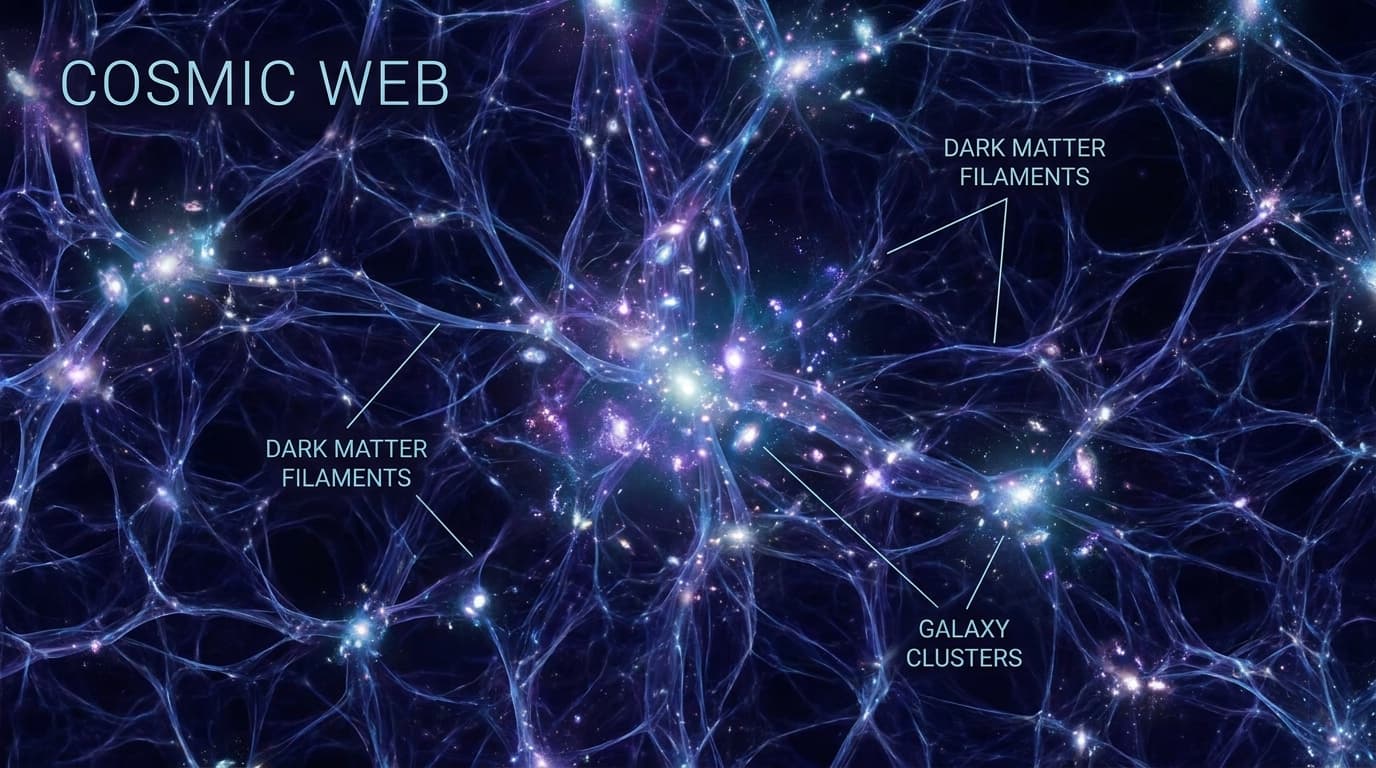
Dark matter is thought to serve as gravitational scaffolding for cosmic structures. After the Big Bang, dark matter clumped into blobs along narrow filaments with superclusters of galaxies forming a at scales on which entire galaxies appear like tiny particles. Without dark matter, galaxies would never have formed in the first place.
Holding Things Together
Based on the motion of what we can observe, galactic dark matter resides in a "halo" surrounding the ordinary matter of the galaxy. This halo protects and stabilizes the visible galaxies within it. It makes our existence possible! If there hadn't been any dark matter in the universe, there wouldn't be enough mass for stars and galaxies—and us—to form.
Searching for Dark Matter
Scientists around the world are conducting sophisticated experiments to detect dark matter particles directly.
Direct Detection
Researchers use large, sensitive detectors located deep underground to directly search for the dark matter particles that may continually pass through the Earth. These detectors typically use liquids like xenon or special crystals that produce detectable signals when a dark matter particle hits an atomic nucleus.
Indirect Detection
Researchers can also search for dark matter indirectly through specific signatures in cosmic rays and gamma rays. Scientists search for these signatures using ground-based and space-based observatories.
Particle Accelerators
Researchers are also trying to create dark matter with particle accelerators, such as the Large Hadron Collider and various DOE Office of Science user facilities. If dark matter particles have the right mass, they might be produced in high-energy collisions.
Why This Matters
Understanding dark matter is one of the greatest unsolved mysteries in physics. That's a question that scientists have been trying to solve for almost 100 years. Finding the answer could revolutionize our understanding of:
- How the universe began and evolved
- The structure and fate of the cosmos
- The nature of matter itself
- Physics beyond what we currently understand
Most of the mass of our universe is in dark matter. Further, because of the sheer quantity of dark matter, more than can be accounted for in the form of ordinary matter, it must be made of something exotic—with elementary particles produced in the early hot universe being the leading candidate.
The search continues. Every day, scientists build better detectors, run new simulations, and analyze data from telescopes. Dark matter remains one of science's greatest frontiers—a reminder that the visible universe is just the tip of an invisible iceberg.
Share
Test yourself
What percentage of the universe is made up of dark matter?
Sources
Related articles
Alpha Centauri: Our Closest Neighbor in the Stars
Alpha Centauri is a triple star system just over 4 light-years away—the closest star system to Earth. Learn about its three stars, the planets orbiting them, and what makes this system so special.

Plasma: The Fourth State of Matter Explained
Discover what plasma is, how it forms, and why it dominates the universe. Learn the key differences between plasma and gases, and see everyday examples you may have missed.

Science and the Paranormal: Understanding the Evidence and the Debate
Explore how scientists approach paranormal claims, the main areas of paranormal research, and why mainstream science remains skeptical of supernatural phenomena.