Black Holes: At the Edge of What We Know
- black holes
- physics
- space science
- mysteries
What Is a Black Hole?
A black hole is a huge of matter packed into a very tiny space. It is so dense that gravity just beneath its surface, called the event horizon, is strong enough that nothing—not even light—can escape. This simple definition masks something profound: black holes are places where the laws of physics as we understand them .
To understand how extreme this is, imagine squeezing all of Earth's mass into something the size of a marble. The Sun, which has a diameter of about 1,390,000 kilometers, would have to be squeezed down to a ball fewer than 3 kilometers across to be as dense as a black hole. At such extreme densities, space and time themselves become twisted in ways that ordinary experience.
The Event Horizon: A
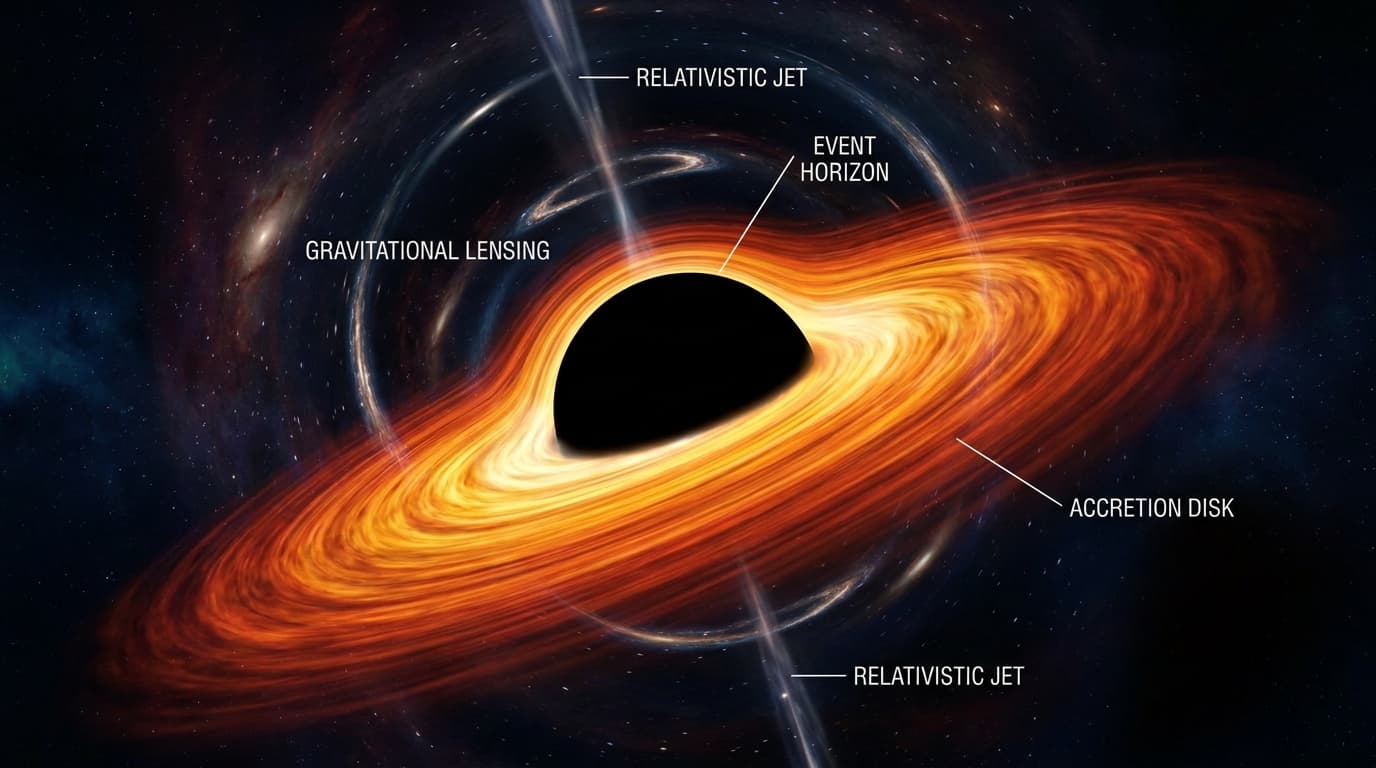
A black hole's "surface," called its event horizon, is the boundary where the velocity needed to escape exceeds the speed of light, which is the speed limit of the cosmos. The event horizon is not a physical surface like Earth's ground. It is not a material surface but rather merely a mathematically defined boundary. Yet it represents an absolute point of no return.
Nothing inside the horizon can ever escape or come back across this boundary, not even light. This implies that nothing that enters the black hole horizon can be observed from outside this horizon. This creates one of physics' deepest puzzles: if we cannot see inside a black hole, and nothing escapes, can we ever truly know what happens there?
The : Where Physics Fails
At the very center of every black hole lies what physicists call a singularity. At the center is the singularity, which is the word used to describe a point that is infinitely small and infinitely dense. This is where our understanding truly falls apart. The previous research suggests all of the object's mass has collapsed to an infinitely dense extent. This means the fabric of space and time around the singularity has curved to an infinite degree, so the laws of physics as we currently know them break down.
How Black Holes Form
Black holes typically form when very massive stars collapse at the end of their life cycle. Not all stars become black holes. A stellar-mass black hole forms when a star with more than 20 solar masses exhausts the nuclear fuel in its core and collapses under its own weight. The collapse triggers a supernova explosion that blows off the star's outer layers. But if the crushed core contains more than about three times the Sun's mass, no known force can stop its collapse to a black hole.
The origin of supermassive black holes—those with millions or billions of times the Sun's mass—remains more mysterious. The origin of supermassive black holes is poorly understood, but we know they exist from the very earliest days of a galaxy's lifetime.
These black holes are believed to exist at the centers of almost every large galaxy, including the Milky Way.
How We See the Invisible
Since black holes emit no light, they are by definition invisible. Yet in recent decades, scientists have developed clever methods to detect them and even photograph them.
Indirect Detection
Black holes can be surrounded by rings of gas and dust, called accretion disks, that emit light across many wavelengths, including X-rays.
X-ray telescopes can observe light from binary systems where matter is pulled from the outer layers of a star that orbits a black hole. These black holes accumulate cosmic matter around themselves in a swirling pattern called an accretion disk. Gas particles in the disk accelerate and collide, heating to millions of degrees and giving off detectable X-rays.
A supermassive black hole's intense gravity can cause stars to orbit around it in a particular way. When very massive objects accelerate through space, they create ripples in the fabric of space-time called gravitational waves. Scientists can detect some of these by the ripples' effect on detectors.
Direct Imaging: The Event Horizon Telescope
On 10 April 2019, the first direct image of a black hole and its vicinity was published, following observations made by the Event Horizon Telescope (EHT) of the supermassive black hole in Messier 87's galactic centre.
In 2022, the Event Horizon Telescope collaboration released an image of the black hole in the center of the Milky Way galaxy, Sagittarius A*.
Radio telescopes around the world are combined into a single virtual telescope—the Event Horizon Telescope. This global network achieved what seemed impossible: making an image of something that cannot emit light. What we see is not the black hole itself, but the glowing matter swirling around it at the edge of the event horizon.
The Mysteries That Remain
Black holes are among the most mysterious cosmic objects, much studied but not fully understood. Despite decades of research and dramatic new observations, fundamental questions remain unanswered.
The Information
One of the deepest mysteries is the black hole information paradox. The black hole information paradox is an unsolved problem in physics and a paradox that appears when the predictions of quantum mechanics and general relativity are combined.
In 1974, Stephen Hawking applied the semiclassical approach of quantum field theory in curved spacetime to black holes and found that an isolated black hole would emit a form of radiation (now called Hawking radiation in his honor). This radiation causes black holes to shrink over time. But here is the puzzle: the information paradox appears when one considers a process in which a black hole is formed through a physical process and then away entirely through Hawking radiation.
Quantum mechanics tells us that information can never be destroyed. Yet if a black hole evaporates completely, where does all the information about the matter that fell into it go? Do black holes produce thermal radiation, as expected on theoretical grounds? If so—meaning black holes can evaporate away—what happens to the information stored in them? This appears to be an issue because the unitarity of quantum mechanics does not allow for the destruction of information.
Recent Progress and Remaining Questions
It is now generally believed that information is preserved in black-hole evaporation.
In a landmark series of calculations, physicists have proved that black holes can , which seems impossible by definition. The work appears to resolve a paradox that Stephen Hawking first described five decades ago.
However, this resolution comes with a catch: views differ as to precisely how Hawking's original semiclassical calculation should be corrected. Multiple competing theories exist, and physicists still debate which one is correct.
What Happens Inside?
Perhaps the most fundamental mystery is simple: There is much we don't know about black holes, like what matter looks like inside their event horizons.
Unless our understanding of general relativity gets a major revamp, we don't think there'll ever be a way to test what actually happens when you enter a black hole. So be cautious when anyone suggests they have a theory for what happens inside or at the event horizon. It probably won't be a theory at all—theories need to make predictions that are testable and falsifiable.
The event horizon creates a perfect shield. No information can escape from inside. This means we can never, in principle, observe what happens there. We are forever separated from the answer by a boundary we cannot cross and from which no signal can return.
A Meeting Point of Theories
Black holes sit at the intersection of our two most powerful but theories. Einstein refined his ideas into his general theory of relativity, which explained how matter affects spacetime, which in turn affects the motion of other matter. This formed the basis for black hole physics. Yet general relativity describes gravity on large scales, while quantum mechanics describes forces on tiny scales.
In a black hole, extreme gravity crushes matter to the quantum scale. Here, both theories should apply equally, yet they give contradictory answers. To study that situation, we need a real, fully integrated quantum gravity theory, and we don't have one yet. The "mash-up" of the Standard Model and general relativity is really just an approximate theory, and breaks down at these singularities.
Solving this contradiction—finding a theory of quantum gravity—is one of the greatest challenges in modern physics. Black holes are not just cosmic curiosities; they are windows into physics we have not yet discovered.
The Limit of Knowledge
Black holes teach us something fundamental about the universe: there are limits to what we can understand, but each discovery also raises new questions. They show us the boundary of human knowledge not as a wall, but as an active .
We have learned much about black holes. We can detect them. We can measure their mass and spin. We can photograph the region around them. We understand their basic properties from Einstein's equations. We don't yet know all the details of how black holes work, but this is not the same as having no knowledge at all.
Yet the deepest questions remain open. What happens to information that falls in? What is the nature of the singularity? How can we unify the physics of the very large with the physics of the very small? As is often the case in frontier science, we don't even have all the questions, let alone the answers. Black holes certainly test the limits of our knowledge, and there's plenty more for us to learn.
Black holes represent a humbling truth: that the universe is stranger and more complex than we imagined, and that human knowledge, vast as it is, has horizons beyond which our understanding cannot yet reach.
Share
Test yourself
What is a black hole?
Sources
Related articles

Plasma: The Fourth State of Matter Explained
Discover what plasma is, how it forms, and why it dominates the universe. Learn the key differences between plasma and gases, and see everyday examples you may have missed.
Dark Matter for Dummies
Dark matter is an invisible substance that makes up about 27% of the universe and holds galaxies together through gravity. Learn what it is, how scientists discovered it, and why it matters.

Understanding Spirituality in 2026: A Guide to Modern Beliefs and Practices
Spirituality in 2026 is shifting toward personal, flexible practices that blend technology with timeless traditions. Young people are choosing individual spiritual paths over formal religion while seeking meaning and connection.