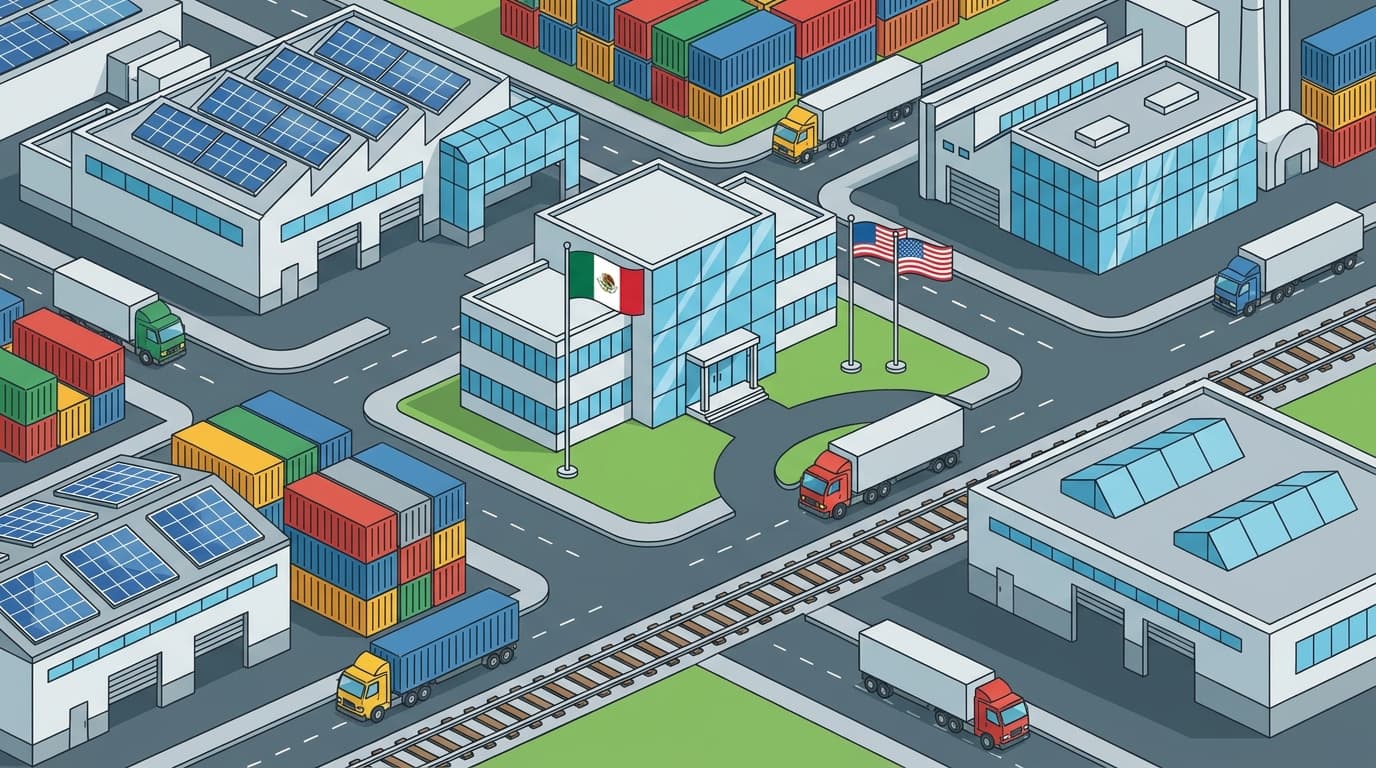
Mexico's Superpower: Why Companies Are Choosing Nearshoring
- business
- trade
- manufacturing
- Mexico
- supply-chain
What Is Nearshoring?
Nearshoring is a form of where a company moves certain business operations—like manufacturing, software development, or customer service—to a nearby country, typically within the same continent or region. It sits somewhere between two other strategies: keeping everything at home (called "onshoring") and moving work to distant countries like China or India (called "").
For many companies, nearshoring combines the best of both onshore outsourcing and offshore outsourcing because it provides a similar culture, , and language to the brand, but at more affordable cost. Think of it as a middle ground—you get some of the cost savings of working overseas, but without the headaches (and hidden costs) of dealing with companies on the other side of the world.
Nearshoring vs. Offshoring: What's the Real Difference?
At first glance, nearshoring and offshoring sound similar. Both mean moving work to another country. But the differences matter a lot in practice.
Nearshoring is the outsourcing of business processes, especially information technology processes, to companies in a nearby country, often sharing a border with the target country. Both parties expect to benefit from one or more of the following dimensions of proximity: geographic, temporal (time zone), cultural, social, linguistic, economic, political, or historical linkages.
Offshoring involves relocating work to a foreign organization to reduce costs, but challenges include time differences, local labor laws, and reduced oversight. When you offshore to Asia, for example, you might save more money on labor, but your team in the US cannot easily have meetings with them in real time—there are simply too many hours' difference.
Here's the key advantage nearshoring offers: With similar time zones, teams can work together in real time. This is especially important for project management, software development, and any operation that requires frequent check-ins or quick problem-solving.
Why Mexico? The Geography Question
For companies in the United States or Canada, Mexico is the obvious nearshoring choice—and geography is just the start.
Shipping and Time
Mexico's proximity to the U.S. is a major advantage. Shipments from Mexico can reach North American markets in a matter of days instead of weeks. When demand shifts, production can adjust without long transit routes or tied up at congested ports.
To understand how much this matters, imagine you manufacture goods in China. Shipping to the US East Coast takes 30 to 40 days. With Mexico, that timeline shrinks dramatically. A shipment from northern Mexico can reach the US in two to five days by truck.
Time Zones and Communication
One of the biggest advantages of nearshoring to Mexico is that it allows companies to be their teams' time zones because communications can be faster and more agile, and you don't need to stay after hours to schedule a meeting with teams. When you call Mexico City from Los Angeles, you are usually only one hour apart. With India, you are 12 or 13 hours apart.
Cultural and Language Affinity
Mexico and the US share strong cultural ties in terms of language, values, religion, and business practices. Many Mexicans have family connections to the US and are exposed to US media and entertainment. This makes communication and understanding between Mexican and American team members smoother.
Moreover, Mexico produces around 200,000 English-speaking IT graduates each year, minimizing language barriers.
Mexico's Workforce: Skill and Cost
Mexico offers a rare combination: you get skilled workers at lower wages than the US.
Mexico also offers the right balance of talent and cost. Its workforce is highly skilled in complex manufacturing, especially in industries like automotive, aerospace and electronics. Combine that with affordable labor and quicker turnaround times, and the often comes out ahead of offshoring alternatives.
Despite multiple rounds of minimum wage increases, Mexico's average manufacturing wage remains at $4.90 per hour, below China at $6.50 per hour and even more so the US, where manufactur… (wage data continues to compare favorably).
Trade and : The USMCA Advantage
The biggest reason companies are rushing to Mexico is trade policy. The US-Mexico-Canada Agreement (USMCA), which replaced NAFTA in 2020, provides duty-free access to goods and services between the countries. US companies can manufacture products and outsource services in Mexico without tariffs or trade barriers. This gives Mexico a edge over Asian offshoring locations.
This matters enormously. If you produce something in China and ship it to the US, you face tariffs. If you produce the same thing in Mexico under USMCA rules, tariffs drop to zero (or near zero). Before the USMCA, U.S. tariffs averaged 3.6%. Today, companies outside the agreement may face duties as high as 30%.
Since the USMCA took effect, intra-regional trade in goods and services has grown by 37 percent, driven largely by growth in industrial supplies and the automotive sector.
The Numbers: Mexico's Nearshoring Boom
The trend is real, and the numbers prove it.
In 2024, Mexico became the largest supplier of imports to the United States, with a total value of USD 466.6 billion, representing 15.6% of all U.S. imports. This shift confirms the country's role in regional manufacturing and its competitive position under the USMCA framework.
Even more striking: Trade between the U.S. and Mexico reached $72.5 billion in September 2024, a significant increase of 8% from the previous year. During the last 20 months, Mexico has been America's largest trading partner for the ninth consecutive month.
Foreign companies are betting big. Nearshoring continues to as foreign direct investment rises, jumping more than 10% year over year to hit $34.3 billion in the first half of 2025. With 36% of that capital flowing into the manufacturing sector, Mexico is fast progressing to the forefront of the world's industrial and logistical landscape.
Key Industries Driving Mexico's Nearshoring
Not all industries are equal in Mexico's nearshoring boom. Some sectors have invested heavily and built deep supplier networks.
Automotive
The automotive sector dominates. Mexico produced nearly 4 million vehicles in 2024, and the automotive sector accounted for 31.4% of Mexico's total exports, valued at USD 193.9 billion in 2024. These figures reflect deep integration with U.S. and Canadian under USMCA.
Electronics and Semiconductors
Electronics manufacturing is growing fast. The Electronics Manufacturing Services (EMS) market in Mexico is projected to grow from USD 53.2 billion in 2025 to USD 97.4 billion by 2031, at a CAGR of 10.6%. Growth is fueled by nearshoring of high-tech production lines, including semiconductors, telecommunications equipment, and automation systems.
Aerospace
Mexico's aerospace exports reached USD 10 billion in 2024, surpassing previous records and marking a full recovery from pandemic-related declines. This achievement expands the country's position as a key supplier within North America's aerospace supply chains.
and Government Support
Mexico is not resting on its geography. The government and private sector are investing heavily in infrastructure to support nearshoring.
Inaugurated in August 2025, Puerto del Norte in Matamoros is Mexico's first major port in 24 years. It shortens shipping times by up to five hours compared to Altamira and supports intermodal connectivity for sectors like automotive, steel, and energy.
In December 2024, President Claudia Sheinbaum extended fiscal incentives, including tax benefits for export industries, lower Income Tax and VAT rates in border regions, and fuel tax reductions to stabilize costs. These measures aim to boost investment, strengthen economic stability, and attract multinational corporations.
The Challenges Mexico Still Faces
Nearshoring is not without problems. Mexico's rapid growth has exposed some weaknesses.
Energy and Infrastructure Bottlenecks
Companies are steering away from the country 'because of energy scarcity.' This refers not only to the intensive power requirements of operations such as data centres, but also relates to the need for gas, which, despite the energy transition, is 'unavoidable in operating heavy industry.'
Legal and Security Concerns
In deciding to maximize these advantages, companies must also be mindful of the challenges associated with corruption, security, regulatory compliance, labor issues, and uncertainty in its judicial system and in the international trade landscape.
Labor Issues
While companies benefit from relatively low labor costs in Mexico, businesses must understand and navigate Mexico's labor laws and practices, which can be complex and subject to change. Workers' rights, union influence, and wage regulations are important considerations when hiring and managing a workforce.
What's Next: The 2026 USMCA Review
Mexico's nearshoring future depends partly on politics. The United States–Mexico–Canada Agreement (USMCA) will undergo a formal review starting in July 2026. What was once expected to be a routine assessment aimed at improving implementation is now likely to become a high-stakes negotiation. The Trump administration is poised to seek additional concessions from Mexico and Canada on long-standing trade disputes, while also leveraging the review to address non-trade issues such as migration, drug trafficking, and continental defense.
Despite this uncertainty, the structural advantages remain strong. The structural advantages driving nearshoring to Mexico (proximity, cost differentials, USMCA access, skilled labor) exist independent of the review's outcome. Even under the most disruptive scenario, Mexico's competitive position relative to Asia strengthens as U.S. tariffs on Chinese goods remain elevated at 25–60%.
The Bigger Picture: A New Global Economy
Nearshoring represents a shift in how the world makes things. For decades, the dominant strategy was simple: move manufacturing to the cheapest country possible, no matter how far away. That meant China, Vietnam, Bangladesh—countries with the lowest labor costs.
But that era is ending. Companies have learned that the lowest cost is not always the best cost. When you add up shipping times, tariffs, supply-chain disruptions, quality control, and communication problems, distant factories often are not as cheap as they first seemed.
Mexico represents a new model: competitive enough on cost, close enough to serve your customers fast, and integrated enough into regional trade to make the whole system work. Nearshoring can help Mexico add an additional 3% to its GDP in the next five years. This isn't just about incremental gains; it's a transformational shift that positions Mexico as a major player in the global economy.
For Mexico, the opportunity is real. Whether the country can execute—build the infrastructure, improve security, train the workforce, and navigate geopolitical tensions—will determine whether nearshoring remains a superpower or a missed moment.
Share
Test yourself
What is nearshoring?
Sources
Related articles
Introduction to Supply Chain Management
Supply chain management is the coordination of all activities involved in moving products from raw materials to customers. Learn the five key stages, why it matters, and how modern technology is transforming this critical business function.

Understanding Spirituality in 2026: A Guide to Modern Beliefs and Practices
Spirituality in 2026 is shifting toward personal, flexible practices that blend technology with timeless traditions. Young people are choosing individual spiritual paths over formal religion while seeking meaning and connection.

How to Manage Risk for the Everyday Man
Learn practical strategies to identify, understand, and manage the financial and life risks that affect your family and future, from emergency savings to insurance and smart budgeting.