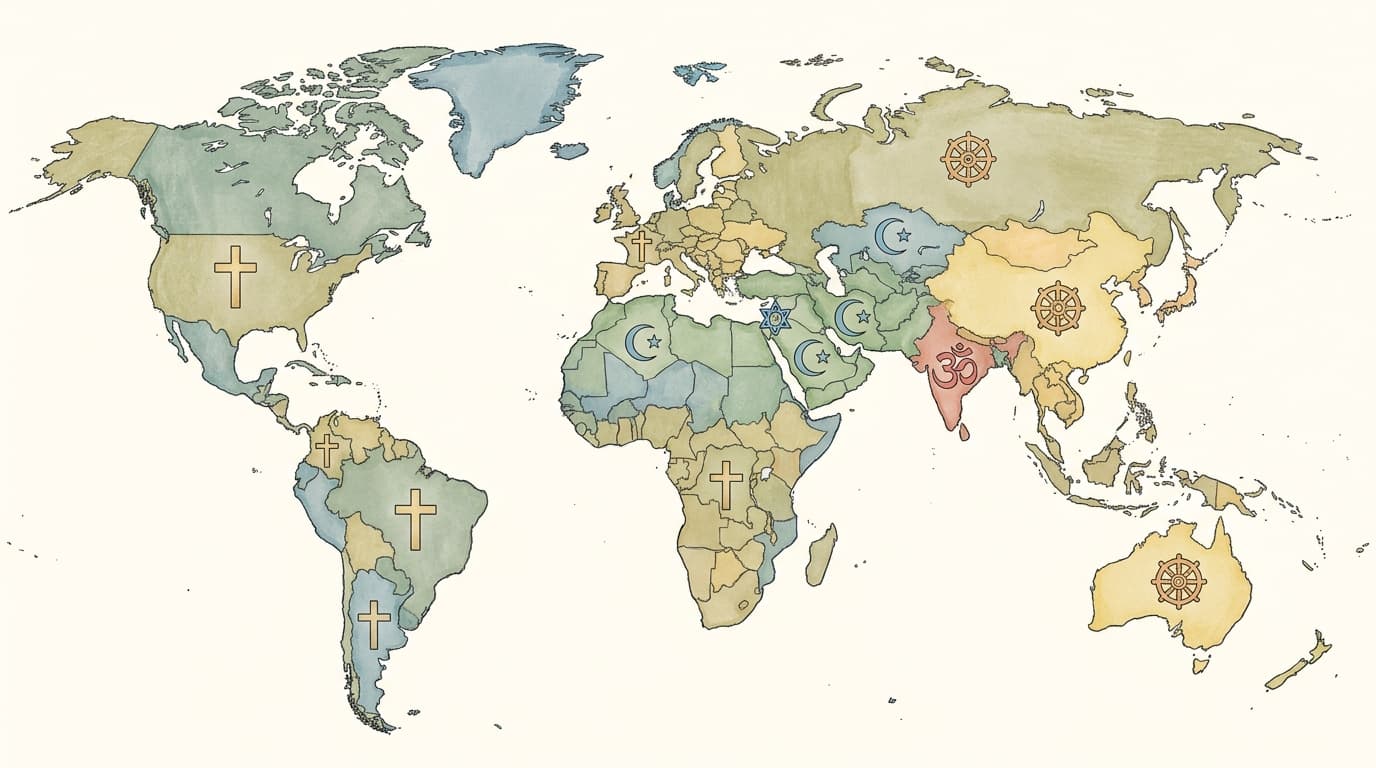
The Most Popular Religions in 2026
- religion
- global
- demographics
- spirituality
The Five Largest Religions Today
An estimated 2.65 billion people identify as Christians, accounting for around 31–32% of the world's population.
Islam represents the second largest religious group globally, with just under 25% of the world's population.
Hinduism remains firmly in third place with just over 1.07 billion .
In fourth position is Protestant Christianity, practiced by approximately 626 million people globally.
About 507 million people practice Buddhism worldwide.
When we look at the world's largest religious traditions rather than broad categories, the ranking shifts slightly. Sunni Islam remains the most widely professed religious tradition in the world. In 2026, the Sunni Muslim population exceeds 1.59 billion, maintaining a clear lead over Roman Catholic Christianity, which now counts around 1.27 billion followers worldwide.
Christianity: The Largest Religion
When combining Roman Catholics, Protestants, Eastern Orthodox Christians (nearly 295 million), and other Christian , Christianity as a whole continues to represent the largest religion in the world, both in absolute numbers and in global presence.
Christianity is based on the life and teachings of Jesus Christ and is approximately 2,000 years old. The religion divides into three main branches: Catholicism, Protestantism, and Eastern Orthodoxy, each with different practices and beliefs (though they share core Christian teachings).
Where Christians live: In 2025, the Global South is home to 69% of all Christians in the world, projected to reach 78% by 2050. Africa became the continent with the most Christians in 2018, passing Latin America (which passed Europe in 2014). This represents a major shift from earlier centuries, when Christianity was in Europe.
Islam: The Fastest-Growing Religion
Islam, which is practiced by more than 1.91 billion people, is second.
Most Muslims belong to one of the two major branches of Islam: Sunnis include approximately 80 percent of Muslims, and the Shiʿah includes approximately 15 percent. The remaining numbers belong to smaller denominations.
Christians remain the largest religious group, and Muslims grew the fastest from 2010 to 2020.
Studies in the 21st century suggest that, in terms of percentage and worldwide spread, Islam is the fastest-growing major religion in the world. A comprehensive religious forecast for 2050 by the Pew Research Center predicts that the global Muslim population will grow at a faster rate than the Christian population – primarily due to the average younger age, and higher of Muslims.
Why is Islam growing faster? Globally, Muslims have the highest fertility rate, an average of 3.1 children per woman – well above (2.1), the minimum typically needed to maintain a stable population. Young populations with more children naturally grow faster than aging populations.
Hinduism: The Third-Largest Religion
Hinduism, with an estimated 1.1 billion followers, is the world's third largest religion and also one of the oldest, with beliefs and practices that date back at least as far as the 1500s BCE. Hinduism is practiced primarily in India (where approximately 80 percent of the population identifies as Hindu), Nepal, and Indonesia.
No religion we analyze is more heavily concentrated in one country than Hinduism, which has remained close to its geographic origins. Unlike Christianity and Islam, Hinduism has not spread widely across the globe. Little is known about the founding of Hinduism, but its teachings deeply influence almost all aspects of believers' lives.
Buddhism: A Religion of Meditation and Philosophy
The fourth most widely practiced religion is Buddhism, with approximately 500 million followers worldwide. Based on the teachings of Gautama Buddha, the religion was founded in India nearly 2,500 years ago.
There are two main branches of Buddhism: Theravada Buddhism and Mahayana Buddhism. of Buddhism include a vow of nonviolence and an adherence to ethical behavior in all aspects of life.
According to estimates, half the world's Buddhists live in China. Most of the rest of the world's Buddhists live in East and South Asia, including 13% in Thailand (where 93% of the population is Buddhist).
Interestingly, Buddhism is the only major religion whose global population shrank between 2010 and 2020. It declined in East Asia, particularly in Japan and South Korea.
Smaller Religions and the
Beyond the four largest religions, several other faiths exist with smaller but significant populations. Judaism, though one of the three major Abrahamic religions (along with Christianity and Islam) is represented by just 0.2 percent of the global population (16 million), most of whom reside in Israel (7 million) and the U.S. (6 million).
An estimated 6 percent of the world's population are adherents of folk or traditional religions. These include African traditional religions, Chinese folk religions, Native American religions, and Australian aboriginal religions.
The religiously unaffiliated: Collectively, 75.8% of the world's people identified with a religion as of 2020. The remaining 24.2% did not identify with any religion, making people with no religious affiliation the third-largest group in this study, after Christians and Muslims. This group—sometimes called the "nones"—includes atheists, agnostics, and people who describe themselves as "nothing in particular." The countries with the largest unaffiliated populations include China, Japan, and the United States.
How Religious Demographics Are Changing
Since 2010, the share of the global population that has any religious affiliation has declined by nearly 1 percentage point (from 76.7%) while the share without an affiliation has risen by the same amount (from 23.3%). Religious "" – especially people shedding their religious identity after having been raised as Christians – explains much of the unaffiliated population's growth between 2010 and 2020.
In the United States, the pattern is especially visible. The Christian share of the population, after years of decline, has been relatively stable since 2019. And the religiously unaffiliated population, after rising rapidly for decades, has leveled off – at least temporarily.
Regional Differences
Religion is not distributed evenly around the world. Across Africa, the Middle East, and South America, the vast majority of people are religious. Rates tend to be well over 90%. Across Asia, Europe, and North America, rates are more mixed.
Nearly six-in-ten people worldwide live in the Asia-Pacific region, including most people in five religious categories: 99% of Hindus, 98% of Buddhists, 78% of the religiously unaffiliated, 65% of followers of other religions, and 59% of Muslims.
What the Future May Hold
Religious demographics are shaped mostly by and population growth patterns, not by large-scale religious conversion. Over the next four decades, Christians will remain the largest religious group, but Islam will grow faster than any other major religion. If current trends continue, by 2050 the number of Muslims will nearly equal the number of Christians around the world.
However, many factors could alter these . Wars, diseases, major cultural shifts, or unexpected patterns of religious conversion could all change these projections in ways demographers cannot predict with certainty.
Share
Test yourself
According to the post, approximately how many people identify as Christian globally in 2026?
Sources
Related articles

Understanding Spirituality in 2026: A Guide to Modern Beliefs and Practices
Spirituality in 2026 is shifting toward personal, flexible practices that blend technology with timeless traditions. Young people are choosing individual spiritual paths over formal religion while seeking meaning and connection.
Similarities Across Major Religions
Despite their differences, the world's major religions share many fundamental beliefs and practices that reflect our shared human values. Learn about the common threads that connect Christianity, Islam, Judaism, Hinduism, and Buddhism.

Life After Death: Beliefs, Science, and Questions
Explore how different religions, scientific research, and philosophical perspectives explain what might happen after death—from heaven and hell to reincarnation and beyond.