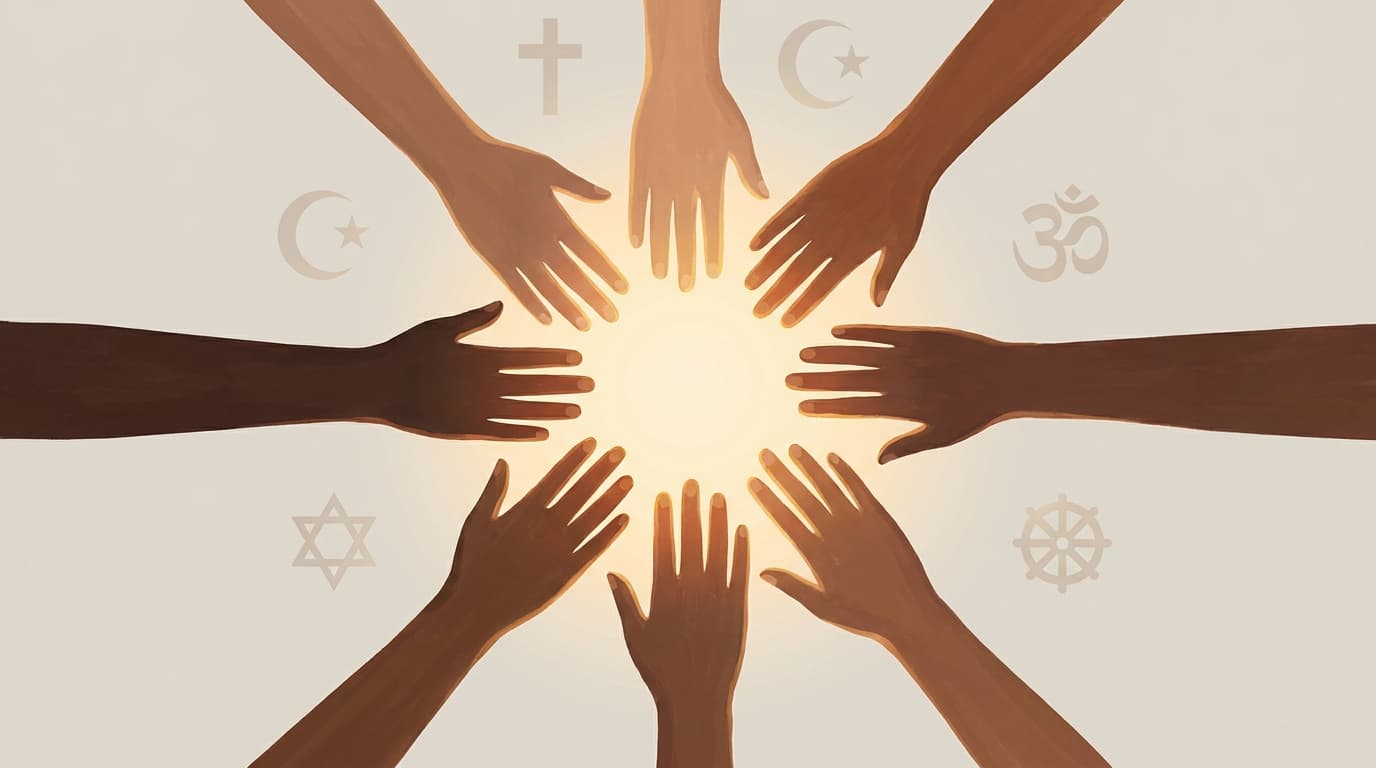
Similarities Across Major Religions
- religion
- world religions
- faith
- spirituality
- culture
Introduction: Beyond the Surface
When we look at the world's major religions—Christianity, Islam, Judaism, Hinduism, and Buddhism—it is easy to see only differences. Each tradition has unique beliefs, practices, and histories. Yet beneath these differences lies a remarkable foundation of shared values and common human concerns.
Research has revealed more than fifty common themes across all religions. These similarities are not surprising when we view religion as a meaning-making endeavor of humanity that expresses itself in different cultural and historical contexts. This post explores the profound ways that religions around the world connect to address fundamental questions about how we should live, what we believe about the sacred, and what happens after death.
: Universal Ethical Foundation
The most striking similarity across religions is a principle known as the Golden Rule. The Golden Rule is the principle of treating others as one would want to be treated by them. This simple but powerful teaching appears in nearly every major faith tradition.
In Christianity, Jesus this in the Sermon on the Mount: "So in everything, do to others what you would have them do to you." In Judaism, the sage Hillel the Elder summarized the Torah while standing by saying, "What is hateful to you, do not do to your fellow." Islam echoes this sentiment in the Hadith: "None of you truly believes until he wishes for his brother what he wishes for himself." Eastern religions also embrace this concept. In Hinduism, the Mahabharata states, "This is the sum of duty: do not do to others what would cause pain if done to you." Similarly, Buddhism teaches, "Hurt not others in ways that you yourself would find hurtful."
This shared principle reveals something profound: religions may disagree about theology (beliefs about God and the nature of reality), but they on the ethical ideal of compassion and . The Golden Rule is a moral principle that transcends time, cultures, and religions. At its core, it emphasizes empathy, respect, and the idea of treating others with kindness and consideration. While this rule is often associated with Christianity, it actually appears in some form across many of the world's major religions. Its universal appeal highlights a shared human value of compassion and reciprocity.
Prayer and Spiritual Practice
Another fundamental similarity lies in how religions approach spiritual connection through prayer and meditation. While the forms vary, the purpose remains consistent: to deepen one's relationship with the divine or ultimate reality.
Prayer, in its various forms, is a central practice in many religions. In Christianity, prayer can be individual or communal, often taking place during church services, and includes specific rituals like the sacraments of Baptism and the Eucharist. Islam Salat, the performance of ritual prayers five times a day facing Mecca, along with personal supplications known as Du'a. Judaism emphasizes daily prayers, as well as specific prayers and readings during Sabbath and holiday synagogue services, alongside the study of the Torah. Hinduism encompasses a wide range of devotional practices known as Puja, which can involve offerings, chanting, and prayers, as well as meditation and the practice of yoga. Buddhism places significant emphasis on meditation, with various techniques aimed at cultivating mindfulness and insight, along with chanting and offerings.
Fasting is a profound spiritual practice observed in all three Abrahamic faiths—Judaism, Christianity, and Islam. Each tradition emphasizes fasting as a means of spiritual reflection, self-discipline, and deepening one's connection with God. Despite differences in the specific practices and occasions for fasting, the underlying intentions are remarkably similar.
Sacred Texts and Spiritual Guidance
Within each religion, sacred texts are as authoritative sources of guidance, wisdom, and divine revelation. They are often regarded as sacred or holy, representing the core teachings and principles that their followers strive to uphold. From Christianity's Bible and Islam's Quran to Judaism's Torah, Hinduism's Vedas, and Buddhism's Sutras, these texts serve parallel functions across faith traditions.
Central to the practice and preservation of nearly all major world religions is a collection of sacred writings. These texts do not merely describe religious beliefs; they actively shape how believers understand ethics, practice their faith, and navigate their spiritual journeys. Though the content and interpretation differ, the role that sacred texts play in guiding followers is strikingly similar across traditions.
Community and Worship
Religion is not merely an individual spiritual pursuit. Community worship refers to the practice where members of a religious group gather collectively to engage in prayer, rituals, and other religious activities that promote unity and express shared religious beliefs and experiences. This communal dimension appears across all major religions.
Regular prayer is central to all three Abrahamic religions. Jews pray three times a day, Muslims five times, and Christians typically observe Sunday worship. Each faith has its own specific rituals, such as the observance of the Sabbath in Judaism, the celebration of the Eucharist in Christianity, and the five daily prayers (Salah) in Islam.
Whether gathered in a church, mosque, synagogue, temple, or monastery, believers experience their faith not in isolation but as part of a community. Key elements of effective and meaningful community worship include a shared sense of purpose, active participation from the congregation, the use of meaningful rituals and symbols, a sense of belonging and inclusivity, and relevant teachings or messages that resonate with the community's values and experiences.
Moral and Ethical Codes
All major religions provide their followers with moral frameworks and ethical guidelines. While these five world religions may be distinct from each other in terms of for instance, creed, belief system, scriptures, law and traditions, they have one important thing in common. Namely, they provide an ethical code or moral guidance for humans to live by, with the aim of ensuring and a prosperous existence for all.
The condemnation of theft, murder, and adultery is a common thread that runs through the sacred texts and legal codes of diverse faiths. Beyond these prohibitions, there is also a shared emphasis on positive virtues. Compassion for the poor and vulnerable is a recurring theme. Islam has the concept of Zakat, or obligatory charity. Judaism emphasizes Tzedakah, or righteous giving. Christianity speaks of caring for "the least of these." Similarly, Hinduism and Buddhism place a high value on Ahimsa, the principle of non-harm to all living beings.
Beliefs about the Afterlife and Consequences of Action
Though religions differ in their specific conceptions of the afterlife, they share a common belief: what we do in this life matters. All the major world religions hold the belief that how a person has conducted himself or herself while living on Earth will greatly influence his or her soul's ultimate destiny after physical death.
The concept of an ultimate scheme which redresses the moral imbalances of the world is common to religion both in the West and in the East. God, or Karma, works to make sure that good people are rewarded, and bad people taught a lesson. It teaches us that we have a powerful social instinct towards justice, and when we don't find it in this life, it is very soothing for us to believe that it is found in the next.
Some religions envision heaven and hell as literal destinations. Others, like Hinduism and Buddhism, teach , the idea that the soul is reborn according to the karma (consequences) of past actions. Reincarnation is a mainstream teaching in Buddhism and Hinduism. In places with enough Buddhists or Hindus to analyze, they are consistently more likely than other religious groups to believe in reincarnation. Despite these differences in description, the underlying principle is the same: With all their diversity of beliefs, the major religions are in accord in one great teaching: Human beings are immortal and their spirit comes from a divine world and may eventually return there.
The Role of Compassion
All faiths insist that compassion is the test of true spirituality and that it brings us into relation with the we call God, Brahman, Nirvana, or Dao. Each has formulated its own version of what is sometimes called the Golden Rule, and further, they all insist that you cannot confine your to your own group; you must have concern for everybody — even your enemies.
This emphasis on compassion as the mark of genuine spirituality points to a profound shared understanding: religion, at its core, is not about belief alone but about transformation—becoming a person capable of genuine love and care for others.
Finding Common Ground
The most important and prominent of religions do not change across time and place — loving one's neighbor, for instance. This insight challenges the common view that religions are fundamentally divided. While theological disagreements are real and significant, the deepest teachings—those about how to live ethically and treat others with dignity—remain consistent across traditions.
There is more a thread of commonality among the world's religions than differences. The focus on differences creates disunity and religious prejudices that are so strong. Understanding these similarities does not require abandoning one's own faith or pretending differences do not exist. Rather, it invites recognition of our shared humanity and our common quest to understand life's deepest questions.
Religious diversity, like cultural diversity, enriches the human experience. When we recognize the common values that bind religions together—compassion, justice, spiritual seeking, and ethical living—we create space for dialogue, mutual respect, and cooperation across faith communities.
Share
Test yourself
What is one of the most universal principles found across nearly all major religions?
Sources
Related articles

Understanding Spirituality in 2026: A Guide to Modern Beliefs and Practices
Spirituality in 2026 is shifting toward personal, flexible practices that blend technology with timeless traditions. Young people are choosing individual spiritual paths over formal religion while seeking meaning and connection.
The Most Popular Religions in 2026
A look at the world's largest religions by number of followers in 2026, their core beliefs, geographic distribution, and how these numbers are changing.

Life After Death: Beliefs, Science, and Questions
Explore how different religions, scientific research, and philosophical perspectives explain what might happen after death—from heaven and hell to reincarnation and beyond.