Tardigrades: The Indestructible Water Bears
- biology
- extremophiles
- cryptobiosis
- microorganisms
What Are Tardigrades?
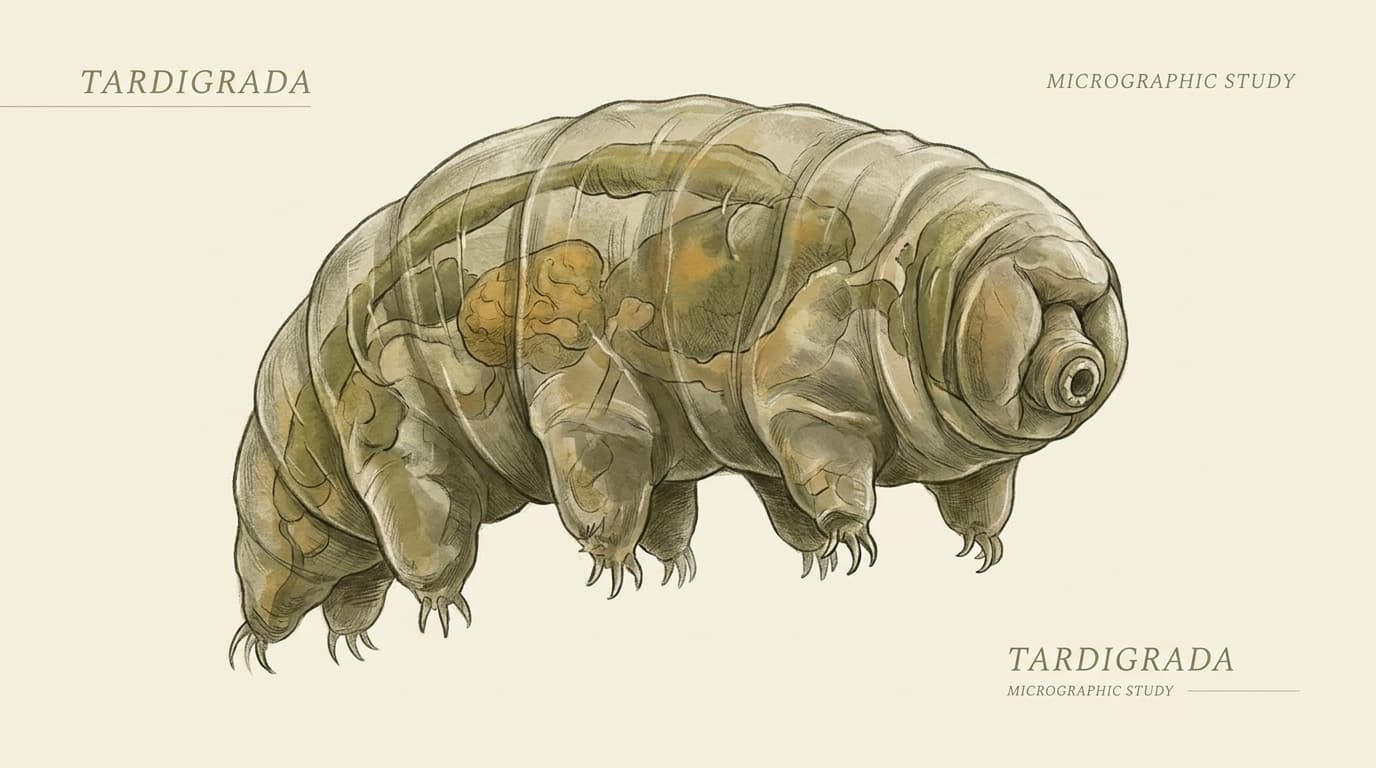
Tardigrades, also known as water bears or moss piglets, are a phylum of eight-legged micro-animals. Despite their nickname, they are not actual bears—they simply resemble tiny, plump creatures when magnified. Tardigrades are usually about 0.5 mm long when fully grown. They are short and plump, with four pairs of legs, each ending in claws (usually four to eight) or sticky pads.
Under the right light conditions, you can see a tardigrade without a microscope.
There are about 1,500 known species in the phylum Tardigrada.
They were first described by the German zoologist Johann August Ephraim Goeze in 1773, who called them Kleiner Wasserbär 'little water bear'. Despite their small size, they have captured the imagination of scientists and the public alike because of one extraordinary quality: their ability to survive in conditions that would instantly kill almost every other living creature.
Where Tardigrades Live
Tardigrades are , living in many environments on land, in freshwater, and in the sea. The majority of species live in damp habitats such as on lichens, liverworts, and mosses, and directly in soil and leaf litter.
In soil, there can be as many as 300,000 per square metre; on mosses, they can reach a density of over 2 million per square metre.
Tardigrades are in mosses and lichens and can readily be collected and viewed under a low-power microscope, making them accessible to students and amateur scientists.
How Tardigrades Survive the Impossible
The remarkable story of tardigrade survival rests on two pillars: special proteins and an extraordinary biological state called cryptobiosis.
Cryptobiosis: The Death-Like State
Cryptobiosis is a state of triggered by a dry environment. Tardigrades push all the water content out of their body, pull in their head and limbs, and roll up into a small ball.
Tardigrades can survive extreme conditions by going into a "tun" state, in which their body dries out and their metabolism drops to as little as 0.01 percent of its normal rate.
Tardigrades can survive as tuns for years, or even decades, to wait out dry conditions.
Live tardigrades have been regenerated from dried moss kept in a museum for over 100 years! Once the moss was moistened, they successfully recovered from their tuns. This is not death—it is what some scientists call a "state of ," existing in a liminal (that is, in-between) zone between life and non-life.
The cryptobiotic state changes everything about how a tardigrade operates. Cryptobiosis is a state of extreme inactivity in response to adverse environmental conditions. In the cryptobiotic state, all metabolic procedures stop, preventing reproduction, development, and repair. Yet , this near-death state is what allows tardigrades to survive what would kill other organisms.
Temperature and Pressure
Once inside the cryptobiotic tun state, a tardigrade becomes nearly indestructible. They can live in very cold temperatures, even at absolute zero, and can survive above boiling temperatures. More precisely, specimens kept for eight days in a vacuum, transferred for three days into helium gas at room temperature, and then exposed for several hours to a temperature of −272 °C (−458 °F) came to life again when they were brought to normal room temperature. Sixty percent of specimens kept for 21 months in liquid air at a temperature of −190 °C (−310 °F) also revived.
They can handle pressure six times greater than the ocean's deepest trenches and exist in the vacuum of space. To put this in perspective, the deepest ocean trenches reach pressures of about 1,000 atmospheres (1,000 bar). Tardigrades have survived pressures of 6,000 bar or more—a crushing force that would pulverize most living things instantly.
Radiation and DNA Protection
Their long term is in part due to a unique protein in their bodies called Dsup, short for "damage suppressor." This protein protects their DNA from harmful radiation, which is present in soil, water, and vegetation.
R. varieornatus Dsup is a nucleosome-binding protein that protects chromatin from hydroxyl radicals. Hydroxyl radicals are destructive molecules created by radiation exposure that damage DNA.
When human HEK293 cells were engineered with Dsup proteins, they showed approximately 40% more tolerance against X-ray radiation. This finding has excited researchers because it suggests that tardigrade proteins might one day be used in medicine to protect human cells during cancer radiotherapy or in biotechnology applications.
Space Survival
The ultimate test of tardigrade came in 2007. Dehydrated tardigrades were taken into low Earth orbit as part of the FOTON-M3 mission. They were exposed to either the hard vacuum of outer space (and protected from UV radiation) or vacuum and solar UV radiation for 10 days straight. After their return to Earth, the water bears that were protected from UV were reanimated within 30 minutes of rehydration.
In 2007, scientists placed the tiny critters into a satellite and shot them into space. There they floated in special containers 167 miles above sea level for 10 days before plummeting back to Earth. Upon inspection, most of the water bears were OK. They had survived radiation blasts 700 times stronger than the sun's rays on Earth.
Are Tardigrades True Extremophiles?
Tardigrades are not considered universally because they are not adapted to exploit many of the extreme conditions that their environmental tolerance has been measured in, only to endure them. This means that their chances of dying increase the longer they are exposed to these extreme environments, whereas true extremophiles thrive there. In other words, tardigrades are survivors, not lovers, of extreme conditions. They can endure them, but they do not prefer them or thrive in them the way bacteria living in hot springs do.
How Long Do Tardigrades Live?
Tardigrades typically live for only a few months when fully active. However, the time spent in cryptobiosis is not counted toward their normal lifespan. In short, whether or not it enters cryptobiosis, a tardigrade's normal active lifespan remains unchanged. This means a tardigrade could theoretically remain in cryptobiosis for decades while aging very little.
The Mystery of Tardigrade Genes
While studying their genetic makeup, scientists were surprised to find that nearly 40% of tardigrade genes are unknown in other species currently living on our planet. Some of these unique genes code for tardigrade-specific proteins like Dsup. However, the question of whether tardigrades acquired additional genes through —that is, receiving genetic material directly from other organisms rather than through reproduction—remains controversial among scientists.
Tardigrades, which have inhabited our planet for about 600 million years, have had time to acquire numerous genes through horizontal gene transfer from species that are now extinct, thereby building up a veritable library. Geneticists believe that tardigrades acquired these genes to enable them to withstand dehydration, but they also suggest that these same genetic tools allow them to survive in all kinds of deadly environments. However, more recent high-quality genome analyses suggest that the extent of horizontal gene transfer in tardigrades is more limited than initially reported.
What Do Tardigrades Eat?
Tardigrades mostly eat plants and algae. Some species eat other, smaller creatures, like microscopic worms and tiny, wheel-shaped animals called rotifers.
A specialized mouthpart, called a bucco pharyngeal apparatus, allows them to suck nutrients from plants and microorganisms.
Why Scientists Study Tardigrades
The study of tardigrades has moved beyond simple curiosity. Scientists are examining these survival mechanisms for solutions to a variety of human health challenges. In 2024 researchers at the University of North Carolina, Chapel Hill, for example, showed that tardigrades responded to damage from large doses of radiation with a flood of repair proteins. After dosing human cells with these proteins, scientists noted that the cells were better equipped to resist damage from radiation.
Future applications could extend far beyond medicine. Any long mission, from lunar bases to a crewed trip to Mars, must deal with radiation, vacuum and large temperature swings. Tardigrade genes, or synthetic molecules designed to mimic them, could one day help shield astronauts' cells, or keep biological samples intact on long journeys.
The Ancient Survivor
The earliest known fossil is from the Cambrian, some 500 million years ago. Tardigrades have walked alongside dinosaurs, survived mass extinction events, and adapted to nearly every environment on Earth. Their microscopic size and remarkable resilience have allowed them to persist when much larger, more powerful organisms disappeared forever. In an age of climate change and environmental instability, these tiny creatures offer a profound lesson: survival is not always about strength or size, but about the ability to adapt, endure, and wait for conditions to improve. The tardigrade's story is a reminder that nature often hides its most remarkable solutions in the smallest packages.
Share
Test yourself
What is the scientific name for tardigrades?
Sources
Related articles

Understanding Spirituality in 2026: A Guide to Modern Beliefs and Practices
Spirituality in 2026 is shifting toward personal, flexible practices that blend technology with timeless traditions. Young people are choosing individual spiritual paths over formal religion while seeking meaning and connection.

How to Manage Risk for the Everyday Man
Learn practical strategies to identify, understand, and manage the financial and life risks that affect your family and future, from emergency savings to insurance and smart budgeting.

The Best Natural Sources of Carbohydrates for Your Health
Discover which natural carbohydrate sources provide the most nutrients and health benefits, from whole grains and legumes to starchy vegetables and fruits.