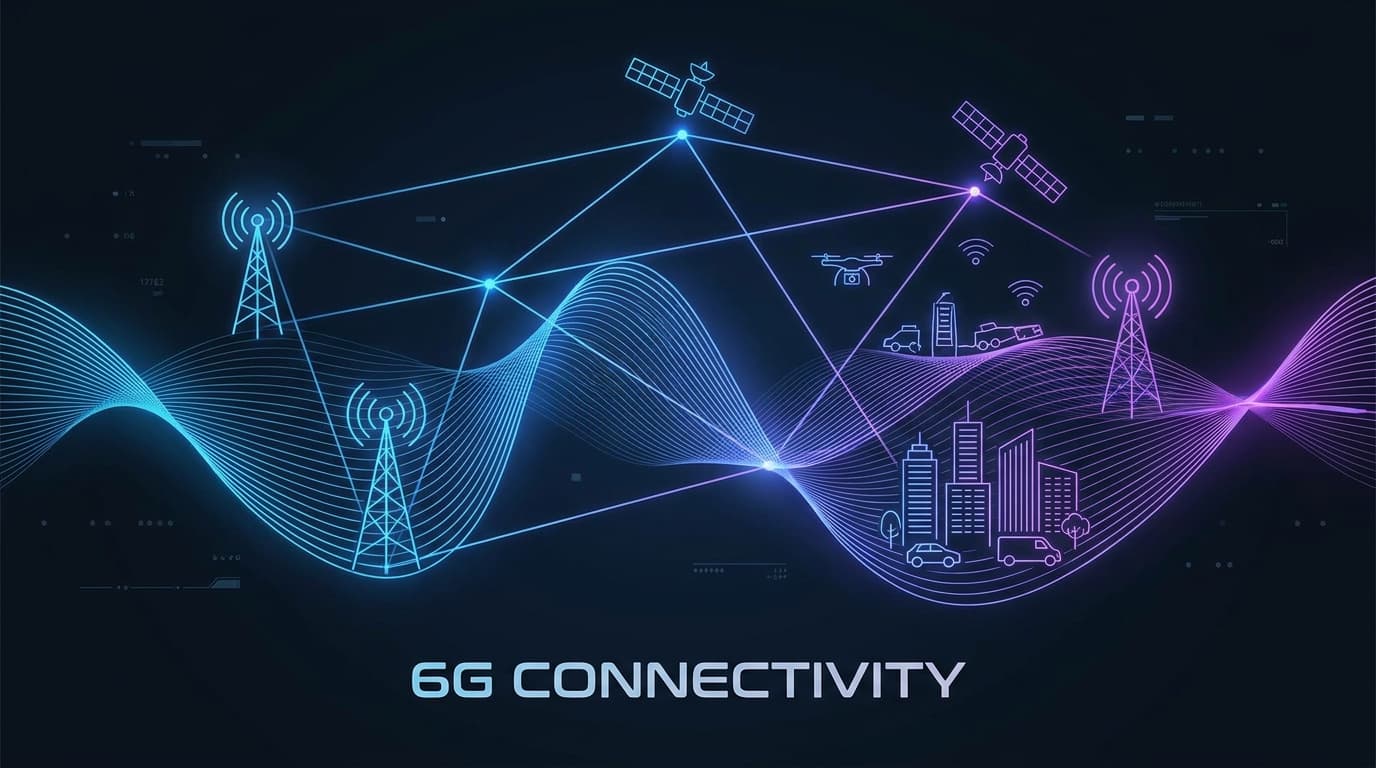
What 6G Networks Will Unlock
- 6g
- wireless-technology
- connectivity
- innovation
- future
What Is 6G?
6G is the proposed and upcoming sixth generation of the mobile communications technology and the planned successor to 5G. While the for 6G is generally expected to begin around 2030 , the groundwork is already being laid in 2026. This is not just an incremental upgrade—it represents a fundamental of how networks will work.
Think of wireless technology as a ladder. 4G gave us basic high-speed internet. 5G added lower delays and more capacity. 6G represents the next in wireless communications, promising to transform not just how we connect but how we interact with technology itself.
Speed and Data Rates: Orders of Magnitude Faster
The most striking difference between 6G and 5G is raw speed. 6G is predicted to provide theoretical maximum speeds up to 100 times faster than 5G. To put this in perspective, a wireless communications expert estimates that 6G is capable of delivering speed of 1 terabyte per second, meaning you could download 142 hours of Netflix's highest-quality video every single second.
Compare this to 5G, which offers speeds up to 10 gigabits per second. The jump is astronomical. 6G is expected to deliver speeds up to 1 terabit per second, which is 100 times faster than 5G, enabling near-instantaneous downloads and seamless streaming of ultra-high-definition content.
Terahertz Frequencies: The Foundation
The secret to these incredible speeds lies in the spectrum—the range of radio frequencies that carry data. 6G will likely operate in the terahertz (THz) frequency range, which offers significantly more bandwidth than the frequencies used by 5G, supporting even more devices and data-intensive applications.
To understand why this matters: current 5G networks use frequencies ranging from under 1 GHz (gigahertz) to 100 GHz. 6G will utilize spectrum from within the 30 to 3000 GHz range. This massive expansion in available spectrum means far more "space" for data to travel, much like expanding a highway from four lanes to forty lanes.
However, higher frequencies come with a cost. THz communication introduces significant technical challenges, such as severe path loss, molecular absorption, narrow beamwidth, and high sensitivity to obstacles and environmental factors. In plain terms, terahertz waves do not travel as far as lower-frequency waves, and they are easily blocked by walls and weather.
: Nearly Instantaneous Responses
Latency is the time it takes for a signal to travel from point A to point B. 5G networks have a latency of about 5 milliseconds, but with 6G internet, latency will slip down to a range of 1 millisecond to 1 microsecond, making massive data transmissions possible in less than a second.
This may sound like a small change in numbers, but for applications that demand —like autonomous vehicles deciding whether to brake or surgical robots performing surgery remotely—it is transformative.
AI Built Into the Network Foundation
One of the most important differences between 6G and its predecessors is how artificial intelligence (AI) will be integrated. AI will be throughout 6G networks, enabling automated operations, optimised resource allocation, and intelligent decision-making. Compared with 5G where AI is an add-on, 6G will be AI capable.
This means the network itself will be "intelligent." Rather than simply moving data from one place to another, 6G will use AI to predict problems before they happen, automatically direct traffic to avoid congestion, and adapt to users' needs in real time. Unlike previous generations where AI was an "add-on," 6G is AI-native, with every component of the network utilizing specialized models and processors to optimize signal processing, interference cancellation, and resource allocation.
Reconfigurable Intelligent Surfaces: Making Walls Smart
One of the most innovative technologies supporting 6G is called Reconfigurable Intelligent Surfaces, or RIS. RIS is a novel technology that uses network nodes to utilize intelligent radio surfaces capable of adjusting their response through control signaling. An RIS generally consists of a large number of low-cost, passive elements, each of which reflects the incident signal with a certain phase shift to collaboratively achieve beamforming and suppress interference.
Imagine smart wallpaper or panels that you could place on the walls of buildings. Terahertz waves have extremely short range and are easily blocked by walls, but 6G utilizes "Reconfigurable Intelligent Surfaces"—digitally controlled "smart mirrors"—that line the walls of buildings and redirect signals around obstacles without the need for high-power base stations.
This transforms the environment itself into part of the network. RIS technology allows the channel to be treated as a part of the network. By controlling signal reflections, an RIS can create a Smart Radio Environment to direct signal energy toward a user or null it in the direction of an interferer.
Device Density and Connectivity
With 6G, we expect to connect ten times more devices per square kilometer compared to 5G. This is essential for the Internet of Things (IoT)—the growing network of smart appliances, sensors, and devices connected to the internet.
6G will support billions of IoT devices simultaneously, powering smart cities, autonomous transport, and connected industries. These devices will not just send and receive data; they will sense their environment, communicate with each other, and work together intelligently.
Integrated Sensing and Communication
A unique feature of 6G is that communication and sensing will be combined. Communication and sensing will be fused in 6G allowing a device to perform both functions simultaneously. It would be advantageous for applications like autonomous driving that require vehicles to use a single system for both communication as well as obstacle detection. Furthermore, such integration will also improve rescue operations and environmental monitoring.
Think of it like this: a 6G signal can simultaneously carry data and gather information about the physical world around it. In 6G, radio waves do double duty: they communicate and sense. A single 6G signal can detect human gestures or vital signs, map environmental conditions, and enable centimeter-level indoor and outdoor positioning.
Global Connectivity Through Space, Air, and Ground
Today's networks are mostly terrestrial—they rely on towers and cables on the ground. 6G aims to provide seamless global coverage, including remote and rural areas, through the use of advanced satellite networks and airborne platforms like drones and high-altitude balloons.
With the seamless multi-access service continuity of terrestrial and non-terrestrial networks, 6G may provide global 3D coverage, extending from land-surface to sea, sky, and space. This means that people in the most remote areas of the world—whether on a ship in the ocean or in the mountains—will have the same high-speed connectivity as those in cities.
Real-World Applications: What 6G Will Enable
Healthcare and Remote Surgery
Remote surgery and telemedicine can operate with , saving lives in areas without specialists. Imagine a patient in a rural village receiving treatment from a surgeon thousands of miles away, with virtually no delay. The surgeon's movements would be transmitted in real time, making the experience nearly identical to being in the same room.
Autonomous Vehicles
Enhanced autonomous driving systems will depend on 6G for real-time data transmission and decision-making leading to improved safety and efficiency. Self-driving cars will communicate with each other and with road infrastructure instantly, preventing accidents before they happen.
and Industrial Automation
Industrial and urban digital twins can simulate entire factories or cities in real time, optimizing logistics, energy use, and maintenance. A manufacturing plant could have a perfect digital copy of itself online, allowing engineers to test changes before making them in the real world. This saves time, money, and reduces errors.
Immersive Extended Reality
6G can enable highly immersive extended reality experiences, including augmented reality (AR), virtual reality (VR), and mixed reality (MR), revolutionizing areas such as gaming, entertainment, education, training, and remote collaboration. With 6G's speed and low latency, virtual worlds could feel completely indistinguishable from reality.
Smart Cities
6G can provide the foundation for fully connected smart cities, where a multitude of sensors, devices, and infrastructure are seamlessly interconnected, enabling efficient monitoring and management of utilities, transportation, public safety, healthcare, and environmental systems.
Agriculture and Environmental Monitoring
Swarms of autonomous drones can coordinate crop monitoring and pest control, increasing yield by 30% while reducing resource usage. Farmers will be able to monitor vast fields with sensors and drones, receiving real-time data on soil conditions, water needs, and pest threats.
Energy Efficiency and Sustainability
Despite its power, 6G is being designed to be more energy-efficient than 5G. 6G is expected to surpass previous generations in energy efficiency. The goal for 6G is to enhance network energy efficiency by a factor of 100, all the while maintaining top-notch service quality and user experience.
AI-powered networks reduce energy consumption. Focus on renewable energy for base stations and satellite infrastructure contributes to efficient terahertz communication and smarter networks that reduce carbon footprint. This is critical, as network infrastructure currently contributes significantly to global emissions.
The Remaining Challenges
Despite the excitement, significant obstacles remain before 6G becomes a reality. Terahertz propagation is affected by obstacles and weather conditions. Coordinating global THz frequencies is complex, and building 6G-compatible base stations, satellites, and devices is expensive.
Ensuring robust security and privacy mechanisms is crucial. Developing advanced encryption methods, authentication protocols, and intrusion detection systems to protect against cyber threats and safeguard user data is a challenge. The more connected a network is, the more potential entry points exist for hackers.
6G is still in the early stages of development, and there is no agreed-upon standard for the technology. This means that it will take time to develop and deploy 6G networks. Different countries and companies may push for different technical standards, which could fragment the global market.
Additionally, infrastructure cost and device ecosystem present challenges. Deploying dense high-band nodes and RIS panels requires capital outlays, and consumer-grade smartphones capable of 6G THz links are not expected until 2030.
The Road Ahead
The 2026 standardization cycle marks the first time that a complete, globally-aligned 6G spec has been released, moving the technology from research labs into commercial planning. This is a crucial milestone—it signals that 6G is moving from theoretical physics into engineering reality.
The transition will not be sudden. 6G will not immediately replace 5G, but will gradually complement and eventually surpass 5G, starting with specialized use cases. Early deployments will likely focus on applications where 6G's advantages (extreme speed, ultra-low latency, massive connectivity) are most valuable: smart cities, autonomous systems, immersive technologies, and remote healthcare.
6G has the potential to generate well over $50 billion in the first five years of rollout, much of which will go to those companies involved in providing the network infrastructure and equipment. This financial incentive will drive rapid innovation and investment worldwide.
Conclusion
6G is not just a faster version of 5G. It is a reimagining of what networks can be—intelligent, , sustainable, and deeply integrated with artificial intelligence. By 2030, when 6G networks begin their commercial rollout, they will enable applications that seem like science fiction today: holographic surgery, fully autonomous vehicles that communicate at light speed, cities that optimize themselves in real time, and global connectivity that reaches even the most remote corners of the planet.
The technical challenges are real and substantial, but the global telecommunications industry is to overcome them. 2026 is the year the talk shifts from "what could be possible" to "what will actually be built." The next chapter of connectivity is not just coming—it is already being written.
Share
Test yourself
According to the post, when is 6G expected to launch commercially?
Sources
- 6G Standardization in 2026: What Changed and Why It Matters
- A Comprehensive Survey on 6G: Enabling Technologies, Key Applications, and Future Challenges
- What is 6G? Overview of 6G Networks & Technology
- The Path to 6G: Connectivity in 2026 and Beyond
- What Are Reconfigurable Intelligent Surfaces (RIS) that enable 6G Networks?
Related articles

Understanding Spirituality in 2026: A Guide to Modern Beliefs and Practices
Spirituality in 2026 is shifting toward personal, flexible practices that blend technology with timeless traditions. Young people are choosing individual spiritual paths over formal religion while seeking meaning and connection.

How to Manage Risk for the Everyday Man
Learn practical strategies to identify, understand, and manage the financial and life risks that affect your family and future, from emergency savings to insurance and smart budgeting.

The Best Natural Sources of Carbohydrates for Your Health
Discover which natural carbohydrate sources provide the most nutrients and health benefits, from whole grains and legumes to starchy vegetables and fruits.